Sarasota commissioners set conservative budget direction, approve staffing for state attorney and other measures
Loading...
Summary
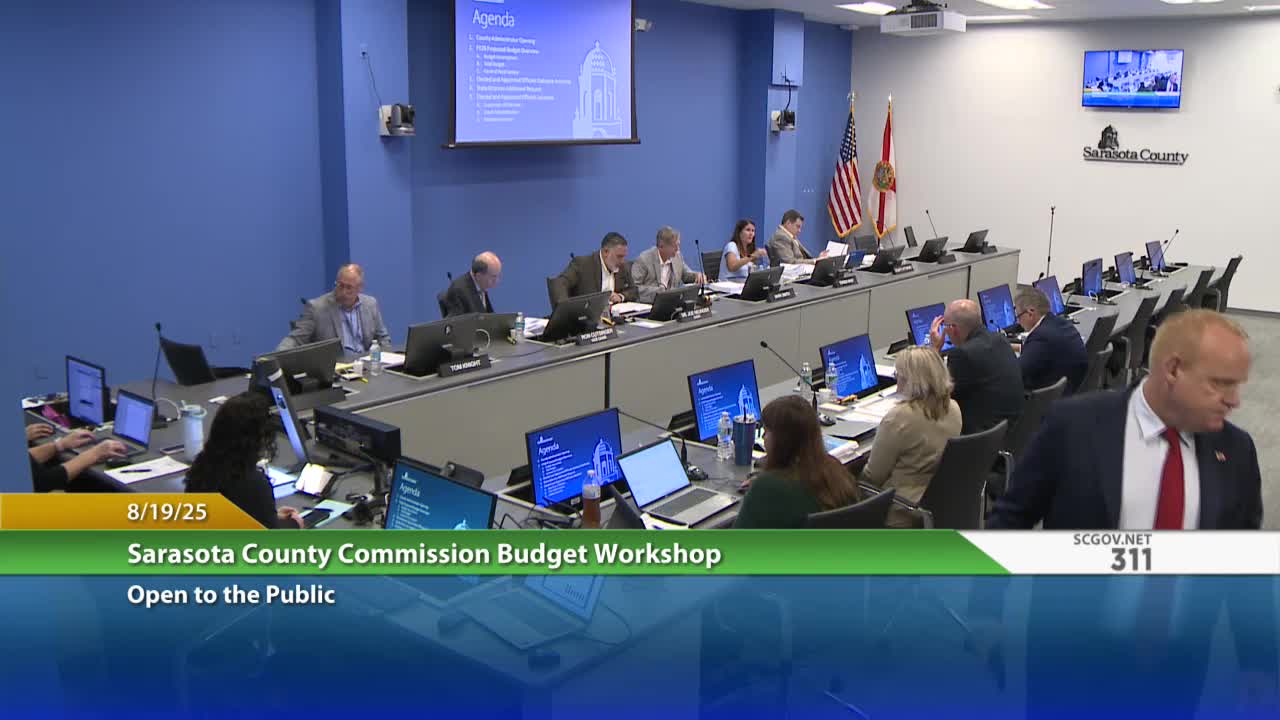
The Sarasota County Board of County Commissioners on Aug. 19 set conservative multi-year budget assumptions, approved 1.5 full-time-equivalent positions for the state attorney's specialty courts and accepted several budget adjustments at a workshop intended to narrow projected future shortfalls.
SARASOTA, Fla. — The Sarasota County Board of County Commissioners on Aug. 19 set new budget-direction measures meant to hold down projected spending, approved staffing for specialty criminal courts and approved several other budget items after a full-day workshop on the county's proposed fiscal 2026 budget.
The board voted unanimously to direct county staff to begin the 2026 budget-building process earlier next year by inviting constitutional officers to a February workshop and to adopt a conservative multi-year expenditure-growth scenario (1.6% for FY2027 and 3.6% in FY2028'FY2030) to guide planning. Commissioners also approved a package of actions that included additional staffing for the state attorney's specialty-court programs and acceptance of a one-time reduction offered by the chief judge to help the medical examiner's budget.
Why this matters: County staff said the fiscal model shows a general-fund shortfall if department and constitutional requests are funded at higher growth rates; the board's new direction narrows modeled future expenditure growth and centralizes early conversations with elected offices in an effort to protect reserves and prepare for likely state-level revenue changes.
What the board decided and why - Early budgeting: Commissioners unanimously adopted a motion from Commissioner Knight directing staff to start the budget-building process in February and invite constitutional officers to participate. County Administrator Jonathan Lewis and finance staff said earlier engagement would let the board and the offices that the board funds discuss assumptions, potential reductions and service priorities before line-item budgets are prepared.
- Conservative projections: By voice vote the board directed staff to use a conservative scenario for multi-year planning (1.6% growth in FY2027 and 3.6% thereafter), an option staff said would eliminate a modeled shortfall in the near term and rebuild an 'economic uncertainty' reserve more quickly. County finance staff framed the recommendation as a planning guideline rather than a fixed appropriation.
- Emergency-borrowing question for voters: The board unanimously asked staff to return with draft ballot language and an informational package so voters can consider allowing the county authority to issue emergency debt above the current charter cap (language to be developed for possible placement on the 2026 ballot). County staff said the board would see draft language and proposed accountability safeguards before anything went to voters.
- State attorney staffing: After a presentation by State Attorney Ed Brodsky about specialty courts and the workloads tied to drug, veterans and other treatment-based dockets, the board approved funding for 1.5 full-time-equivalent positions (one attorney and one half-time support position) to expand specialty-court casework. The motion (moved by Commissioner Mast and seconded by Commissioner Knight) passed unanimously.
- Medical examiner and court administration: The board accepted a judicial-budget adjustment from the chief judge's office that reduces the county's medical examiner budget by $270,000 (a $200,000 one-time component and $70,000 recurring, per the judge's memo). The motion passed unanimously.
- School board fee correction: Commissioners voted unanimously to forward a correction of $589,556 to the School Board that county staff identified in recent budget review work; county staff said the amount represents a longstanding fee allocation the county had been carrying and that the item will be corrected in FY2026.
What staff stressed County Administrator Jonathan Lewis and finance staff repeatedly told commissioners that small changes in projection assumptions can move multi-year reserve outcomes materially. Lewis said bringing constitutional officers and key elected officials into the process earlier ''makes the preliminary budget building simpler'' and recommended a February start so the board and offices can align assumptions.
In public comment, one resident urged tighter department caps, saying ''No more than 5% for any department,'' an appeal from the podium that commissioners heard during the early public-comment period.
Context and background County staff presented a multi-year model showing the county's general-fund outlook under different revenue and spending assumptions. Staff said the county had a $23 million gap in departmental and constitutional requests compared with $14 million in estimated new revenue for FY2026 under one set of assumptions; staff and commissioners repeatedly noted that one-time grant inflows (for example, a large resilience/HUD grant in the current budget cycle) inflate year-over-year budget totals but do not represent recurring millage-supported capacity.
Board members discussed the difficulty of absorbing large permanent increases to the base budget, particularly given possible state-level property-tax and homestead changes the board heard will be under discussion in Tallahassee in 2026. Several commissioners said they do not favor increasing millage to close gaps and want staff to look for recurring savings or other options.
Votes at a glance (motions recorded during the workshop) - Start early budget-building workshop with constitutional officers (February): motion by Commissioner Knight; second Commissioner Mast. Outcome: passed unanimously (five yes). Notes: formal direction to staff to schedule and invite constitutional officers. - Adopt conservative planning scenario (1.6% FY2027; 3.6% FY2028'FY2030) and send expectations memo to constitutional officers and funded agencies: motion by Commissioner Smith; second Commissioner Mast. Outcome: passed unanimously (five yes). - Direct staff to return with additional detail on emergency medical services (EMS) fiscal impacts and MSTU implications: motion by Commissioner Knight; second Commissioner Smith. Outcome: passed unanimously (five yes). - Approve funding for 1.0 attorney and 0.5 support FTEs for the State Attorney's specialty-court work: motion by Commissioner Mast; second Commissioner Knight. Outcome: passed unanimously (five yes). Notes: staff to provide the exact budget line item and dollar amount; the board discussed partial funding scenarios before approving 1.5 FTE. - Accept chief judge's offered reduction that reduces the county's medical examiner request by $270,000: motion by Commissioner Knight; second Commissioner Smith. Outcome: passed unanimously (five yes). - Forward $589,556 to the School Board to correct a long-standing fee allocation: motion by Commissioner Mast; second Commissioner Smith. Outcome: passed unanimously (five yes). - Return to the board with ballot language and accountability guardrails to allow the county to borrow above the charter cap for emergencies and to consider debt-refinancing authority (discussion item to return for board approval of any final language): motion by Commissioner Maas; second Commissioner Cuttsinger. Outcome: passed unanimously (five yes).
What comes next Staff will package the board's new direction into a memorandum for constitutional officers and other county-funded entities, bring draft ballot language and accountability proposals on emergency borrowing for future board review, and bring detailed EMS operating- and MSTU-analysis material at a future meeting (staff recommended the Sept. 5 agenda for the detailed stormwater/rates item already scheduled). The board agreed to continue budget deliberations into the fall and to use the conservative multi-year scenario to guide preliminary staff recommendations.
Ending Commissioners emphasized that the board's next steps are designed to protect the county's reserves and give staff and constitutional officers earlier, clearer direction for the FY2026 and FY2027 budget cycles. Several commissioners said they expect additional fine-tuning before final millage and budget hearings later this year.