Get Full Government Meeting Transcripts, Videos, & Alerts Forever!
Get email alerts on the Solar Energy topic
No spam. Unsubscribe anytime.
Lexington council approves amended zoning rules on utility-scale solar, sets work group to refine standards
Summary
After more than two hours of public comment and council debate, the Lexington-Fayette Urban County Council voted unanimously to place a revised zoning ordinance text amendment (ZOTA) on the Aug. 28 docket for first reading, adding caps and environmental and procedural requirements and directing a work group to draft implementing guidance.
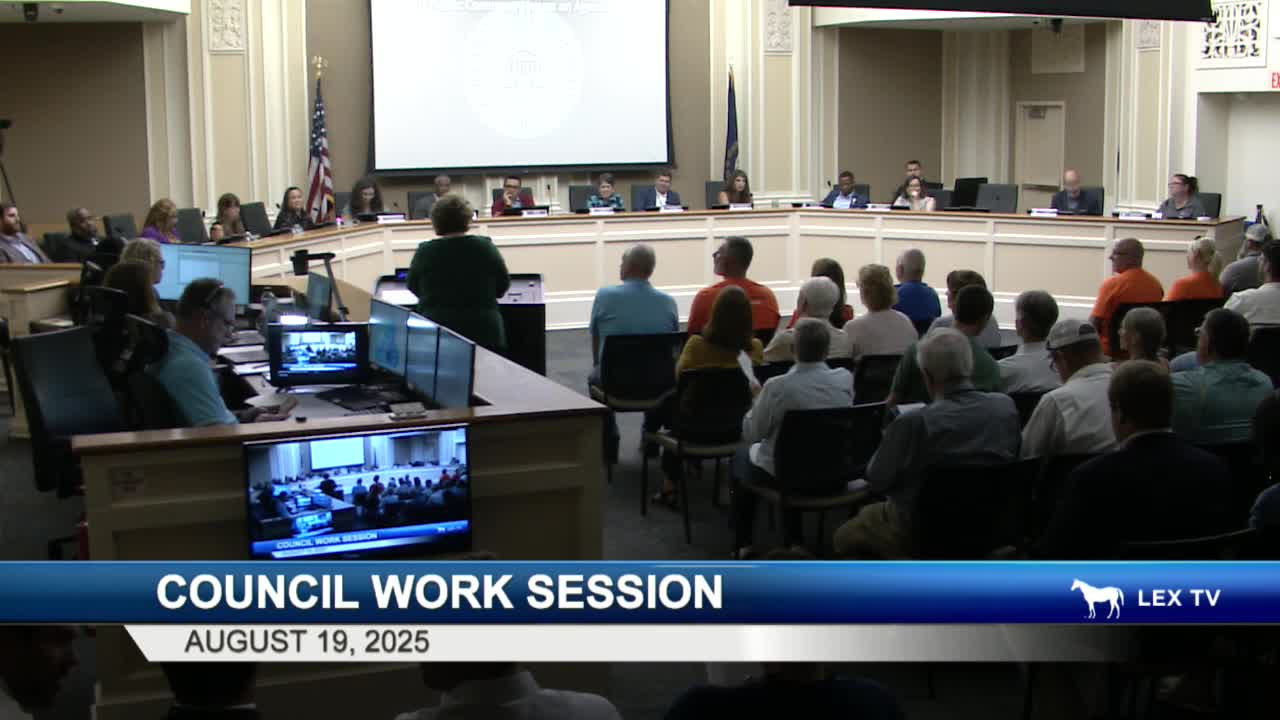
LEXINGTON, Ky. — The Lexington-Fayette Urban County Council voted 14-0 on Aug. 19 to advance a revised zoning ordinance text amendment on solar energy systems to first reading Aug. 28, following extended public comment and several council amendments that limited how much agricultural land could be used for private large-scale solar and added environmental and procedural requirements.
The ordinance as amended directs that large-scale ground-mounted solar in agricultural areas be capped at a level computed as 1 percent of Fayette County’s total land area, adds vegetative/land-management and decommissioning expectations, and requires specific application materials and community-facing processes when intermediate- and large-scale projects seek approval. Councilmembers also approved language encouraging (but not mandating) community benefit plans tied to large projects.
The council’s action was the culmination of a months-long process that began with a Planning Commission recommendation and a General Government and Planning Committee (GGP) discussion in July. Dozens of residents, farmers, business owners and industry representatives addressed the council during public comment, sharply divided over whether agrivoltaic approaches can protect farmland while expanding renewable energy.
“We support the amendment to the solar energy, system, SOTA, that would allow, development of ground mounted solar on 2% of agricultural land,” said Judith Humble, chair of the Bluegrass Climate Action Team, during public comment, urging the council to allow pilot projects that pair solar with agriculture.
Opponents — including longtime local farmers and the Bluegrass Land Conservancy — said prime soils and the county’s rural character should be protected. “We support the planning commission and the general government and planning committees proposed zoning ordinance text amendment that would prohibit industrial scale solar in the rural service area,” said Robert James, president of the Fayette County Farm Bureau.
Industry and labor speakers described agrivoltaic models and job opportunities. “At Silicon Ranch, our motto is to make solar do more,” said Blake Spurgeon, who identified himself as a representative of Silicon Ranch, describing grazing and plantings under panels at other sites.
Councilmembers exchanged multiple amendments on the council floor. Among the most significant changes approved before the final vote were: - A countywide cap computed as 1 percent of Fayette County’s land area to limit the total acreage that could be used for large ground-mounted systems in agricultural zones (language moved by Councilmember Hale and supported by others). - A vegetative cover and land-management requirement: applicants for large projects must provide land-management plans addressing soils, pasture/ground-cover composition, erosion control, staged-area restoration, fencing and access, with periodic review tied to decommissioning planning (moved by Councilmember Curtis). - New conditional-use review criteria and a checklist of required application materials for projects in agricultural zones (maps, soils/NRCS data, topography, conceptual site plan, screening/renderings, insurance and restoration/decommissioning assurances). - Intermediate-scale (larger small-scale) projects in agricultural zones were set to require conditional-use approval rather than by-right accessory status; small ground-mounted installations in residential zones were likewise moved to conditional use to ensure neighborhood review. - An optional community-benefit concept was added: the Board of Adjustment must acknowledge impacts and any proposed community benefit plan; the council approved language suggesting a framework ($750 per megawatt sold annually for 15 years was discussed as a guideline) but did not make it mandatory.
Councilmember Sheehan, who offered the motion to place the amended ZOTA on the Aug. 28 docket, told colleagues she introduced protections “to prevent bad solar and promote good sustainable solar.” The Kentucky Public Service Commission, represented in a recent state conference, has told local governments that local ordinances help set expectations for siting even when state-level utility applications are involved.
Council members said they would form a work group to develop implementing language, enforcement mechanisms and clearer definitions for the new standards. Several council members urged that the work group include planning, building inspection and environmental services staff and community representatives; Councilmember Morton moved that a community-benefits discussion be referred to the Budget, Finance and Economic Development committee for further drafting.
The Aug. 19 vote on the amended motion was 14-0 to place the ordinance on the Aug. 28 docket for first reading. Members debated and adopted multiple amendments by electronic votes during the work session before reaching the final, unanimous vote.
The council’s packet and the July 1 committee materials list the Planning Commission’s recommended ZOTA and the GGP draft language. The council recorded several roll-call and electronic votes during the work session on amendment text and thresholds; final ordinance language remains subject to the first- and second-reading process at the Aug. 28 meeting.
The discussion makes clear that while Lexington will allow some private, ground-mounted solar in agricultural zones under the amended approach, the council intends to couple permission with soil-protection, revegetation, screening and community-engagement requirements, and to keep the total acreage tightly constrained. The council also directed staff to convene additional stakeholder discussions and produce more detailed, enforceable standards through a work group before subsequent approvals.
The zoning amendment does not alter the authority of state-regulated utilities to pursue projects through the Public Service Commission; council members repeatedly noted that utility projects regulated at the state level are not fully subject to local zoning but that local guidance can influence siting expectations and community negotiations.
The ordinance will be scheduled for first reading at the Aug. 28, 2025 council meeting; additional amendments or technical cleanups are expected as the council and staff finalize implementing procedures.