Wright County approves amendment letting Twin Rivers test closer to road structures with $110,000 permit fee
August 07, 2025 | Wright County, Iowa
This article was created by AI summarizing key points discussed. AI makes mistakes, so for full details and context, please refer to the video of the full meeting. Please report any errors so we can fix them. Report an error »
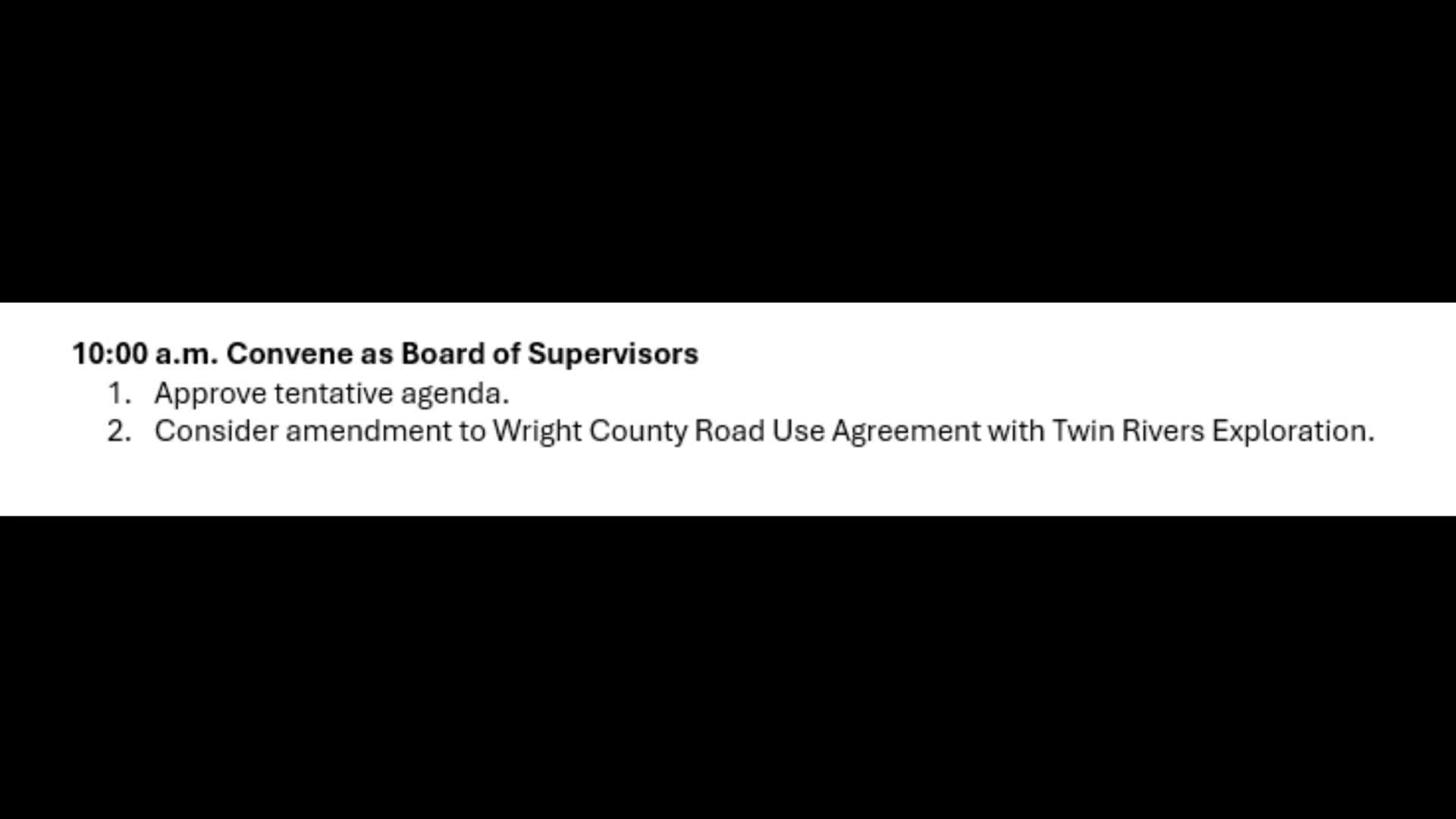
The amendment, described at a special board meeting, also keeps a 250-foot prohibition for seismic testing near bridges and requires Twin Rivers to submit test-route maps for county approval before operations begin. Twin Rivers representatives told supervisors they would provide daily reports and mapping updates and that an independent contractor will monitor PPV and provide downloadable measurement reports each evening.
Board members said the county needs assurances that drainage tile and other infrastructure will be protected and that the county will not be left with repair costs if claims are denied. Twin Rivers’ presenters said the company provided a certificate of insurance naming Wright County and that the project is covered by an aggregate of policies totaling $11,000,000 for property-damage related to these operations.
Why this matters: Supervisors framed the item as a trade-off between allowing noninvasive seismic testing that Twin Rivers says could help identify subsurface hydrogen resources, and protecting county infrastructure and landowners from damage. County officials said the permit fee can be used to pay for tile repairs or other county costs if insurance does not cover a claim.
During discussion, Twin Rivers’ representatives emphasized that the forces their vibroseis truck applies to the ground are substantially lower than a standard vibratory roller used in road construction. The company said its vehicle is operated at about 70% of maximum capacity for maintenance reasons, which they said limits ground force and reduces PPV compared with larger rollers. Twin Rivers also said it keeps a map of every vibration point and will provide daily location reports and PPV logs to the county.
Board members pressed for clarity on several points: how the insurance-claim process would work, whether a permit fee should be placed in a dedicated drainage fund, how closely PPV meters are calibrated and monitored in real time, and how the county’s existing drainage-tile maps (which supervisors said are imperfect) would be reconciled with Twin Rivers’ shot locations.
County staff and supervisors said they will require Twin Rivers to submit a proposed route map for each planned round of testing; the county retains the right to reject proposed routes. Supervisors discussed an earlier, larger proposed permit sum (the company and county earlier referenced a possible $200,000 project fee and other pro rata calculations); they settled on $110,000 as a compromise at the meeting.
The motion as approved specifies: a $110,000 permit fee payable to Wright County before operations commence; no testing within 250 feet of bridges; seismic testing allowed to within 25 feet of other roadway structures provided active PPV monitoring shows values remain at or below 0.5 inches per second; and county staff (Adam) will have authority to approve or reject submitted route maps. Twin Rivers agreed to deliver daily maps and nightly PPV measurement downloads and said an independent PPV monitor (named Mike) will operate as an auditor and provide the data.
The board recorded the vote as three ayes, one opposed and one not present. Supervisors said the county will retain the permit fee and may use it for drainage repairs if insurance does not cover damage claims.
What’s next: Twin Rivers said crews working on current nearby operations expect to finish within about a week and that the company is preparing more precise route maps for submission. County staff will review submitted maps and any daily reporting procedures before allowing additional testing on county roads.
View the Full Meeting & All Its Details
This article offers just a summary. Unlock complete video, transcripts, and insights as a Founder Member.
30-day money-back guarantee
Sponsors
Proudly supported by sponsors who keep Iowa articles free in 2026

