Get Full Government Meeting Transcripts, Videos, & Alerts Forever!
Get email alerts on the Property Tax Millage topic
No spam. Unsubscribe anytime.
Marion County sets proposed maximum millage at 4.29 mills; general fund kept at 3.35
Summary
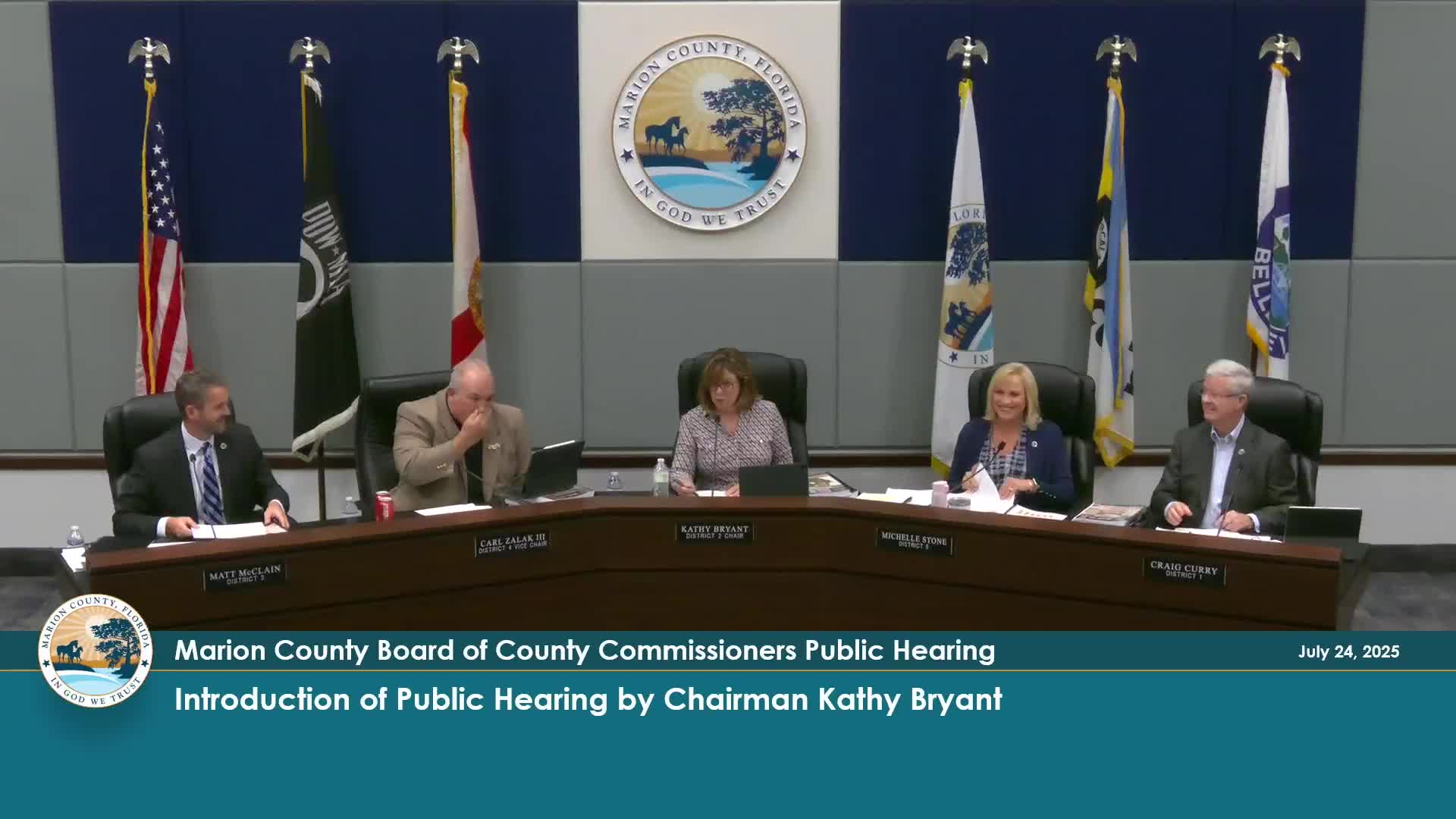
Marion County commissioners set proposed maximum millage rates on June 11, keeping the countywide rate at 4.29 mills by holding the general fund at 3.35 mills, the fine and forfeiture fund at 0.83 mills and the Marion County health unit trust fund at 0.11 mills.
Marion County commissioners set proposed maximum millage rates on June 11, keeping the countywide rate at 4.29 mills by holding the general fund at 3.35 mills, the fine and forfeiture fund at 0.83 mills and the Marion County health unit trust fund at 0.11 mills. The board voted unanimously to adopt the proposed rates and scheduled the first public budget hearing for Sept. 4, 2025, at 6 p.m. in the commission chambers.
The decision followed a staff presentation by Audrey Fowler, the county budget director, who reviewed recent adjustments and several millage scenarios intended to close recurring deficits while limiting immediate tax impacts. Fowler told commissioners the budget workshops produced $448,484 in additional recurring general-fund revenue and $1,500,000 in nonrecurring adjustments. She said the proposed fiscal year 2026 expenditure budgets total $33,965,180, with recurring revenue of $31,593,627 — a recurring deficit of $2,371,553 under the current budget as presented.
Fowler presented two principal options the board considered: (1) keep the general fund millage at 3.35 and the fine and forfeiture at 0.83 (countywide 4.29) and use nonrecurring transfers to cover shortfalls; or (2) shift a small fraction of mills from the general fund to the fine and forfeiture fund (for example, 0.02 mills) so the fine and forfeiture fund is more self-sustaining. Fowler summarized the trade-offs: "We have $448,484 of additional recurring revenue in the general fund," and later explained that the two funds would generate the same dollar amount per hundredth of a mill but differ in how much of each fund’s revenue is property-tax driven and therefore how growth in taxable value affects them.
Commissioners debated policy and timing. Several members said they were concerned about reducing general-fund capacity ahead of known general-fund pressures, including upcoming contract negotiations and expected increases in EMS and jail costs. Commissioner McLean moved — and Commissioner Stone seconded — a motion to set the countywide millage so the general fund remains at 3.35, fine and forfeiture at 0.83 and the health unit at 0.11 (combined 4.29). The motion passed unanimously.
Commissioners also discussed a growing charge from the Department of Juvenile Justice (DJJ) that staff and several commissioners said is the main driver of pressure on the fine and forfeiture fund. Fowler and county staff estimated the DJJ-related increase would equate to roughly 0.046 mills (about 0.04 mills) and said staff had estimated the household impact on an average property tax bill at roughly $6 per year for that portion. Commissioners disagreed on strategy: some urged raising the millage now to make the fund self-sustaining; others favored holding the countywide millage steady and using one-time transfers while requiring those drawing from the fine and forfeiture fund to reduce planned spending.
The board approved several related motions unanimously: to set the countywide special-district millages (including MSTU law-enforcement and fire-protection MSTUs, Rainbow Lakes Estates, Marion Oaks MSTU, Silver Spring Shores tax district and Hills of Ocala) at their current rates; to set the tentative public hearing for the county budget for Sept. 4, 2025, at 6 p.m.; and to authorize the chair to execute documents related to the approvals. Commissioners also asked staff to continue working with affected departments and entities to identify cuts or transfers so the proposed budget can be balanced to the adopted millage before the final hearing.
Clarifying details from the meeting include: auditors’ and staff projections, the use of about $901,497 of prior-year nonrecurring fine-and-forfeiture reserves in the scenarios Fowler presented, and a suggested transfer of approximately $1,448,912 from the general fund in one scenario to make both funds whole. Fowler cautioned that the scenarios were short-term patches that could require further adjustments in 2027 and possibly 2028 if revenue and expense growth do not align.
The board’s action sets the ceiling for future budget work; commissioners and staff will return to public hearings in September to finalize levies and the budget. Fowler told the board she would make the budget adjustments required to present a balanced proposed budget consistent with the millages the commission set today.