Get Full Government Meeting Transcripts, Videos, & Alerts Forever!
Get email alerts on the Gaza Ceasefire Humanitarian Crisis topic
No spam. Unsubscribe anytime.
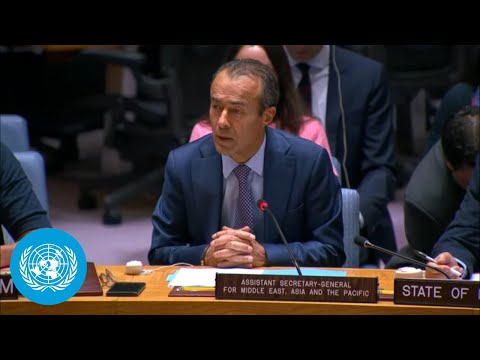
UN Security Council hears urgent briefing calling for immediate Gaza ceasefire, hostage releases and humanitarian access
Summary
A Security Council briefing warned of worsening conditions in Gaza, detailed casualties and hostage counts, raised alarm about the Palestinian Authority fiscal crisis and UNRWA’s funding shortfall, and reiterated calls for a political path toward a two-state solution.
Khaluf Khairi, briefing the United Nations Security Council, urged an immediate ceasefire in Gaza, the unconditional release of hostages and unimpeded humanitarian access as talks on a potential ceasefire continued.
"It is long past time for the fighting to end, for hostages to return home, for adequate humanitarian aid to enter the strip, and for recovery and reconstruction to begin in the context of a return to a political path towards a two-state solution," Khaluf Khairi said.
Khairi told the council that the humanitarian situation in Gaza was deteriorating and provided casualty and operational figures cited to official sources. He said at least 1,891 Palestinians had been killed in Gaza since his last briefing on June 30, citing the Ministry of Health in Gaza, and that 294 people were reported killed while attempting to collect aid. He said Israeli sources reported about 50 hostages remain in Gaza, including one woman, and that 28 of those are believed to be dead. Since June 30 he said 13 Israel Defense Forces soldiers had been killed in Gaza operations.
Khairi described a recent strike that hit the Catholic Church of the Holy Family in Gaza City, saying the strike killed three people and forced the evacuation of roughly 600 people sheltering in the compound, including children and people with special needs. He said the Patriarchate of Jerusalem described the incident as a targeted strike and that the Israeli prime minister's office said Israel "deeply regrets that a stray ammunition hit the church" and is investigating the matter.
On fuel and humanitarian access, Khairi said that since July 9 a small number of fuel trucks had been allowed through the Karim Shalom Karim Abusallam Crossing for medical facilities and essential services, but that the amount was "a fraction of what is required" to run life-saving services in Gaza. He warned that nearly every aspect of life in Gaza depends on fuel.
Khairi also raised concerns beyond Gaza. He said the situation in the occupied West Bank remained "deeply concerning," citing ongoing Israeli military operations, settler attacks on Palestinians, and Palestinian attacks on Israelis. He reported specific incidents described in the briefing, including the killing of a 17-year-old Palestinian in Ramallah on July 1 and several attacks in early July that resulted in deaths on both sides. He said settlement advancement and intensified calls by some Israeli ministers and Knesset members to annex parts of the West Bank were exacerbating tensions.
Khairi warned of a fiscal emergency for the Palestinian Authority, saying Israel's continued withholding of clearance revenues — which he quantified as 2,700,000,000 US dollars — had severely affected the Authority's ability to pay civil servant salaries and sustain basic public services. He said the Palestinian cabinet warned on July 17 that the Authority might be forced to temporarily shut down vital sectors without urgent support.
He also sounded an alarm about UNRWA, saying the agency faced "immense operational, political, and financial pressures" and that, based on current forecasts, there would not be enough money to sustain all operations beyond August 2025. He said "330 agency staff have been killed in the war in Gaza," and did not specify which agencies.
Khairi addressed regional flashpoints, noting that the situation along the Blue Line between Israel and Lebanon remained fragile, that the Israel Defense Forces maintained a presence north of the line, and that unauthorized weapons had been found in southern Lebanon. He urged both Lebanon and Israel to implement resolution 1701 in full. He also described violence in Syria, including heavy casualties in Suwaida, and urged respect for the 1974 disengagement of forces agreement relating to the Golan region.
Khairi closed by reiterating that there would be no lasting solution without a political horizon and an end to occupation, and he highlighted an upcoming ministerial meeting co-hosted by France and Saudi Arabia as an important opportunity to reaffirm international support for a two-state solution.
"I implore the parties first and foremost to end this war, release all hostages, and allow the Palestinian population in Gaza to receive the humanitarian assistance they so desperately need," he said.
The briefing recorded no formal Council vote or decision; it was presented as an information briefing and a call to member states to take steps to bring about a ceasefire, fiscal relief for the Palestinian Authority and sustained support for humanitarian operations.