
Board considers sending resolutions to WASB on free school meals and a state endowment; asks for coauthoring and research
Get AI-powered insights, summaries, and transcripts
Sign Up Free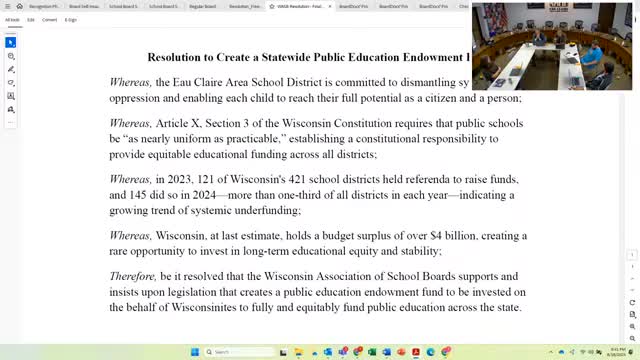
Summary
A board member proposed two resolutions for the Wisconsin Association of School Boards delegate assembly: one to provide free meals to all Wisconsin students and another to explore a state-level endowment for school funding. Members discussed WASB's role as a lobbying platform, past defeats, and the need to coordinate with other districts before a
A board member proposed sending resolutions to the Wisconsin Association of School Boards (WASB) delegate assembly urging (1) free meals for all Wisconsin students and (2) creating a state-level endowment funded by budget surpluses to stabilize future school funding.
"The first one is a resolution to provide free meals to all Wisconsin students," the proposer said, describing the free-lunch item as a concrete step to reduce inequity. The proposer added a second resolution suggesting an endowment fund to capture surpluses and provide ongoing revenue for schools rather than relying on ad-hoc budgeting cycles.
Board members discussed process and strategy. One member reminded colleagues that WASB resolutions form a lobbying platform rather than creating law: passage in the WASB delegate assembly signals the association's support when lobbying legislators but does not itself change state statute. Members discussed prior attempts to pass a free-meals resolution at WASB, noting a recent effort had been voted down and cautioning that repeated defeats could be used by opponents as evidence that school districts do not back the idea.
Members recommended practical next steps: reach out to other districts that have submitted similar resolutions (co-authorship), check WASB's past resolution history and committee processes, and consider educational outreach to delegates before the assembly so that member delegates understand funding mechanisms. One board member suggested contacting districts such as Green Bay (which previously submitted free-meal work) to coordinate.
For the endowment idea, a participant noted examples of endowed funds used to support libraries and local schools, citing a local "Cowen School Fund" example where land sale proceeds were invested to create a lasting fund. Members asked staff to do additional research and to check for any U.S. state-level precedents.
No formal vote was taken on either resolution; members agreed to continue drafting the language, seek co-authors at other districts, and submit items for the WASB delegate process if timing permits.
Ending: Staff and the proposer will continue refining resolution text and outreach to peer districts ahead of WASB deadlines; the board was clear that if a resolution is submitted it should be coordinated with other districts to improve chances of passage.