Get Full Government Meeting Transcripts, Videos, & Alerts Forever!
Get email alerts on the Transportation Planning topic
No spam. Unsubscribe anytime.
SamTrans-led Grand Boulevard Initiative team briefs Belmont council on corridor action plan and long-term implementation
Summary
SamTrans, Caltrans and partner agencies presented a progress update on the Grand Boulevard Initiative Action Plan, outlining a corridor-wide vision for safety, multimodal travel and a countywide Caltrans project development pathway; presenters said full implementation could take 8–10 years and may cost hundreds of millions of dollars.
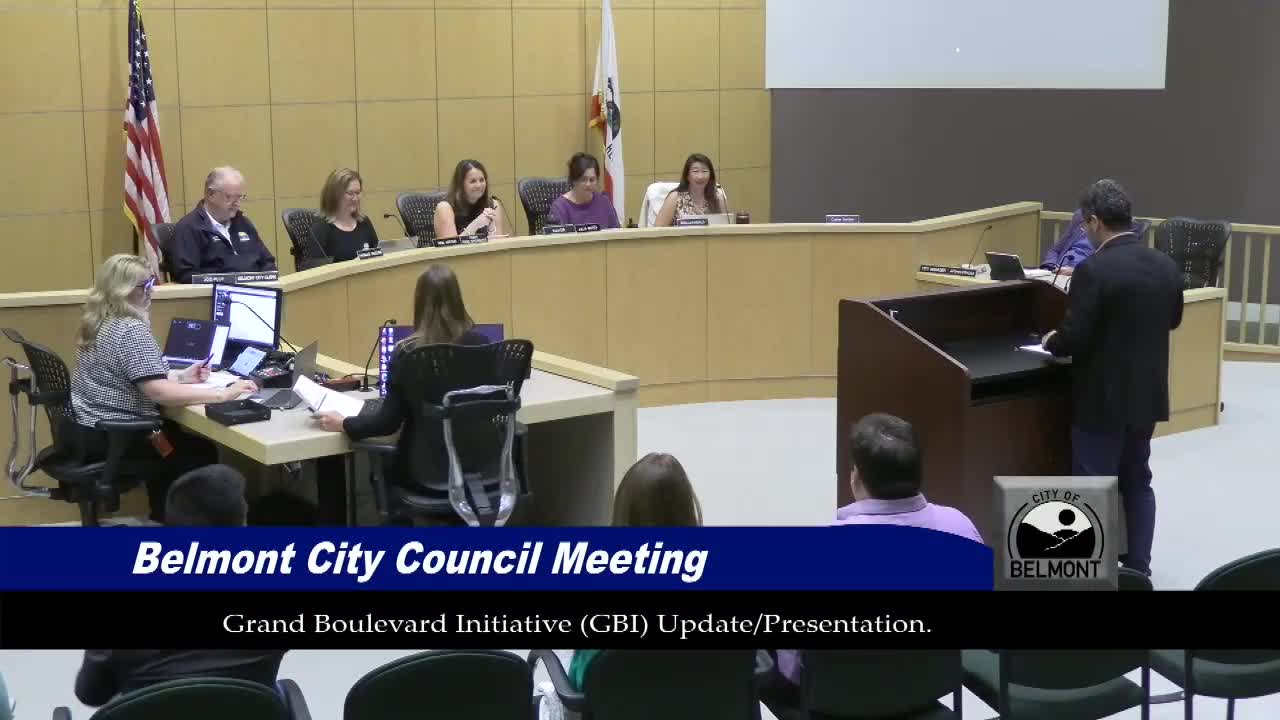
Representatives from SamTrans, Caltrans, the San Mateo County Transportation Authority (TA) and other partners briefed the Belmont City Council on Sept. 9 about the Grand Boulevard Initiative (GBI) action plan, a countywide effort to develop a unified vision for El Camino Real and a path into the Caltrans project development process for State Route 82.
Cassie Halls of SamTrans said the GBI action plan intends to build a corridor-wide vision—“El Camino Real is a safe and vibrant street where people of all ages and abilities travel comfortably”—and provide a menu of design options cities can adapt to their local context. The plan, Halls said, will serve as a precursor to the Caltrans Comprehensive Multimodal Corridor Plan and aims to coordinate across 15 jurisdictions that share El Camino Real.
SamTrans and TA staff emphasized that the effort balances local “main street” design objectives with the corridor’s regional mobility role, and that implementation will require substantial funding. Jessica Manzi of the TA said the authority can help leverage and coordinate funding so jurisdictions are not competing for the same grants. Jake Buffenbarger of Caltrans District 4 described how Caltrans will incorporate GBI outputs into its CMCP process and noted this is Caltrans’ first CMCP for a conventional highway, which requires extensive local coordination.
Officials said a preferred alternative is not yet selected; the action plan will present a toolbox of options (e.g., pedestrian and bicycle facilities, bus stop improvements, landscaping and safety-first street design) and local jurisdictions will choose context-appropriate elements. Staff projected the planning-to-construction timeline for corridor‑wide improvements could be 8–10 years and cited potential capital needs in the hundreds of millions.
Council members thanked the presenters, asked about coordination with Santa Clara County and Caltrain property, and raised design concerns including urban greening, sidewalk and tree management, integration with the Central El Camino multimodal plan and opportunities to align the corridor with Caltrain properties. Halls and partners said the process will include city staff workshops and presentations at city councils for comment; adoption is planned by SamTrans and the TA later in the year.