Get Full Government Meeting Transcripts, Videos, & Alerts Forever!
Get email alerts on the Zoning Residential Conversion topic
No spam. Unsubscribe anytime.
Zoning board delays decision on Ridge Avenue conversion after applicant agrees to revise request
Summary
An Allentown zoning applicant who sought to convert a vacant first-floor commercial space into two one‑bedroom apartments agreed to amend the application to a single dwelling unit; the board voted to continue the case to allow retooling and re-advertising.
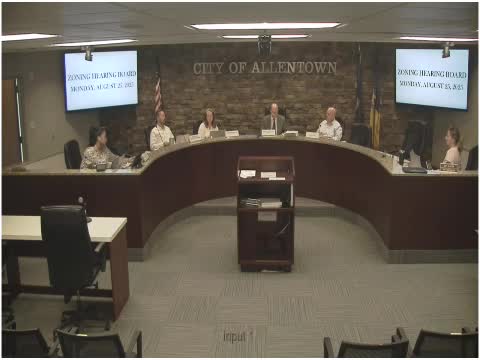
The Allentown City Zoning Hearing Board on Aug. 25 continued a request from Raul Echeverria, owner of Echeverria Properties LLC, to convert the vacant first-floor commercial space at 322–324 Ridge Avenue into two one‑bedroom apartments, after board members said a reduced proposal — a single ground‑floor dwelling — would require less relief and likely be easier to approve.
The board and applicant agreed to continue the hearing so Echeverria may revise the plans and re-advertise the matter. The applicant indicated he would waive procedural timing requirements in writing to allow the amended filing; the continuance was approved by voice vote.
The proposal originally before the board asked for three variances: a use variance to convert the first-floor commercial space to residential, a parking variance of one space (the ordinance requires six spaces for four dwelling units), and a dimensional variance related to the minimum square footage required per dwelling unit. Echeverria testified he purchased the mixed‑use, three‑story property about four years ago and that the ground‑floor commercial tenant left after COVID and the space has been vacant for roughly two years. He told the board he had listed the space for retail but found limited market interest because the block is largely residential.
Realtor Aon Codner told the board he had marketed the property for about a year and had seen limited interest from retail prospects, despite incentives such as short introductory free rent. Codner testified that the block lacks foot traffic and that several nearby former commercial storefronts have been converted to apartments.
Board members said they found the record persuasive that the ground‑floor space had been difficult to lease for retail and that a residential conversion would decrease traffic and other impacts on surrounding houses. One member said converting the entire first floor to a single residential unit would be a different, lower‑level relief (a special‑exception request) than the use variance the applicant had sought for two units; several members said they preferred adjudicating a reduced request if the applicant chose to amend.
During discussion the board also flagged density and lot‑size considerations, noting the ordinance’s minimum square footage per dwelling requirement and the board’s historic caution about increasing density in small, detached‑building lots.
The continuance was granted to permit the applicant to submit amended plans for a single ground‑floor dwelling (or to otherwise reduce the relief requested) and, if necessary, to re‑advertise the revised application. The board indicated it was willing to accept an amended application and re‑hear the matter rather than rule on the current request as presented.
Next steps: the applicant will file an amended application and either accept re‑advertising or submit a written waiver of the municipal timing requirement; the board will set a new hearing date once the amended materials are filed.