Get Full Government Meeting Transcripts, Videos, & Alerts Forever!
Get email alerts on the Utility Rates topic
No spam. Unsubscribe anytime.
Hundreds of Hoosiers urge IURC to reject AES Indiana rate increase, citing affordability and service problems
Summary
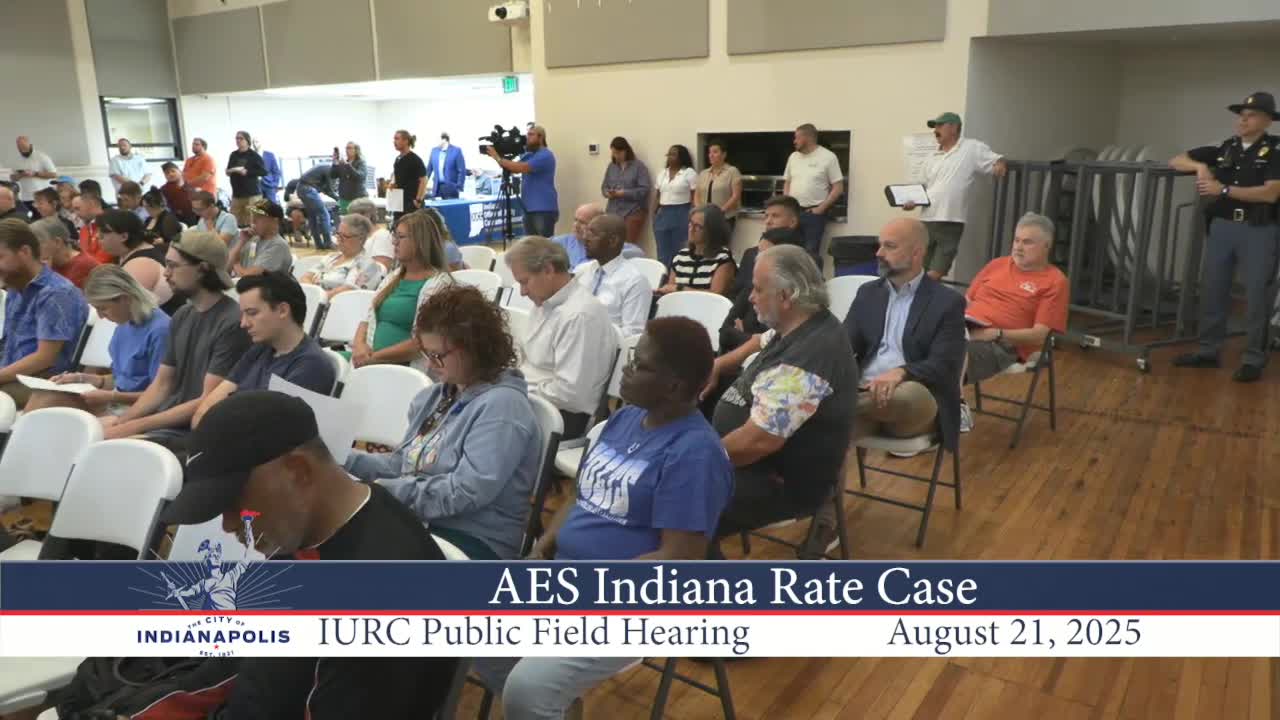
At a field hearing held by the Indiana Utility Regulatory Commission on a petition by Indianapolis Power & Light Company d/b/a AES Indiana (cause no. 46258), dozens of residents, neighborhood leaders and consumer advocates urged regulators to reject a proposed rate increase that would raise residential electric bills by double-digit percentages and shift costs onto low-income households.
Indianapolis — At a field hearing held by the Indiana Utility Regulatory Commission on a petition by Indianapolis Power & Light Company d/b/a AES Indiana (cause no. 46258), dozens of residents, neighborhood leaders and consumer advocates urged regulators to reject a proposed rate increase that would raise residential electric bills by double-digit percentages and shift costs onto low-income households.
Speakers at the Aug. field hearing told the commission the proposal would be unaffordable and unfair. "Such a proposed rate increase on a basic service like electricity will force individuals and families to make hard choices between basic needs," said Andy Nielsen, city-county councilor for District 14, in his testimony to the commission.
The petition before the commission seeks multiple forms of relief, including a residential revenue increase that witnesses and filings characterized as a 13.45% phase-one increase for many residential customers, an increase in the monthly fixed customer charge from $17 to $20, changes to declining-block per-kilowatt-hour tiers, revised depreciation rates, accounting deferrals, and a proposed property-tax rider. The administrative law judge read the full caption of the case into the record, describing requests for revised depreciation, accounting relief, capital inclusion, rate-adjustment mechanisms and new schedules of rates, rules and regulations for service.
Why the hearing matters: Many witnesses said the proposed changes would disproportionately affect households that use the least electricity or are on fixed incomes. "The customer charge should not be increased," testified Jason Tomsey, representing AARP Indiana, who told commissioners the proposed fixed-charge hike and overall increases would make bills harder to control for older Hoosiers and low-income customers.
Community leaders and residents cited recent operational problems and affordability indicators in urging denial. Clark Mathis, speaking for the Bates-Hendricks Neighborhood Association, told the commission that many neighbors have experienced lengthy outages and that "asking us to pay more for an unreliable service is fundamentally unfair." Multiple speakers described billing-system problems after a rollout last year that led to delayed or inaccurate bills, disconnection notices for many customers and difficulty restoring service promptly.
Speakers also criticized the distribution of increases across customer classes. Several witnesses pointed out that large industrial or commercial customers — including new or proposed data centers — would see much smaller percentage increases while residential customers would face the largest jump. Testimony from residents and local officials framed that distribution as a subsidy of large energy users by households, especially renters, seniors and medically vulnerable customers who rely on electric-powered medical equipment.
Calls for commission action and scrutiny: Commenters asked the IURC to scrutinize AES Indiana’s capital requests, to deny the requested property-tax rider and to reduce the utility’s authorized return on equity. Residents also asked the commission to require an independent audit or greater transparency about how AES’s revenues and earnings are used, and to protect affordability by rejecting increases to the residential fixed charge and declining-block rate design.
Consumer-advocate and nonprofit input: The Office of Utility Consumer Counselor (OUCC) and other intervenors were present; OUCC staff told attendees that written comments will be treated the same as oral testimony and that OUCC planned to file testimony in the case on Sept. 9, with a final commission order not expected until 2026. Jason Haas appeared on the record for the OUCC; Jennifer Washburn appeared for Citizens Action Coalition of Indiana; Jeffrey M. Peabody entered an appearance for the petitioner, AES Indiana.
Hearing continuation and next steps: The administrative law judge announced that the field hearing record would remain open. The hearing was continued to Monday, Aug. 25 at 6 p.m. at New Augusta Public Academy North Middle School in Indianapolis to allow additional public testimony. The OUCC fact sheet provided to attendees lists a written-comment deadline of Sept. 2; OUCC staff emphasized that written consumer comments submitted by that date will be part of the formal case record.
Voices from the crowd: Testimony ranged from technical rate-design critiques to personal hardship accounts. Sharon Lepper said AES executives have substantial corporate profits and said the company "plans to increase their own profit to $417,000,000 in 2026 on on the backs of these same Hoosiers." Hannah Allison said the proposed change would increase her household bill by about $30 a month and asked the commission to deny the request. Multiple speakers detailed disconnections, medically necessary electric equipment, difficulty paying and requests for tree trimming and faster outage response.
No ruling was made at the hearing. Commissioners and the administrative law judge listened but did not engage in discussion about the merits of the case, consistent with procedural restrictions in pending adjudicatory proceedings. The commission will consider the record — including oral testimony and written comments — as part of its review. The IURC’s final decision will be based on evidence filed in the docket and legal standards the commission must apply.
The hearing record remains open; additional public comment may be filed in writing with the OUCC or the IURC docket for cause number 46258 by the dates listed in the OUCC fact sheet.