Get Full Government Meeting Transcripts, Videos, & Alerts Forever!
Get email alerts on the Land Use topic
No spam. Unsubscribe anytime.
Broomfield council holds concept review for Great Western Park PUD amendment amid resident opposition to SkyStone Parkway extension
Summary
City and County of Broomfield staff, the applicant and developers presented a concept review to change two Great Western Park PUD tracts from employment to residential uses. Staff and dozens of residents raised fiscal, noise, transit and safety concerns; no decision was made.
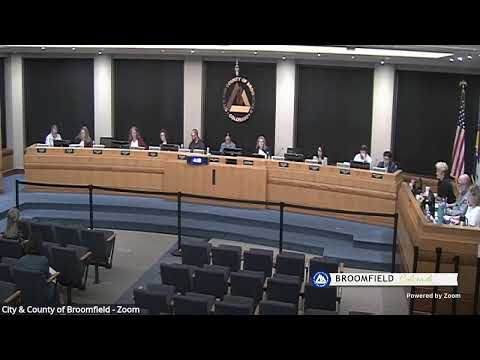
City and County of Broomfield officials on a study-session night reviewed a concept proposal to amend the Great Western Park planned unit development to change two northern tracts from employment uses to residential development, and heard lengthy public comment focused largely on the proposed SkyStone Parkway extension.
The concept review, presented by Planning Manager Brandon Roe and applicant counsel Carolyn White on behalf of Church Ranch, outlined a request to change Tract N3 to medium-density residential (15 dwelling units per acre, up to about 440 units) and Tract N4 to high-density residential (30 dwelling units per acre, up to about 330 units). Roe and White emphasized the session was advisory: “there is no formal vote or decision made this evening,” Roe said, and any formal application would require future public hearings and review by the Land Use Review Commission and city council.
The plan area includes about 42 acres north of Walnut Creek, east of the Great Western Open Area and west of Sims Street. White said the applicant expects about nine acres of open lands and that housing developers under discussion have committed to provide income-aligned units on site: “about 35 for-sale income-aligned units in the medium density area and about 64 rent income-aligned units in the high-density area,” she said.
Why it matters: staff told council the proposed conversion of roughly 40 acres from commercial employment to residential would reduce planned commercial space by nearly a half-million square feet and, using the city’s long-range financial model, could produce an estimated negative fiscal impact to the city of about $1,300,000 annually if the site were developed to the maximum intensities presented. That potential loss, combined with concerns about transit access, airport and firing-range noise, wildlife impacts and traffic, framed much of the council and public discussion.
Staff and applicant positions: Roe reviewed the PUD history—original approval in 2001 envisioned a mostly employment campus and dedicated a right-of-way for the roadway that later became Skystone Parkway—and staff noted the road has been included in prior approvals. Roe said the Metropolitan District and property owners can continue the construction drawings process for Skystone Parkway independent of whether the northern parcels are redeveloped as residential or remain employment. White and developer representative Greg Bradbury said market conditions over many years have hampered leasing or sale of office employment space and that commercial brokers found residential proposals more viable; CBRE market analyst Eric Roth told council “the Northwest office employment market right now has a 27–32% vacancy rate” and that residential builders had expressed willingness to build attainable product.
Traffic and emergency access: the applicant’s traffic engineer, Curtis Rowe of Kimley-Horn, told the council that the proposed rezone would reduce trips compared with the previously assumed employment uses—“In the morning peak hour, we’re seeing a 78% reduction in traffic” relative to the employment scenario, Rowe said—and that the developer proposes traffic-calming measures including raised crosswalks, chicanes and narrower travel lanes (proposed 11-foot lanes on the new extension). North Metro Fire representatives told the council an additional access is desirable for emergency response and evacuation; however, City staff and the city attorney clarified that North Metro cannot unilaterally compel construction of the parkway and that council could direct staff to revisit the roadway configuration, in consultation with the Metropolitan District and property owners.
Public comment and community concerns: more than a dozen residents, many from the adjacent SkyStone age-restricted community, opposed the rezoning and the roadway extension. Speakers said the neighborhood was chosen for its low-traffic, senior-oriented character and warned the extension would split SkyStone, increase traffic “from just under 500 vehicles per day to over 5,000,” harm private amenities and expose new residents to aircraft and range noise. SkyStone residents also asked whether the city or the Metropolitan District would fund the parkway; applicant counsel said the developer/Metro District would construct the road and dedicate it to the city at no upfront city cost. Multiple speakers requested alternatives such as limited emergency-only access or routing traffic to other existing corridors.
Council response and next steps: council members asked for more technical detail on traffic, lane widths and bike facilities and suggested a future study session focused solely on SkyStone Parkway alternatives. Several council members stressed the fiscal trade-offs in converting commercially zoned land to residential uses, and others underscored compatibility concerns given the nearby Rocky Mountain Metropolitan Airport and an outdoor firing range. City Attorney Nancy Rogers and Planning Manager Brandon Roe confirmed council could direct staff to explore options for the parkway and return with recommendations. Because the item was a concept review, no vote was taken.
Clarifying details offered during the meeting include staff and applicant estimates, and staff noted that the Metropolitan District has submitted construction drawings for the SkyStone Parkway extension and that those drawings are under review. The applicant told council it expects a narrower buildout than the maximums shown and suggested the realistic unit total could be closer to 500–532 units rather than the theoretical maximum of roughly 820 units shown in the concept materials.