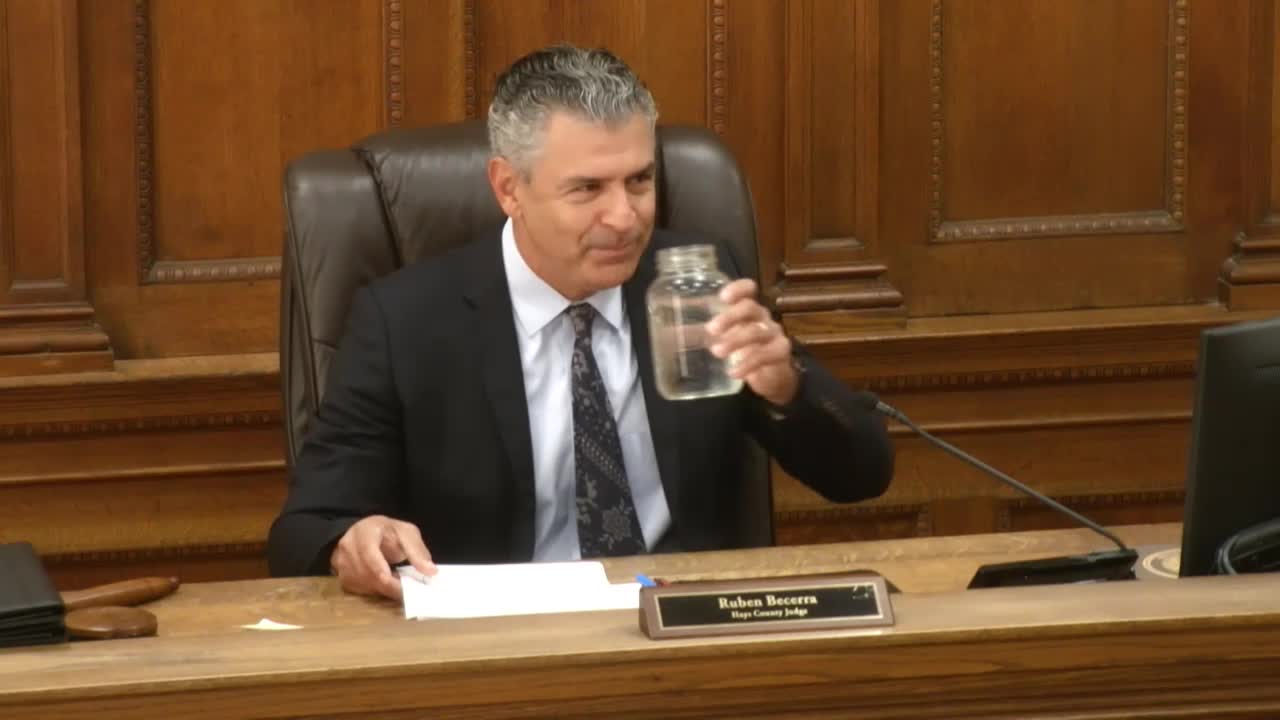
Hays County delays decision on Flock Safety license‑plate readers after hours of public comment
Loading...
Summary
After hours of public comment both for and against automated license‑plate readers (ALPRs), Hays County Commissioners voted to table a motion to terminate all contracts with Flock Safety and asked for more information and safeguards before taking action.
Hays County Commissioners on Tuesday heard more than two hours of public comment — including a Flock Safety representative, prosecutors and a string of residents — before deciding to table a motion that would have terminated the county’s contracts for automated license‑plate‑reader (ALPR) cameras.
The commissioners’ court opened the item (agenda J‑4) after a large public comment section in which supporters and opponents of the systems argued about privacy, effectiveness and potential federal data-sharing. After discussion, the court voted to postpone action and asked for additional information and meetings with stakeholders.
The debate centered on two conflicting claims: supporters, including law‑enforcement allies and a Flock Safety representative, said ALPR systems help detectives find vehicles linked to crimes and assist with AMBER alerts; opponents warned the system creates a broad surveillance database accessible across agencies, including federal partners. “Flock is not facial recognition or biometric tracking. It is not using personally identifiable information,” Trevor Chandler, director of public affairs at Flock Safety, told the court. Chandler also said the company certifies its storage to Criminal Justice Information Services and that search activity is auditable.
Opponents raised privacy concerns and cited examples from other jurisdictions. Shannon Fitzpatrick, a speaker in the public forum, said: “This is a company that sells the info it collects to over 700 different entities, and those entities can share with whomever they please.” Claudia Zapata, a Precinct 3 resident, told the court she heard the sheriff’s office state that “this does not prevent crime, this doesn't lead to arrests, and we cannot credit any case being solved due to Flock,” and warned the commissioners about sharing data with federal agencies.
Prosecutors and some county officials pushed back on claims that the system has no law‑enforcement value. “Case after case I have dealt with — whether it’s murder, sexual assault, serial aggravated robbery — have been solved in part because of Flock,” Mark Rank, an assistant criminal district attorney for Hays County, said. Supporters also told the court that ALPR evidence is photographic and limited to license plates and vehicle descriptors.
Commissioner Inglesby said county staff and the sheriff had proposed procedural safeguards — including a publicly accessible logging portal for searches, monthly audits of system use (the sheriff’s office currently runs quarterly audits), and requiring officers to record a search reason and case number. Inglesby said those steps and more discussion with Flock representatives and the community could help narrow the debate.
After about an hour of internal discussion the court voted to table the motion to terminate Flock contracts (agenda J‑4) and to schedule further meetings and follow‑ups so staff and the court could consider changes such as a searchable audit portal, monthly audits and limits on external data sharing. No formal contract termination, suspension or expansion was enacted.
The court’s action followed testimony from many residents, community groups and nonprofit representatives, including immigrant‑rights advocates who said ALPRs would chill reporting and travel patterns among vulnerable populations. Speakers also described national examples of alleged misuse of ALPR data and questioned whether a local contract can prevent secondary uses or federal access.
What the court decided - The court received public comment from over two dozen in‑person speakers and dozens of emailed statements. - A motion to terminate all Flock Safety contracts (agenda J‑4) was made and seconded; the court formally TABLED the motion and asked staff to return with further information and possible safeguards. (See Actions[] below.) - Commissioners asked county staff to pursue additional community meetings, to request more detailed written answers from Flock Safety on audit and sharing practices, and to refine a proposal for a public search‑logging portal and more frequent audits.
Why it matters Hays County’s decision to pause rather than act immediately leaves existing ALPR networks in place while the county explores policy changes and safeguards. The issue has split residents and local officials, with public‑safety officials citing cases helped by ALPR hits and community groups warning of data aggregation and federal access that could harm immigrants and other vulnerable groups. Commissioners said the pause gives the court time to seek clearer contractual protections and to weigh technical and legal limits on data sharing.
What’s next Commissioner Inglesby and others urged continuing public engagement and a forum that includes Flock representatives, the sheriff’s office and independent civil‑liberties stakeholders. The court scheduled follow‑up discussions; staff said the court will revisit the item after those briefings and after receiving more details about audits, logging and data‑sharing controls.
Ending note The commissioners’ action leaves Hays County in the position many other Central Texas jurisdictions have faced recently: balancing public‑safety tools against privacy and civil‑liberties concerns while seeking contractual and technical limits that address local priorities.