Get Full Government Meeting Transcripts, Videos, & Alerts Forever!
Get email alerts on the Public Safety 911 topic
No spam. Unsubscribe anytime.
Wapello County supervisors hear 9-1-1 service board report; chair says system needs major radio upgrades
Summary
The county's 9-1-1 service board warned supervisors the current call‑taking and radio systems are reaching end‑of‑life, outlined options including a SARAH connection with neighboring counties, and said funding limits mean surcharge revenue will only cover maintenance unless new funding is found.
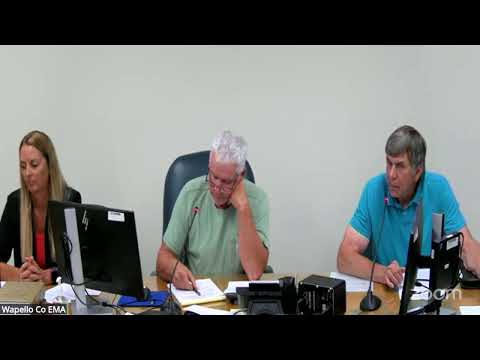
WAPELLO COUNTY — The Wapello County Board of Supervisors heard a detailed briefing from the county 9-1-1 service board on current operations, technology needs and funding shortfalls, during which the board chair said the county will soon need to decide how to pay for a major radio-system upgrade.
The 9-1-1 board presentation, given by Tim, chair of the Wapello County 9-1-1 Service Board, outlined the evolution from rural addressing to enhanced 9-1-1 and the county’s current work toward next‑generation 9-1-1 capabilities such as text and video dispatch. “Right now, it’s a dollar,” Tim said of the wireless 9-1-1 surcharge that funds local 9-1-1 infrastructure. “The only thing we’re gonna be able to do on the go forward with 9-1-1 surcharge money is just do the maintenance.”
Tim summarized the board’s recent study of radio systems and said Wapello County currently uses a simplex VHF system that is becoming inefficient and unreliable. Newer 700/800 megahertz trunked systems require more towers but provide the interoperability and indoor coverage responders expect. Tim said his study showed options ranging from incremental improvements to a full buildout and recommended the county consider staged approaches while preparing for higher costs.
Why it matters: The 9-1-1 system funds public-safety answering-point (PSAP) computer equipment and radio infrastructure used by county dispatchers, police, fire and EMS. If the county does not upgrade, responders will continue to rely on aging VHF radios or on cell phones for tactical communications — a suboptimal solution for public‑safety operations.
Key details from the briefing:
- Costs and timing: The board’s worksheet shows a typical 10‑year refresh cycle for dispatch equipment (about $250,000) and maintenance obligations that will rise. Tim said a SARAH connection to link with Mahaska County would cost “500,000 ish,” and an additional roughly $500,000 was discussed as a possible permanent bridge between 700/800 MHz and VHF systems. Tim cautioned these are study estimates and that costs have risen substantially since prior projects.
- Funding pressure: Historically the county receives about $300,000 a year in wireless surcharge revenue, Tim said, and current projections show that maintenance alone will soon absorb most of that amount. He warned that a recent state-level change left the state 9-1-1 system short of funds and that a legislative decision will affect local revenue; locally the county faces about a $36,000 hit in current projections because of the state action.
- Interoperability and staging: Tim and other presenters said vehicles and departments will likely need dual‑band radios (VHF plus 700/800 MHz) during a multi‑year transition so Wapello responders can work with both neighboring counties and statewide systems. “We already have VHF in our vehicles… our recommendation right now is get a radio that’ll do both,” Tim said.
- Regional collaboration: Tim described talks with Mahaska County and consultants; Raycom produced coverage maps and the consultant is reviewing technical questions before making a recommendation. The board discussed possible partnerships with the city to share costs and towers.
Supervisors and staff also raised operational connections: Darren (county official) asked about the SARAH vs. state ISIC systems and noted tradeoffs between local control and statewide platforms. Sean Canto, Tummo fire chief, was cited by a supervisor as being “certainly aware of the need” for improved communications.
Next steps: Tim said the 9-1-1 board plans to refine recommendations and return to the supervisors with a funding plan and specific vendor/technology choices. “At some point, the 9-1 board needs to…come up with a solid recommendation for you and come to you and say, this is what we believe next step should be, and here's what that spend is gonna be,” he said.
Ending: Supervisors acknowledged the topic touches other county priorities — jail expansion, EMS, and budget capacity — and directed further discussion and a future work session to explore cost‑sharing, partnership and financing options.