Get Full Government Meeting Transcripts, Videos, & Alerts Forever!
Get email alerts on the Naloxone Mandate Bars topic
No spam. Unsubscribe anytime.
Committee forwards bill requiring bars to keep naloxone on premises
Summary
A Hawaii County policy committee on Aug. 5 voted to forward Bill 71 to the full council with a favorable recommendation, proposing a requirement that venues licensed to serve alcoholic beverages keep naloxone on premises and ensure employees are aware of its location and how to administer it.
A Hawaii County policy committee on Aug. 5 voted to forward Bill 71 to the full council with a favorable recommendation, proposing a requirement that venues licensed to serve alcoholic beverages keep naloxone on premises and ensure employees are aware of its location and how to administer it.
The 7-0 vote, with two members excused, came after testimony from public-health advocates and a presentation by the county liquor department about past naloxone distribution and current supply concerns. The committee’s action sends the proposal to the council for first reading.
Bill 71 would amend chapter 6 of the Hawaii County Code by adding an article requiring each bar or similar venue to keep at least two doses of naloxone nasal spray (commonly sold as Narcan) in a visible, labeled location during business hours and to ensure employees are aware of its location and method of administration. The ordinance would also shield owners and employees from liability for administering naloxone. The bill sets a fine of up to $500 per day for establishments found in violation.
Hannah Preston Pita, with the Big Island Substance Abuse Council and representing the Hawaii Island Fentanyl Task Force, testified in support of the bill, saying it would “allow the county to make sure that we are there to save lives” and that the organizations were “in full support of this bill. Mahalo.”
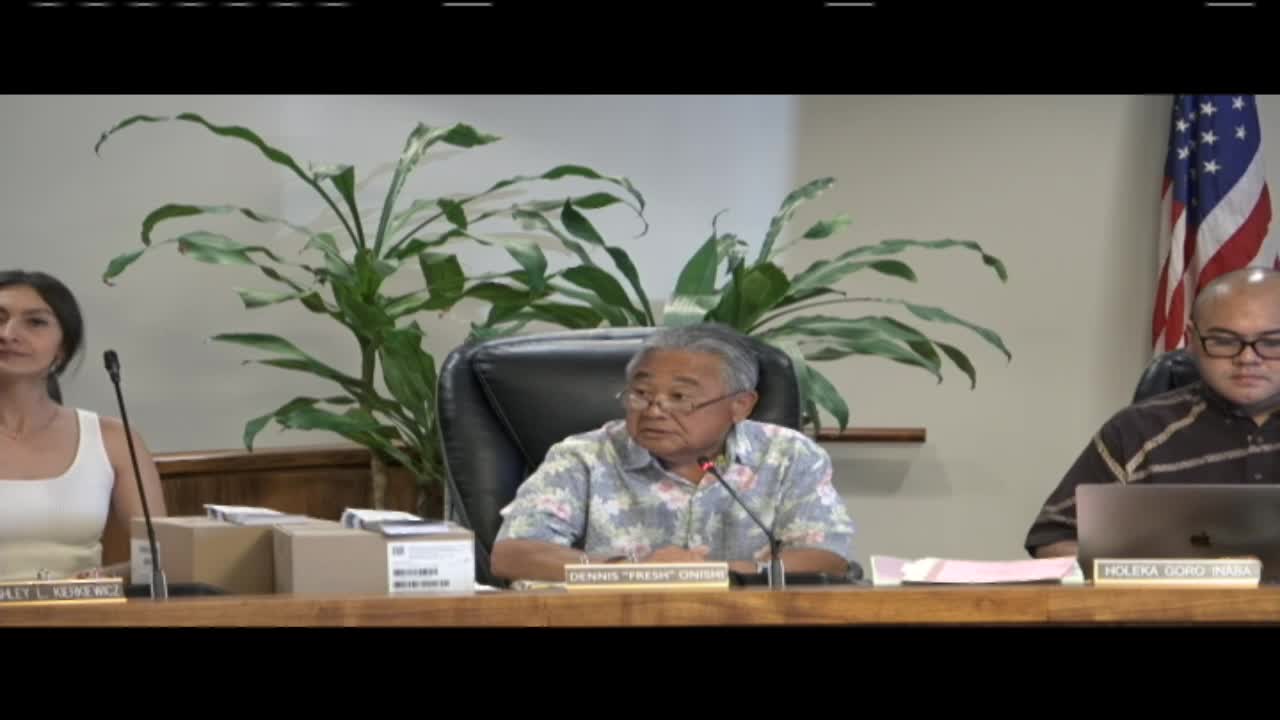
Councilmember Inaba, a sponsor, told the committee the measure was modeled in part on Honolulu’s law and aimed to provide a faster response to on-site opioid emergencies prior to arrival of county emergency medical services. “This is a matter of safety and wellness for our community,” Inaba said.
Councilmember Eustace, a co-sponsor, noted local partnerships with the Fentanyl Task Force and other volunteers and said the committee members were given sample naloxone boxes from the task force for their communities.
Director DeCoste of the liquor department told the committee the department has been involved in naloxone distribution since 2023 and that the attorney general’s office and the state Department of Health previously supplied doses for distribution to bars and other licensees. “Of the ones we surveyed, about 80% could still locate it and are still available,” DeCoste said, and reported that only a small number of locations had used doses. DeCoste said some of the existing stock is set to expire by the end of the year and that the department can work with nonprofits and state partners to replenish supplies.
Members pressed the administration on who would bear the cost of naloxone if the county did not provide it. Councilmember Kimball asked that finance or the office administering opioid settlement funds brief the committee at a future hearing; Mayor’s Office executive assistant Erin Zamora said the county has received one settlement check, that an RFI is open on use of the funds, and that purchases have been made through ADAD (Alcohol and Drug Abuse Division). “We have received our first check, and there is an RFI out right now on how to use the funding appropriately,” Zamora said.
During discussion, members emphasized avoiding placing an undue financial burden on small businesses. A liquor-department representative said prior voluntary distribution minimized resistance among licensees and estimated the county has roughly 400 liquor licensees islandwide and under 200 establishments that fit the draft bill’s bar definition. The department suggested hotels were not explicitly included in the draft definition and that wall-mounted, visible storage might improve accessibility and awareness.
The committee’s formal motion — “Motion to forward Bill 71 to council with a favorable recommendation” — was made by Councilmember Inaba and seconded on the record; the committee recorded seven ayes and two excused members. The action forwards the ordinance for first reading by the full council.
Next steps: Bill 71 will appear before the full Hawaii County Council for first reading and further consideration; committee members requested follow-up briefings on opioid settlement funding and coordination with the liquor department and nonprofits to supply naloxone without shifting costs to small businesses.