Get Full Government Meeting Transcripts, Videos, & Alerts Forever!
Get email alerts on the Veterans Wellbeing Assessment topic
No spam. Unsubscribe anytime.
Researchers report high satisfaction with Veterans Innovation and Insight Forum; analysis continuing
Summary
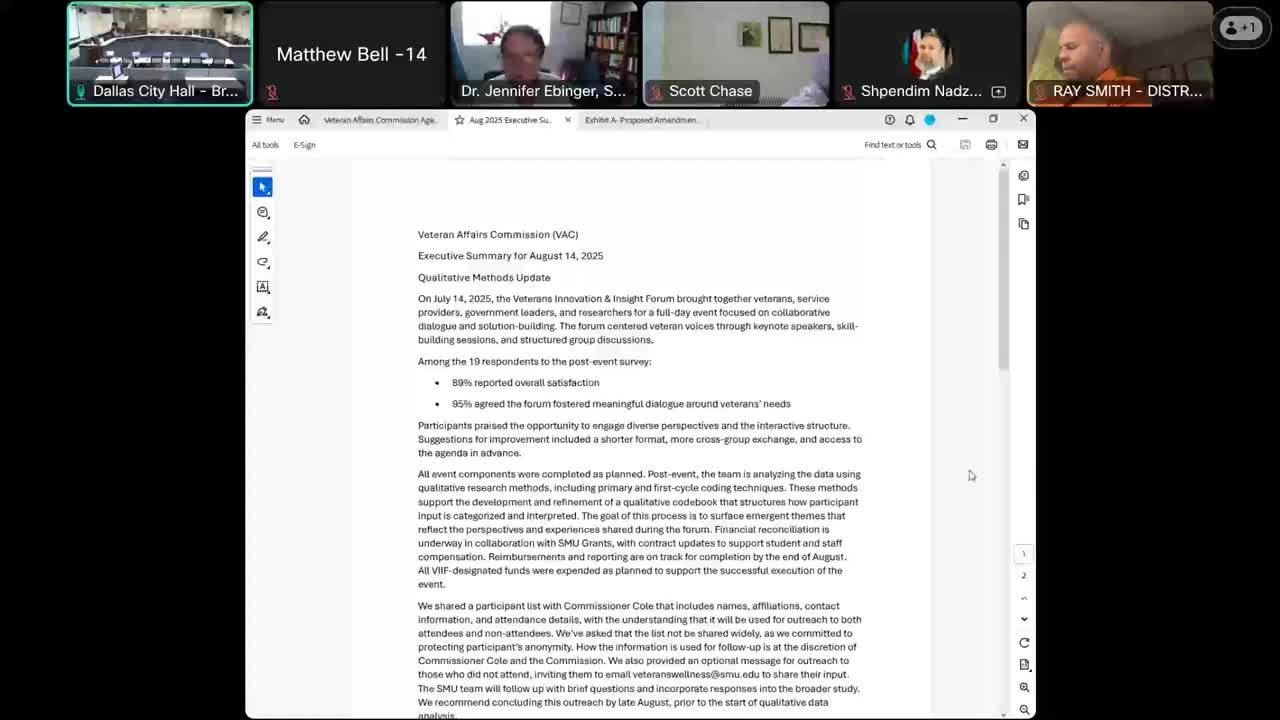
Dr. Ebinger, presenting on the Veterans Innovation and Insight Forum (VIIF) evaluation, told the Dallas Veterans Affairs Commission that forum participants reported high satisfaction and that researchers are continuing quantitative and geospatial analysis to identify service gaps for Dallas-area veterans.
Dr. Ebinger, presenting on the Veterans Innovation and Insight Forum (VIIF) evaluation, told the Dallas Veterans Affairs Commission that forum participants reported high satisfaction and that researchers are continuing quantitative and geospatial analysis to identify service gaps for Dallas-area veterans.
“There were 89% shared that they were satisfied overall” and “95% of them said that it fostered meaningful dialogue,” Dr. Ebinger said, summarizing participant survey results and initial qualitative coding from the July 14 forum. She said forum attendees praised the interactive structure and the chance to share diverse perspectives, and that suggested improvements included a shorter format, more cross-group interaction and publishing the agenda in advance.
The viif evaluation team is conducting both qualitative and quantitative work, Dr. Ebinger said. On the quantitative side, researchers have reviewed 28 city council agendas and 29 meeting videos for patterns, are assembling keyword topic maps and are building a geospatial database of services. She said the team is pulling data from the U.S. Census American Community Survey and local databases and integrating participatory mapping the forum produced.
Dr. Ebinger told commissioners that researchers initially sought cell-phone mobility data but abandoned that option because of “the exorbitant cost,” and instead have begun analyzing Reddit discussions about service access from 2020 to the present as a complementary social-media data source. She said the project is “on track and under budget right now,” with one student working over the summer and additional student staff expected to join.
Commissioners asked about outreach to forum invitees who did not attend. Dr. Ebinger said the plan is to have commissioners (Commissioner Cole will lead outreach) invite nonattendees to participate in a brief follow-up sampling; she estimated that sampling outreach would be limited in duration—“probably about 2 months at the max”—to avoid lengthy, straggling responses.
Commissioners also asked whether the geospatial team had connected with City of Dallas data stewards. Dr. Ebinger said she had seen email exchanges indicating contact between the project and city staff (she mentioned Dylan Harvey and that she expects to meet with Dr. Zarzaga soon) and that she would report status in the next team update. She declined to give additional quantitative detail on items she could not answer immediately, offering to follow up in writing where necessary.
Dr. Ebinger said the team aims to finish coding and synthesize findings promptly and will present consolidated results when analysis is complete. She asked commissioners to send any follow-up questions; commissioners offered to assist with outreach and data access where helpful.
The presentation included requests for procedural follow-ups—confirmation of data access from city departments, limited targeted outreach to nonattendees, and a future budgeted discussion should commissioners want an additional in‑person or half‑day convening. Dr. Ebinger cautioned that VIIF funds have been used as intended and that an additional convening would require identifying unspent funds or supplemental resources.
Commissioners thanked Dr. Ebinger for the update and asked that the next report include more precise participation numbers and any new geospatial access confirmations.