Get Full Government Meeting Transcripts, Videos, & Alerts Forever!
Get email alerts on the Emergency Medical Services Ambulance Contract topic
No spam. Unsubscribe anytime.
Syracuse officials present three-year AMR contract with response targets, reporting and complaint process
Summary
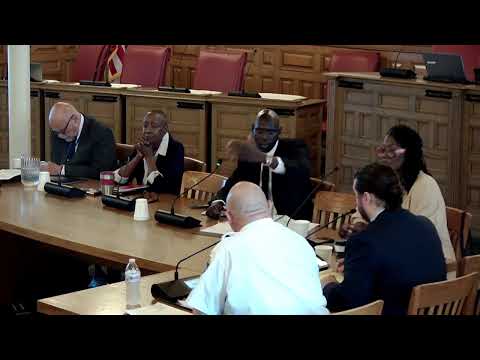
Syracuse City officials and contractors presented a proposed three‑year contract with American Medical Response (AMR) to formalize ambulance service, set response-time standards and create a monthly public reporting and complaint process, city staff said at a study session.
Syracuse City officials and contractors presented a proposed three‑year contract with American Medical Response (AMR) to formalize ambulance service, set response-time standards and create a monthly public reporting and complaint process, city staff said at a study session.
The contract, which is eligible for a two‑year renewal, would not require direct payment from the city and would bind AMR to service-level expectations including a target that critical “echo” calls be reached within 8 minutes, 59 seconds for at least 90% of cases and a cap on mutual‑aid handoffs to no more than 3% of total monthly call volume, Craig Whitmer of API, the city’s consultant on the procurement, said. "We saw about nearly a 30% increase in 911 calls in Onondaga County," Whitmer said, describing the local trends that prompted the RFP and negotiations.
Why it matters: City presenters framed the agreement as adding transparency and local oversight where historically there was none. The city lacks prior contractual access to AMR’s call‑level data, officials said, and the proposed contract would require monthly reports on total responses, transports, response‑time distribution, clinical quality metrics and mutual‑aid usage so the city can review performance and open formal inquiries when thresholds are exceeded.
Details and provisions - Length and oversight: The draft is a three‑year contract with a possible two‑year renewal. AMR would provide daily staffing notices, monthly operational reports and participate in recurring meetings with Syracuse Fire Department (SFD) command staff and the mayor’s office. - Response standards and mutual aid: For the highest‑priority medical calls the agreement sets an 8:59 response target (measured from call intake to arrival at the patient’s door) and limits mutual‑aid reliance to 3% of calls per month; presenters said AMR’s recent operations have been within that threshold for several months. Dan Downs, first deputy chief, described the contract as “the signatures for when the system is working correctly and everybody’s gonna be held to that standard.” - Reporting and complaints: The contract would require monthly metrics, a clinical quality improvement (CQI) committee, a complaint/concern hotline and a documented downgrade policy when call severity is changed after initial coding. - Community commitments: AMR has agreed in the draft to outreach commitments including two scholarships per training class for city residents and visits to high schools to discuss career paths, officials said. - Equipment and training: The draft calls for vehicle age and joint training requirements; the precise maximum vehicle age was discussed but not specified in the meeting record.
Local context and data presented City staff said AMR responds to roughly 130–140 calls a day within Syracuse, and the regional system receives about 52,000 ambulance-related calls per year. Whitmer and SFD officials described workforce pressures, growth in 911 volume since 2023, limited access to primary care and higher ER wait times as contributing factors that stressed emergency response systems.
Questions and concerns from councilors Councilors pressed staff and AMR on several operational points: how county dispatch and the Onondaga County 911 center interface with AMR; whether translation services and new street data are handled in the county CAD; hospital offload times and their effect on ambulance availability; and whether AMR’s daily deployment could be aligned more closely with SFD station placement.
SFD and AMR officials described the dispatch sequence: calls go to the county 911 center, which geocodes and routes city calls to AMR; the fire department dispatches concurrently for serious calls so first responders can begin life‑saving measures ahead of ambulance arrival. Deputy Chief Nick Pagano, who oversees SFD’s EMS operations and serves as the department’s 911 liaison, explained that fire engine “mini” units staffed with two certified EMTs often stabilize patients while an ambulance—whose typical on‑scene and transport cycle can be about an hour—completes transport and hospital transfer.
County role and data access Multiple councilors and staff emphasized that effective accountability requires county coordination. City presenters said the contract will provide the city with AMR-specific operational data that previously was not available to Syracuse staff and will support meetings to investigate performance shortfalls. Whitmer said the negotiation team studied other cities’ approaches (Seattle was cited for performance‑management lessons) and chose a layered accountability path that emphasizes communication and escalation rather than immediate financial penalties: regular operational meetings, a broader stakeholder review if issues persist for two to three months, and a requirement for AMR to appear at a public meeting if problems are not resolved.
Billing, public reporting and next steps Councilors asked whether AMR would assume billing for transports; city staff said billing remains handled by third‑party vendors at present and that the contract contains no city payment obligation. Councilors requested that the monthly operational data be made public where legally permissible (dashboards or summaries) so residents can track response‑time performance; staff said they will explore the public reporting format while respecting proprietary and privacy constraints.
Process history and current status City staff recounted that the RFP was launched in 2023 and that AMR was the sole respondent. The RFP committee met in July and unanimously voted to move forward with AMR’s proposal. The draft contract emerged from months of negotiation among city staff, SFD and AMR; staff presented the draft and answered councilors’ questions at the study session and will incorporate follow‑up items (notably a public reporting approach and continued coordination with the county 911 study) ahead of legislative action.
What officials said Craig Whitmer, API consultant: "We saw about nearly a 30% increase in 9 1 1 calls in Onondaga County." Dan Downs, first deputy chief: "This is the signatures for when the system is working correctly and everybody’s gonna be held to that standard." Bill McGarity, AMR regional director, described AMR’s current staffing and dispatch practices and confirmed daily staffing notices and joint operational coordination.
Outlook Staff said the contract is intended to give Syracuse formal oversight and transparency over AMR’s city operations, create mechanisms to investigate performance shortfalls, and strengthen coordination with county partners. Councilors asked for publicly accessible performance summaries and clearer integration with the county’s ongoing 911 study; staff committed to returning with follow‑up details in advance of the council’s upcoming study session and any required legislative vote.