Get Full Government Meeting Transcripts, Videos, & Alerts Forever!
Get email alerts on the Redistricting topic
No spam. Unsubscribe anytime.
Appropriations Committee approves AB 604, authorizes funding for potential special congressional election
Summary
The California Senate Committee on Appropriations voted 5-2 to pass AB 604 to the Senate floor after a hearing focused on the bill's fiscal impacts. Supporters said the measure is a limited, conditional response to federal actions; critics pressed for clearer cost details and litigation estimates.
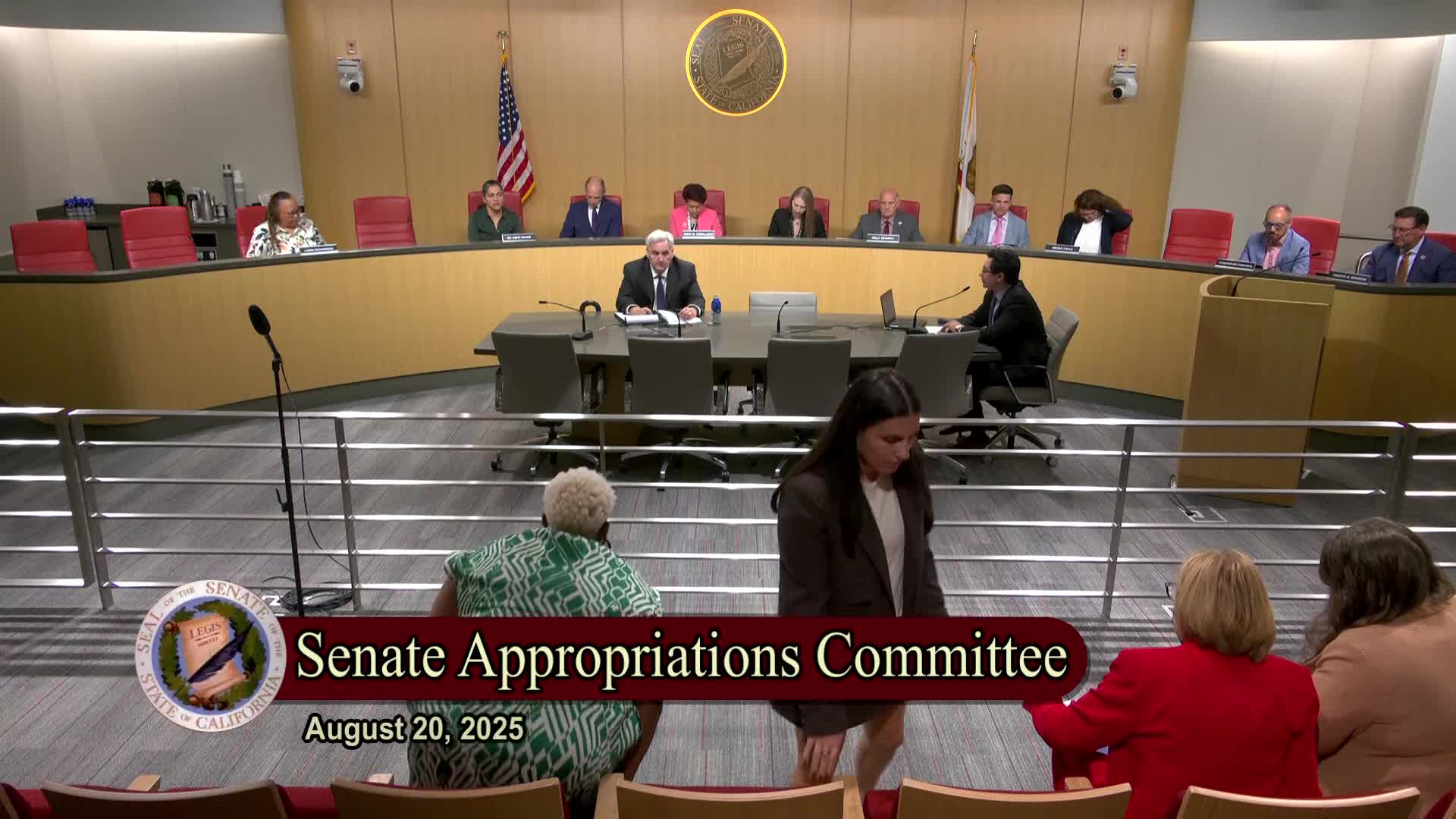
The California State Senate Committee on Appropriations voted 5-2 on AB 604 on Oct. 25, 2025, sending the bill to the Senate floor after a hearing focused on the measure's fiscal impacts and potential downstream costs.
AB 604 would establish a temporary congressional district map if two trigger conditions are met: a successful voter approval of ACA 8 and actions by other states that would, according to the bill's authors, require California to respond. "AB 604 lays out a temporary congressional district map, but only if the voters approve ACA 8 and only if partisan maps are pushed through in other states," Assemblymember Aguiar Curry said during her remarks to the committee. She told the committee the proposal reflects the work of the independent citizens redistricting commission and said local election dates were chosen to help lower costs.
The hearing was limited to fiscal issues. Christian Belcher of the Department of Finance told the panel that a recent special election in 2021 cost about $200,000,000 and said that figure is a reasonable baseline for estimating the cost to administer a statewide election tied to AB 604. "We can fairly estimate it'd be $200,000,000 or potentially more," Belcher said. He also noted that the companion bill, SB 280, directs the Department of Finance to work with the Secretary of State on county resources.
Supporters argued the measure's fiscal footprint was small compared with the cost to California if federal cuts to programs such as Medicaid (Medi-Cal) or K-12 funding proceed. "The fiscal impact of this bill should be minimal and pales in comparison to Trump's and congressional Republicans' fiscal attacks on California," Assemblymember Aguiar Curry said. Dolores Huerta, president of the Dolores Huerta Foundation and a witness in support, told the committee: "Democracy does not have a price" and urged members to vote yes.
Several organized labor and health groups registered or spoke in support during the hearing, including the California Nurses Association, the California Federation of Labor, Planned Parenthood affiliates of California, campus Democrats and Teamsters California.
Opponents and some committee members pressed for clearer, comprehensive fiscal accounting. One senator asked whether the $200 million estimate included potential litigation costs already incurred or likely to follow; Belcher said litigation spending would come from other budget line items such as the Attorney General's appropriations and that those costs are separate from the election-administration estimate. Committee members also questioned whether money had already been spent drafting maps and whether consultants or in-house staff performed that work; the Department of Finance representative said he did not have that procurement detail at the hearing and offered to follow up with committee staff.
Committee debate repeatedly returned to the question of prioritizing scarce state funds. One senator said the state had deferred funding for veterans' GI benefits, judgeships, and other programs while considering this appropriation. Supporters replied that the cost of inaction could be far greater and described AB 604 as a contingent, defensive measure intended to protect California's federal funding and representation.
Chair Yellen moved the bill to the Senate floor. The roll call recorded the following votes: Caviero, aye; Ciarto, no; Cabaldon, aye; Dolly, no; Grayson, aye; Richardson, aye; Wahab, aye. The committee's final tally was 5 ayes and 2 noes. "The final vote is 5 to 2. That bill is out," the chair said after the vote.
The committee limited testimony to fiscal impacts and noted related measures (ACA 8 and SB 280) are being considered separately; several senators indicated they expect further fiscal detail as the companion measures move through the legislative process.