Get Full Government Meeting Transcripts, Videos, & Alerts Forever!
Get email alerts on the Affordable Housing topic
No spam. Unsubscribe anytime.
Maui committee backs CD1 for Kahului affordable housing project, approves exemptions after water, trees and EV debate
Summary
The Maui County Council Housing and Land Use Committee voted to recommend adoption of Resolution 25-161 (CD1) on Aug. 20, 2025, approving the residential phase of a mixed‑use project in central Maui as a 100% affordable rental development and granting a package of exemptions and fee waivers to facilitate construction.
The Maui County Council Housing and Land Use Committee voted to recommend adoption of Resolution 25-161 (CD1) on Aug. 20, 2025, approving the residential phase of a mixed-use project in central Maui as a 100% affordable rental development and granting a package of code exemptions and fee waivers to facilitate construction.
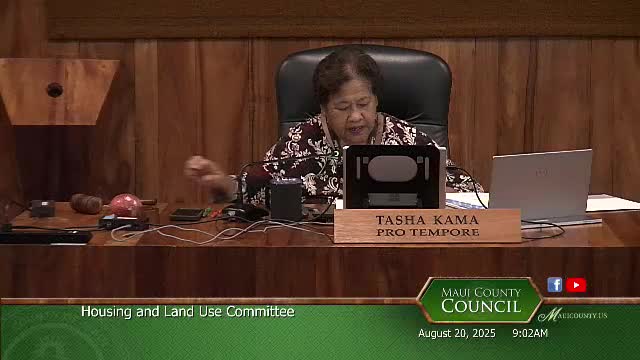
The committee, chaired by Tasha Kamah, approved the CD1 substitution and subsequent motion to recommend the resolution as amended in unanimous committee votes reported during the recess meeting: the substitution and related amendments passed by voice with counts reported as 9-0 on the floor. The body then voted to file related resolutions; that filing vote was recorded as passed with eight affirmative votes and one member listed as excused.
Why it matters: the committee’s recommendation clears a procedural step toward building roughly 240 affordable rental units in the project’s first phase and reduces several local regulatory and fee barriers that developers said were required to match the project’s financing plan. The packet and discussion show the county and developer negotiated exemptions covering taxes, certain permit and inspection fees, impact and availability requirements and several public-improvement items; committee members pressed county staff and developers on water supply, parking, landscaping and electric-vehicle infrastructure.
Committee action and key details - Motion: the committee entertained a motion to recommend adoption of Resolution 25-161 and to substitute the resolution with the CD1 version distributed for the meeting. The substitute motion (to replace the version on file with the CD1 text) was put and approved; the committee then considered amendments to the CD1 and voted on the resolution as amended. (Motions and votes recorded in the meeting minutes; substitution and main recommendation passed with counts reported as 9-0.) - Construction schedule amendment: members approved an amendment changing the milestone language in Exhibit A so both phases must start construction by Dec. 31, 2028, and complete by Dec. 31, 2030. That amendment passed on voice vote reported as 9-0. - Exemptions granted: the resolution as amended includes exemptions and waivers for multiple county code requirements and fees as applied to the residential (201H) component, including: real property tax exemptions for the affordable housing operation period, certain landfill/permit fees during construction, select streets/driveway/landscape requirements with conditions, water system development and water-availability treatment (per the county rule cited in the packet), wastewater assessment fees, traffic impact fees (if established before completion), building-plan and building-permit fees, certain electrical/plumbing/inspection fees, and allowance for specific frontage improvements (curb, gutter, sidewalk) consistent with the project drawings rather than full frontage build-outs in every case. The committee also accepted a park-dedication shortfall in lieu of on-site acreage per the project exhibits.
Water supply, workforce-housing agreements and the civic center component Committee members pressed county water staff and project representatives over a written Department of Water Supply (DWS) comment included in the packet that said, “at this point, there is not sufficient remaining capacity on the Central Maui water system to serve this project.” Council Member Tamara Paulton asked, “If there isn't sufficient remaining capacity on the Central Maui water system to serve the project, where is the water coming from?”
Department staff told the committee that DWS re-ran system analyses and determined it could provide capacity for the residential portion of the housing project by using additional output from one treatment facility and by utilizing an existing meter on the property; staff cited two analyses in the record that list 169,000–171,000 gallons per day as the figures under discussion. The deputy or senior DWS representative told the committee they were "able to find a way that we can use more water from one of our treatment plants" to serve the residential portion.
Staff also explained that DWS relies on a recorded residential workforce housing agreement to document whether a developer qualifies for an administrative exemption under County administrative rule 16-201-O3 (the packet cites that rule and Maui County Code section 2.96.020). County staff said the housing and civic-center components were being processed separately: the residential component before the committee is seeking 201H exemptions and is 100% affordable; the civic-center (nonresidential) portion is a separate DAGS/state component that will be reviewed separately and, if it triggers the residential-workforce threshold, would require its own workforce-housing agreement or an alternative compliance approach (land in lieu, payment, or purchase of credits) at the time permits or subdivision triggers that requirement.
Developers and HHFDC representation Project consultants and the applicant said the CD1 before the committee covers only the residential 201H component; Tom Schnell of PBR Hawaii told the committee that “the subject of this 201H application is only the residential housing component. The civic center is not part of the 201H and is not seeking 201H exemptions.” Representatives from EAH Housing, PBR Hawaii and the Hawaii Housing Finance and Development Corporation (HHFDC) were present and answered questions about operations, maintenance and the project budget.
Parking, EV infrastructure, sidewalks and site improvements The committee accepted a parking layout that reduced the total off-street stalls requested for the residential project and allowed a block of compact spaces (146 compact spaces sized at 16' x 7.5') with the remainder meeting standard dimensions; developers said parking would not be charged to residents and property management would assign and monitor stalls. The applicant said 18 EV-ready stalls would be provided (conduits/panel-sizing issues discussed), and requested explicit relief from the county’s broader EV-infrastructure requirements as they apply to market-rate projects; the developer told the committee the current design included the 18 EV-ready stalls and that a larger, full-buildout EV plan would add cost and was not in the project budget.
Landscaping and street trees Council members pressed the developer to work with the Maui County Arborist Committee and county planning staff to prioritize shade-producing street trees along the project frontage. Developer landscaping staff said they had already reached out to arborists and preferred the existing CD1 language that allows "reasonable substitutions in species," citing plant-size constraints, fire-safety and long-term maintenance. Planning Director Kate Blystone (joined later in the session) said the landscape-planting plan will be reviewed during the building-permit/LPA process and noted the county does not currently have an on-staff arborist; she said Department of Agriculture and the Arborist Committee have been a resource in other projects and that planning staff will review species at permit stage.
What the committee did and next steps The committee voted to recommend adoption of Resolution 25-161 (CD1) as amended. Committee members instructed staff to follow up on outstanding technical clarifications (planning timing/SMA status, tree-species coordination, and some fee-impact questions for county finance departments). The resolution recommendation moves the matter to the full County Council for final action; separate state and agency approvals (HHFDC, DAGS, DWS permits and building reviews) remain necessary before construction can begin.
Votes at a glance - Substitute Resolution 25-161 with CD1 (motion to substitute together with CD1 text): passed on voice vote (reported 9-0). - Amendment to Exhibit A (construction dates): committee adopted amendment to start by 12/31/2028 and complete by 12/31/2030: passed on voice vote (reported 9-0). - Recommendation to adopt Resolution 25-161 (CD1) as amended: passed on voice vote (reported 9-0). - Filing of related resolutions (25-160 and 25-162): passed (recorded as 8-0 with one member excused, per the meeting record).
Ending Committee members and staff reiterated commitments to follow up on technical clarifications requested on water-availability justification, SMA/planning review timing, and landscaping/tree-species coordination before the full Council considers the recommendation. The committee adjourned the recessed meeting at 12:03 p.m.
(Reporting note: the article summarizes committee discussion and votes recorded in the Aug. 20, 2025 Housing and Land Use Committee recess meeting. Exact vote counts and wording below reflect committee minutes and the CD1 packet distributed to committee members.)