Get Full Government Meeting Transcripts, Videos, & Alerts Forever!
Get email alerts on the Budget topic
No spam. Unsubscribe anytime.
Miami-Dade leaders identify $66 million to patch budget gap as tougher decisions remain
Summary
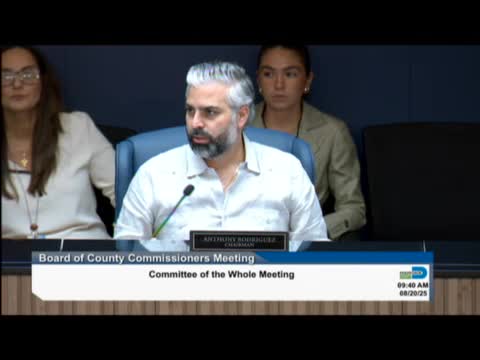
Miami-Dade County commissioners and the mayor convened a full-day budget workshop to narrow a roughly $400 million shortfall; the administration said it had identified about $66 million in additional funds and savings, but commissioners pressed for recurring solutions, departmental clarifications and a multi-year staffing plan for public safety.
Miami-Dade County commissioners and the mayor—onvened a full-day budget workshop focused on closing a roughly $400 million shortfall in the proposed 2025-26 spending plan. The mayor nd administration told commissioners they had identified about $65.9 nd $66 million in additional funds and savings that could be reallocated to priorities ranging from public safety and reserves to cultural grants and community-based organizations.
The mayor nd Chief Operating Officer Jimmy Morales told the commission that, after meetings with constitutional officers and department reviews, the administration identified "about 65, almost $66,000,000 in funding" that could be applied to the county deficit and to restore some programs. Morales said proposals under discussion would add "about $7,500,000" for public safety, about "$11,500,000" for cultural arts, roughly "$18,400,000" for community-based organizations, and $12.5 million to county reserves.
Why it matters: Commissioners face a multi-month calendar to approve a balanced budget for September hearings. Workshop exchanges made clear that many of the items discussed are one-time fixes or partial restorations and that commissioners expect more durable, recurring funding solutions before the budget is finalized. The session also exposed fault lines over priorities and how far to rely on reserves, departmental cuts, or new fees.
What administration proposed and where the money came from
Morales and other administration officials described three primary sources of the new $66 million package: $26 million of returned excess tax-collector commissions worked out with the tax collector, roughly $33 million of unspent funds identified with constitutional officers at year-end, and more than $6 million of department-level adjustments and savings. The mayor sked the commission to consider those items for a change memo to be released ahead of the first formal budget hearing.
The administration floated how that $66 million would be applied: restore most cultural-arts funding, partially restore community-based organization (CBO) grants, add roughly $7.5 million targeted to law enforcement and public safety, and put $12.5 million into reserve to soften next year—udget headwinds.
Appropriations chair—ommissioner Regalado: audits and cuts
Appropriations Chair Commissioner Regalado presented a wide-ranging departmental review prepared with the commission auditor and the commission uditor general. Her memo and slides identified a mix of program reductions, contract irregularities, and opportunities to limit growth. Key examples she flagged: - Corrections: higher-than-expected overtime and contractor costs, contracts that did not deliver projected savings on inmate meals and services, and possible savings opportunities in commissary and tray contracts. - Fire Rescue: questions about sequencing for capital vehicle purchases and clothing/uniform line items; some portion of returned tax-collector funds would legally need to flow back to fire reserves. - IT and internal operations: overlapping contracts and maintenance charges; questions about whether consolidation or outsourcing would save money. - Parks and recreation: fees and rentals not updated in many years; suggestions to retain access while modernizing fees and reinvesting revenue for improvements. - Transit: recommendation to reconsider full free-ride policies for some services and to explore partial fares, dynamic pricing for high-demand nights, and clearer first/last-mile geofencing for Microtransit.
Regalado pressed administrators to provide line-by-line explanations for large swings in certain budgets and asked departments to return cost-justifications for items that were more than 10% different from recent actuals.
Sheriff ppeal for personnel and training funding
The Miami-Dade constitutional sheriff briefed the board on staffing, attrition and an ask for substantial additional funds. In a lengthy presentation the sheriff said the office faces roughly 180 deputy vacancies and that the office needs multiple academy classes next year to prevent a projected rise to more than 260 vacancies by summer 2026. The sheriff presented a requested additional operating need of roughly $93.8 million above this year—udget, which he said included $63 million in preexisting collective bargaining obligations and roughly $30.7 million in other operational needs (academy classes, overtime, civilian hires, equipment and phased vehicle rebranding).
"The majority of our budget request is in salaries," the sheriff said, and later summarized: "Number $263,000,000 is a preexisting obligation" in the context of commitments the office needs funded. In follow-up questions, OMB staff and the mayor—xplained that the mayor nd OMB had proposed to add approximately $64 million to the sheriff's general-fund allocation in the recommended budget (including $7.5 million drawn from newly identified funds), and that the sheriff's office had indicated it could return some year-end savings (the sheriff described a conservative estimate of $7.5 million returned and an optimistic, if less-certain, $10.3 million figure).
Commissioners repeatedly pressed for a multi-year staffing plan and for trade-offs: the sheriff said his "bottom line" ask was to preserve current levels of service by funding five academy classes and related civilian hires to free sworn deputies from administrative duties.
CBOs, cultural grants and a recurring funding debate
Commissioners and the mayor discussed proposals to partially restore cultural and community grants. The mayor and OMB said the administration's package would restore approximately $11.5 million of cultural-arts funding and about $18.4 million for community-based organizations; commissioners urged development of a recurring, dedicated funding source.
Approaches discussed included an expanded procurement deduction (the county's existing uniform administrative program fee of 2%) or a new charge in contracts to seed a CBO trust fund; procurement staff said the UAP currently generates roughly $20.5 million and would require ordinance changes to increase. County legal staff said a new trust fund and contract-fee mechanism would be legally possible but would require formal ordinance revisions. Commissioners asked OMB and procurement to deliver legal and fiscal analysis, including estimated annual yield and constraints tied to federal funding.
Transit: Metro Connect and Metro Mover pricing options
Commissioners debated whether to charge for Metro Mover and how to preserve Metro Connect microtransit for low-density areas. Commissioner Regalado and others urged shifting from "full subsidy" models to partial fares or zone pricing for flexible services; Commissioner Higgins circulated a vendor proposal that she said could operate on a substantially smaller discretionary subsidy and urged DTPW to bring a $2.5 million option back to the board. Transportation staff said Metro Connect is currently an intersection-to-intersection on-demand service (not door-to-door) and uses a mix of app and phone requests; commissioners and staff agreed to refine geofencing, pricing, municipality subsidies and a short timetable for alternative proposals.
Reserves, health care trust fund and health-insurance forecasting
OMB staff explained how the per-employee health-care rate was developed with actuaries and said the recommended per-employee allocation for budget development is $19,200. Staff and commission auditor cautioned that savings from a new vendor will be realized over time and will be retained in the health-care trust fund; any early-year changes would be accounted for through reserves and the multi-year forecast. Commissioners asked OMB for a 5-year health-fund forecast and six-month status reports on the trust fund.
Mental-health facility: Miami Center for Mental Health and Recovery debate
Several commissioners pressed to move forward on an already-renovated county-owned facility intended for behavioral health diversion. Supporters said the center would provide a cost-effective alternative to jail for people with serious mental illness; others cautioned the board to resolve outstanding governance and long-term financing questions before opening. The mayor and commissioners agreed to schedule a focused summary/sunshine session for commissioners and relevant constitutional and city partners to lay out: (1) the remaining lead-time for opening; (2) multi-year operating-cost projections and funding sources beyond initial federal/ARPA support; and (3) any legal or bond limitations tied to the site.
What was decided and next steps
No formal votes were taken at the workshop. Commissioners asked OMB and department directors to: - Provide a change memo before the Sept. 4 first budget hearing documenting the $66 million package and the administration llocations; - Deliver a 5-year forecast and six-month status for the employee health trust fund and a short memo explaining how contract savings will flow to reserves or lower per-employee rates; - Return a legal/fiscal analysis on options to create a CBO trust fund, including yield estimates for potential contract fees and procurement-deduction changes; - Produce a short list of actionable department-level savings and explained variances greater than 10% between recent actuals and proposed budget lines; and - Prepare alternative, lower-subsidy Metro Connect operating proposals (including a roughly $2'.5 million option) and a Metro Mover fare-implementation plan that accounts for transfers and tourist riders.
Ending: what to watch
The most immediate items to watch before the Sept. 4 hearing are the administration—hange memo, the sheriff's office follow-up on returned savings and requested academy classes, and the OMB/commission-auditor reports that will size reserve trade-offs and possible recurring revenue sources for CBOs. Commissioners emphasized that partial, one-year restorations are politically visible but that the board needs recurring, legally durable revenue or structural changes to avoid repeating the current shortfall next year.
Speakers quoted in this article are drawn directly from the workshop transcript and identified in the speaker list below.