Get Full Government Meeting Transcripts, Videos, & Alerts Forever!
Get email alerts on the Public Order Protests topic
No spam. Unsubscribe anytime.
Panel weighs making highway blockades a misdemeanor after protesters occupied roadways
Summary
Republican sponsor and law enforcement urged criminal penalties for people who occupy public highways and block traffic; the ACLU warned the change would chill constitutionally protected protest. Committee adopted a substitute and exchanged questions but did not report final passage in the transcript segment.
The Michigan House Judiciary Committee heard spirited testimony on House Bill 4664, a proposal to make intentional, assembly-based obstruction of public highways a misdemeanor punishable by up to 93 days in jail and a $5,000 fine.
Sponsor Rep. Saint Germain said the measure is narrow and focused on safety: "We have had protests ... blocking people from getting to work, coming home, getting to the airport, getting to a hospital," he told the committee, describing videos shown during the hearing and arguing that occupants in a vehicle can be held "hostage" when a crowd blocks traffic. Saint Germain said the bill is intended to protect emergency access and public safety.
Macomb County Prosecutor Pete Lucido and Oakland County Sheriff Mike Burchard testified in support. Lucido told the committee that existing disorderly-conduct or permit-overage laws do not sufficiently address people who deliberately impede highway traffic and said the proposed misdemeanor would give enforcement "teeth." Sheriff Burchard said blocking roadways can have "life and death ramifications" by delaying emergency vehicles and cited local incidents, including multiple pedestrian hit-and-run events in Pontiac in the prior year.
The American Civil Liberties Union of Michigan opposed the bill. Kyle Zawaki, legislative director for the ACLU of Michigan, said the proposal would "criminalize assembly on public highways" and risk a chilling effect on First Amendment protests. "Driving is not a right. It is a privilege," Zawaki said during testimony, adding that public streets historically serve as venues for political speech.
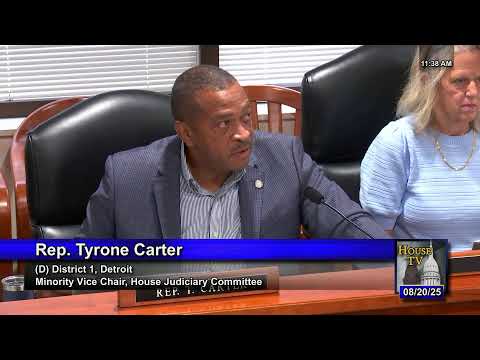
Committee members questioned scope and enforceability. Rep. DeBoer and others argued that free-speech protections weigh heavily in public-space cases and warned of a chilling effect if organizers or participants fear criminal prosecution. Rep. Carter asked staff for historical counts of highway-blocking incidents; the sponsor cited several recent events in Ann Arbor and Detroit-area incidents and said organizers have staged large, planned blockades of interstates.
The committee adopted an H-1 substitute for H 4664 by roll call (substitute adoption recorded as 7 ayes, 4 nays, 0 pass) to refine the language used to define assembly and applicability. That substitute was adopted during the hearing; the transcript does not show a subsequent final roll-call vote on the underlying bill in the provided segment.
Supporters said the bill would create a clearer criminal standard to deter dangerous blockades and give law enforcement a stronger tool. Opponents said enforcement discretion already exists under current civil and criminal statutes and urged restraint to avoid curbing protected protest activity.