Get Full Government Meeting Transcripts, Videos, & Alerts Forever!
Get email alerts on the State Legislation topic
No spam. Unsubscribe anytime.
Missouri City council receives 2025 Texas legislative update; enters closed session on special session topics
Summary
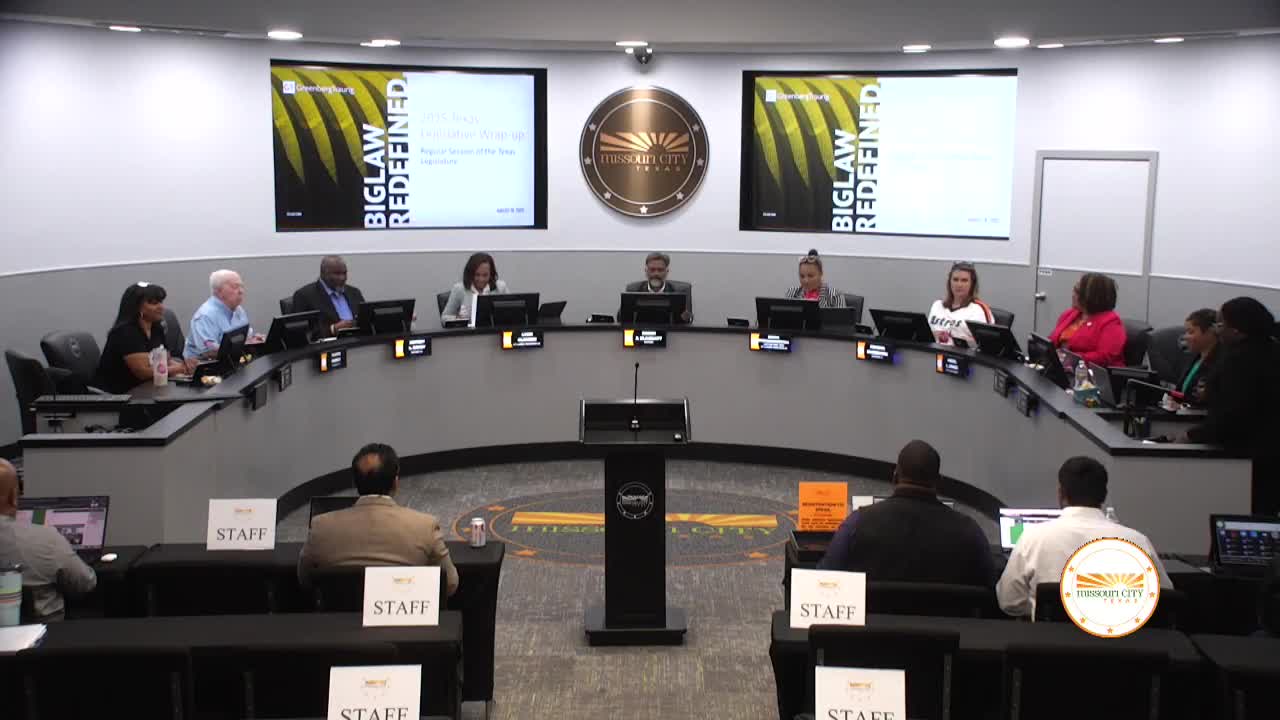
Missouri City’s council on Aug. 18 received a presentation on legislation from the 2025 Texas regular session and an ongoing special session that affect several city priorities, then voted 7‑0 to enter a closed executive session to discuss items on the special session agenda.
Missouri City’s council on Aug. 18 received a presentation on legislation from the 2025 Texas regular session and an ongoing special session that affect several city priorities, then voted 7‑0 to enter a closed executive session to discuss items on the special session agenda.
The update, delivered by City Attorney E. Joyce with legislative consultant Karen Kennard of Greenberg Traurig in attendance, summarized bills tied to priorities the council adopted in January and highlighted near‑term changes residents are likely to notice. Joyce said the regular session produced roughly 1,200 enacted bills and that staff is reviewing more than 250 measures that could affect municipal operations.
Joyce said, "House Bill 21 requires traveling housing finance corporations to obtain the consent of a city before opening in those cities or in a city," and noted the change is prospective only. She added the city has previously faced attempts by out‑of‑area housing finance corporations to locate projects in Missouri City’s extraterritorial jurisdiction.
The presentation flagged other enacted measures the city prioritized or monitored: House Bill 148, which requires appraisal‑board members to obtain additional education hours; Senate Bill 763, which requires the Texas Commission on Environmental Quality to review concrete‑plant permits at least once every eight years; and House Bill 1522, which moves the public‑notice posting requirement for city council meetings from 72 hours to three business days (effective after Sept. 1). Joyce told council members staff will identify which bills require ordinance changes, process changes or other implementation steps.
Karen Kennard, the city’s legislative consultant, summarized bills the council had tracked but which did not advance this session. "Those bills did not get any traction this year," she said of several proposals addressing group‑home regulation. Kennard and Joyce also described ongoing special session topics that could affect the city, including flood response measures, congressional redistricting and several revenue‑cap and property‑tax items being debated in Austin. Joyce and the consultant said the city has been primarily on the defensive against proposals that would further limit local revenue, including bills that would reduce the current 3.5% no‑new‑revenue threshold and proposals to add a broad revenue cap that could affect bonds and enterprise fund revenue.
Council members asked for details about specific bills and next steps. Joyce said some bills have effective dates as soon as Sept. 1 and others will be implemented over the coming months; she told council staff will work with departments to develop implementation plans and present ordinance or process changes as needed through the end of the calendar year.
Council Member Boney moved, and Council Member Clauser seconded, a motion to convene a closed executive session to discuss matters in the special session; a roll call recorded Mayor Alikat and six council members voting yes and Joyce announced, "The motion carries 7 to 0."
Joyce said the presentation materials can be posted to the city’s website with the consultant’s permission and that legal and operational items identified for departments will be routed to the appropriate staff for action and reporting back to council.
Effective dates and implementation timing for individual bills will vary; council members were told staff will return with specific recommendations where ordinance changes or other formal council action is required.