Get Full Government Meeting Transcripts, Videos, & Alerts Forever!
Get email alerts on the Ethics Enforcement Regulations topic
No spam. Unsubscribe anytime.
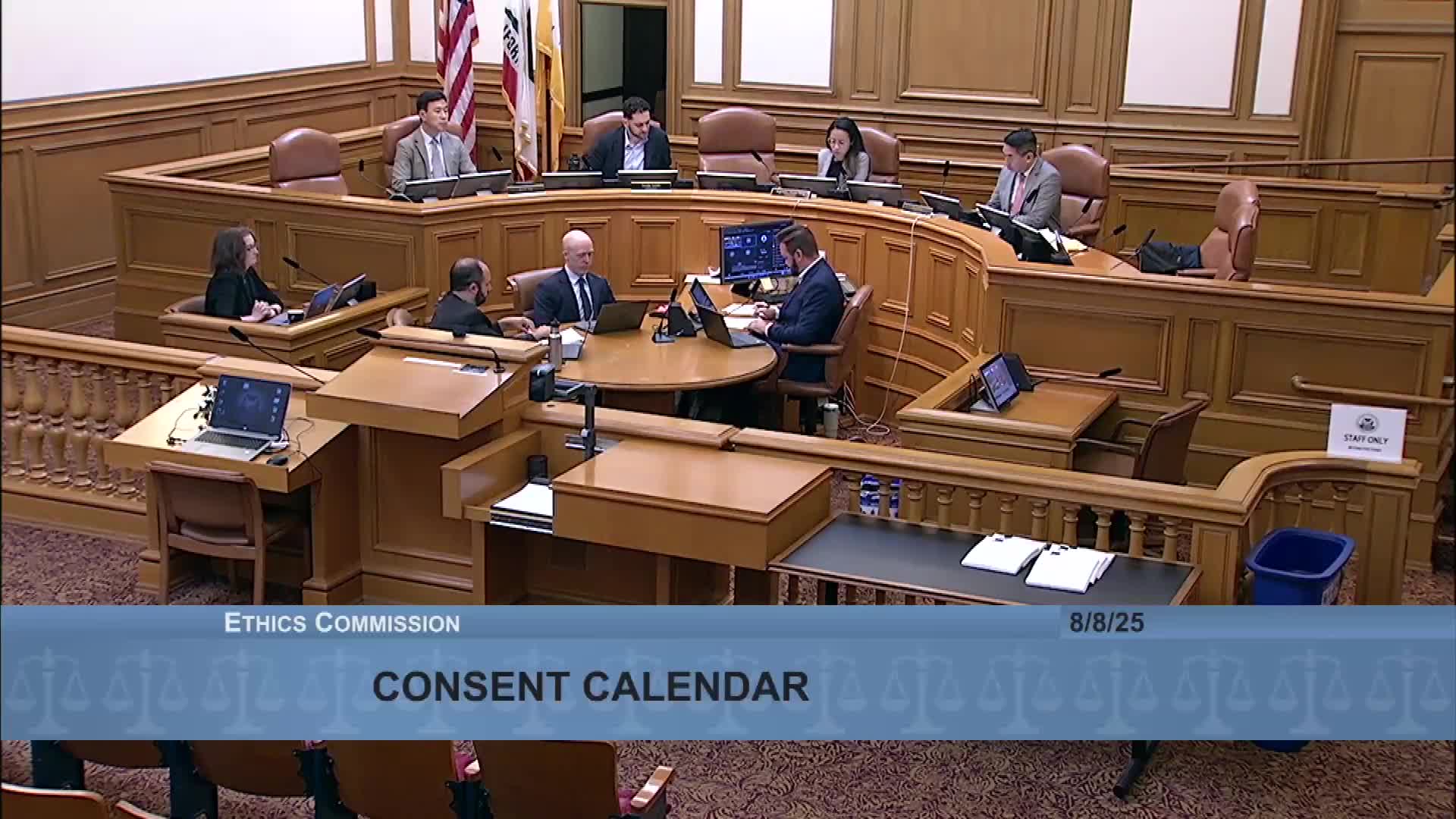
Ethics Commission defers vote on large set of proposed enforcement-regulation changes after extended discussion
Summary
The San Francisco Ethics Commission on Thursday discussed proposed amendments to its enforcement regulations, including deadline extensions, a clarified "good cause" definition, authority to reopen closed cases, and a new rule allowing the commission to charge for willful withholding of information.
The San Francisco Ethics Commission on Thursday discussed proposed amendments to its enforcement regulations, including deadline extensions, a clarified "good cause" definition, authority to reopen closed cases, and a new rule allowing the commission to charge for willful withholding of information. After extended discussion and public comment, the commission voted 4-0 to defer action to a future meeting to allow staff to refine language and hold additional stakeholder engagement.
The enforcement director, BC Matthews, presented the package and said the changes aim to resolve ambiguities in rules adopted in 1997 and last updated in 2018, to reflect current Enforcement Division practice, and to strengthen due process and efficiency. Matthews listed specific proposals: provide deadline extensions that fall on weekends and holidays; relocate and broaden a "good cause" definition under definitions; rename and reorganize withdrawal procedures; change reporting from monthly to quarterly; permit the commission to reopen cases after discovery of new material facts; add explicit authority to bring charges for withholding under specified Municipal Code sections; clarify which investigative records remain confidential until introduced at an administrative hearing; clarify delivery/place-of-service rules; adopt gender-neutral phrasing; and reorganize procedural sections covering prehearing and hearing stages.
Commission discussion focused longest on delegation of probable-cause (PC) determinations and the review pathway for cases staff closes without reaching PC. Director Matthews said the proposal would allow the executive director to make findings of probable cause or no probable cause (rather than only recommendations), and would permit delegation of the preparation of probable-cause reports to the Director of Enforcement. Executive Director Pat Ford and several commissioners discussed whether the commission should retain a clear mechanism to review "no probable cause" findings that currently become final at staff level. Commissioners expressed concern that a staff-level no-PC finding could foreclose future public review; staff noted closed-case reporting and the quarterly closed-case report would list such closures and could form the basis for commissioners to request further review. Commissioners asked staff to draft a clear, practicable review procedure (including whether one or more commissioners should trigger review, and how confidentiality and Brown Act/closed-session rules would be handled).
Members also debated a proposed new rule to authorize charges for "withholding" information (citing campaign and government code sections mirrored in the municipal code). Commissioners and staff agreed the regulation must reflect whether the code provision requires proof of intent (purposeful concealment) and whether submitting objections or motions to quash in response to a subpoena would constitute noncompliance. Staff agreed to consider language that excludes good-faith objections while allowing action when objections are frivolous or in bad faith.
Other notable proposed changes discussed: raising page limits for briefs (staff proposed increasing limits to accommodate complex cases and allowing stipulations for more pages), clarifying discovery and subpoena procedures and adding an explicit "frivolous objection" carve-out, renaming and reorganizing sections for clarity, and limiting separate whistleblower reports by folding them into a quarterly enforcement report. Staff also proposed expanding the circumstances for reopening cases and aligning confidentiality rules with practice (investigative records remain confidential until introduced at administrative hearing).
Public commenters asked the commission to hold at least one additional interested-persons meeting before finalizing changes. Representatives included Vince Carson of the California Political Attorneys Association, who requested another IP meeting and earlier written input be incorporated; a caller identified as David Pilfel raised concerns about Sunshine Ordinance and notification practices and asked for clearer communications about case status and closure; and other callers urged careful review. The commission acknowledged those requests and the need for additional stakeholder engagement.
After the presentation and discussion, Commissioner Yeh moved to defer a vote until staff returns with revised language and additional stakeholder engagement; the motion passed 4-0 on a roll call (Yeh, Sy, Salahi, Chair Flores Fing voting aye). Matthews and Ford indicated staff will consult further with the city attorney and return revised draft language that addresses the commission’s questions about review of no-PC findings, clarity on subpoena objections, and other suggested edits.
The commission’s action was procedural (deferral). Commissioners and staff emphasized that no substantive enforcement-policy changes took effect at the meeting and that current regulations and investigative confidentiality practices remain in place until any final ordinance or regulation is adopted.