Get Full Government Meeting Transcripts, Videos, & Alerts Forever!
Get email alerts on the Wetlands Development topic
No spam. Unsubscribe anytime.
Torrington wetlands hearing continued after debate over industrial expansion and mitigation
Summary
The Torrington Inland Wetlands Commission on Aug. 5 continued a public hearing on Alan Borghese’s application to expand an industrial building and add a parking lot at 3651 Touringford Street after debate over the condition of mapped wetlands and what mitigation would be effective and feasible.
The City of Torrington Inland Wetlands Commission on Aug. 5 continued a public hearing on an application by Alan Borghese to expand an industrial building and construct a parking lot at 3651 Touringford Street, citing the need for a revised plan showing planting and low-impact design details.
The application covers a roughly 4-acre parcel zoned for industrial use adjacent to an existing 93,000-square-foot building owned in part by Borghese. Borghese told the commission his tenant has about 130 employees and that the lot could allow an addition only if compensatory mitigation around wetlands could be accommodated; he said if the required mitigation reduced the developable area too much he might not proceed with purchasing the property.
Why it matters: Commissioners and staff said the proposal raises the usual tradeoffs for inland-wetlands review — protecting wetland functions while allowing industrial development that could preserve local jobs. The hearing drew technical testimony about soils and hydrology and at least one resident raised groundwater concerns.
Tom Stansfield, a professional soil scientist with Stansfield Environmental Science Services LLC, summarized the site assessment for the commission. Stansfield said soils on the parcel meet Connecticut’s definition of poorly drained soils and that long-term agricultural use — including compaction by animals and placed fill — has degraded the soils’ ability to perform wetland functions. “They are considered wetland soils because they are poorly drained,” Stansfield said, adding many areas are so impacted he described them as “man-made wetland soils.”
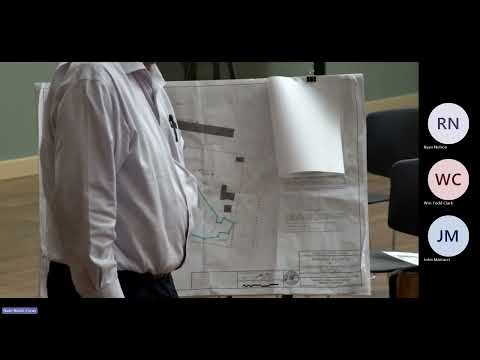
Stansfield and the applicant discussed where mitigation might be located. Borghese showed two conceptual layouts: one intended to attach to the adjacent building if that tenant expands, and an alternate stand-alone building to show what would be feasible if his tenant did not expand. Borghese told the commission he spent about $400,000 to pursue the purchase and an additional $25,000–$30,000 on engineering; after accounting for required mitigation he calculated the largest feasible new building would be about 20,000 square feet and said, “If I have to have this mitigation, I will not proceed with this purchase.”
Commissioners and staff pressed details about the proposed stormwater design. The plan presented shows a wet-bottom water-quality basin for runoff from new pavement; commissioners asked whether roof drains would route to that basin and the applicant’s consultants explained the basin will capture pavement runoff while most roofing runoff will bypass the basin to match existing drainage patterns.
A local resident, Laura Sanderson, asked about groundwater impacts and whether filling the mapped wetland would alter local groundwater levels. Stansfield said, based on his observations, the wetland is a seasonally perched system and not directly tied to deep bedrock wells; he said the site’s hydrology would not likely directly affect a typical domestic well. He added he had not done formal hydrologic modeling and that more testing could be requested.
Commission discussion focused on whether a modest mitigation approach — for example, planting fringe wetland species in a southeast corner of the parcel and integrating low-impact development elements into landscape islands — could offset wetland loss without requiring excavation and large-scale mitigation that Borghese said would render the purchase uneconomical. Stansfield said creating a small, meaningful pocket of wetland vegetation in the heavily compacted area would be difficult without substantial grading and additional water inputs, and that the proposed detention basin may offer a more reliable place to encourage wetland species.
Nate Nardi, the city’s inland-wetlands enforcement officer and assistant city planner, told the commission he and the applicant could develop a species list and planting scheme for the next submission.
Action: The commission voted to continue the public hearing to the next regularly scheduled meeting to allow the applicant to submit a revised plan with planting/species details and notes on low-impact development measures. The hearing remains open and no final permit decision was made.
Looking ahead: Commission members and staff said any wetlands approval should be coordinated with future planning-and-zoning review; commissioners emphasized that a wetlands conceptual approval should not authorize grading or site work until planning-and-zoning approvals and detailed construction permits are issued.