Get Full Government Meeting Transcripts, Videos, & Alerts Forever!
Get email alerts on the No Knock Warrants topic
No spam. Unsubscribe anytime.
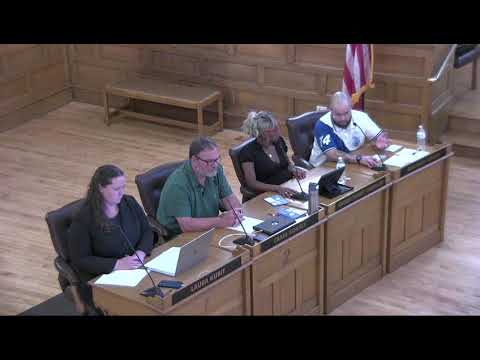
Bay City commission refers no-knock-warrants resolution back to sponsor after hours of debate
Summary
After more than two hours of public comment and testimony from Bay City law enforcement, the Bay City City Commission voted to refer Commissioner Jessica Tenney’s resolution banning no‑knock search warrants back to the sponsor for revisions and staff review.
Commissioner Jessica Tenney’s proposed resolution to prohibit “no‑knock” search warrants in Bay City was the subject of extended public comment, testimony from multiple law enforcement representatives and commissioners, and a final vote to refer the measure back to the sponsor for further work.
The resolution, introduced at the Aug. 4 commission meeting, would require officers to follow knock‑and‑announce procedures and to wait a reasonable time for occupants to answer before entering, except in circumstances allowed by law. “This resolution is intended to protect our law enforcement and the people we serve,” Commissioner Jessica Tenney said during discussion.
The debate drew speakers on both sides. Detective Sergeant Ben Krizminski of the Bay City Department of Public Safety told the commission the Louisville case of Breonna Taylor involved broader failures beyond the use of a no‑knock clause and cautioned the body against a rushed policy change. “The Breonna Taylor tragedy wasn’t a result of a no knock search warrant,” Krizminski said, adding investigators later found problems with the underlying affidavit and corroboration of evidence. Officer Ruston LaRose, president of the Bay City Police Officers Association, said no‑knock entries are rare locally but can be necessary for officer safety in high‑risk cases: “No knock search warrants are not a common practice for us, but they do play an important role in officer safety during high risk search warrants.”
Several residents and advocacy speakers urged the ban. Paul Kalidow, a Bay City resident, framed the proposal as a protection for officers and civilians: “The goal of blocking those warrants is not just the defense of the potential criminal going into those wards. It’s to protect the officers themselves.” Denise Davidson, another resident, called the resolution government overreach and urged caution: “I believe it is micromanaging the city and the Department of Public Safety, and it is government overreach.”
Safety Director Raul explained operational practice and constraints to the commission, saying Bay City has requested state emergency services for high‑risk warrants and that the city’s department has participated in few no‑knock warrants in recent years. “In looking through the past few years, I found 4 that we’ve done since 2021,” he told the commission, and he added the city has not run any since 2023. Raul flagged a practical concern: if Bay City prohibits use of the no‑knock option, outside tactical teams may decline to assist in certain high‑risk cases, leaving local officers without the specialized equipment or armored support needed for those incidents.
Commissioners raised legal and operational questions in the public discussion. Commissioners and the city manager noted the city charter and existing labor contracts limit the commission’s authority over personnel discipline and that some language in the draft resolution (for example, a requirement that officers physically knock before entry) could conflict with operational practice or the ability to request state tactical assistance. The city’s body‑worn camera retention policy was also discussed; the safety director said felony footage is retained at least seven years and misdemeanors at least five, which in some cases would exceed the five‑year retention period in the draft resolution.
Commissioner Runberg proposed tabling the measure to allow staff, the sponsor and stakeholders to craft revised language; Commissioner Runberg moved that the item be set aside until the next meeting to permit further conversations and edits. That motion (seconded by Commissioner DeWitt) was modified on the floor and the commission ultimately voted to refer the resolution back to the sponsor for revisions and staff review. The referral carried in a roll‑call vote (Yes: DeWitt, Rhumburg, Charlevoix, Cubitt, Mayor; No: Tenney, Morris, Coakley). No formal ban was adopted at the meeting.
What happens next: the resolution will return to Commissioner Tenney for revision and staff will be asked to coordinate with the Department of Public Safety and other stakeholders on language that addresses concerns raised about legal authority, officer safety, body‑camera handling and exigent‑circumstance exceptions. The commission did not set a new hearing date at the meeting.