Get Full Government Meeting Transcripts, Videos, & Alerts Forever!
Get email alerts on the Student Cell Phone Policy topic
No spam. Unsubscribe anytime.
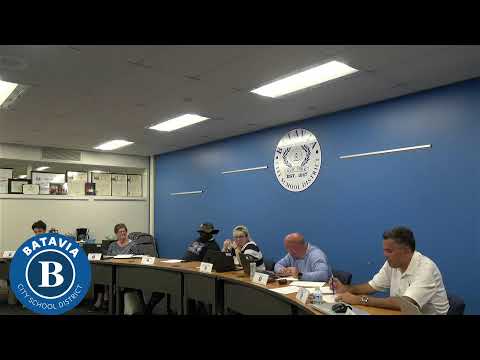
Batavia board adopts New York State-required ban on Internet-enabled devices for grades 7–12
Summary
The Batavia City School District board voted to adopt a New York State–mandated policy restricting student use of Internet-enabled devices during the school day for grades 7–12, setting implementation steps, limited exceptions for medical and IEP needs, and timelines tied to $10,000 state funding.
The Batavia City School District Board of Education voted to adopt a New York State–required policy restricting the use of Internet-enabled devices during the school day for students in grades 7–12.
Superintendent Smith told the board the district surveyed families, staff and students at the middle and high schools and received about 208–209 responses; he said the board must post a policy and adopt it by Aug. 1 to receive a $10,000 state reimbursement and that the policy will be posted on the district website. "The law does not allow for that," he said when describing limits on some concerns; he also noted that "the law does allow for the second bullet exceptions for medical needs" and other IEP- or 504-related accommodations.
Board members debated implementation details for roughly an hour, focusing on daily collection and storage logistics, supervision and enforcement. Superintendent Smith described the district's current plan: each student in grades 7–12 would place a phone in a pouch; the pouch would go into a labeled folder, and the folders would be stored in locked cabinets or a locked room. The district has authorized spending on storage containers and expects the $10,000 state allowance to cover supplies. Smith said larger cabinets considered can hold about 70–72 pouches per unit and that an estimate of "about a thousand" pouches was discussed to cover needs across buildings. He added that principals and staff are still refining the morning drop-off and retrieval details.
The board discussed exceptions and enforcement. Smith said medical exceptions and accommodations documented in IEPs or 504 plans would be allowed and handled through individual plans (for example, diabetes management or communication aids). He said that initial violations would be managed through staff direction to put the phone away and that repeated refusals could be addressed through the district code of conduct as insubordination, with progressive disciplinary steps rather than immediate punishments tied solely to possession of a device.
Several board members raised logistical concerns: how pouches and folders would be matched to individual students, who would supervise collection and retrieval, how the system would work for students entering through different entrances or leaving from buses, and whether file-cabinet storage would create bottlenecks at bell times. Staff replied that principals are working on site-specific procedures and that some buildings may require multiple storage stations to accommodate different entrances. Smith acknowledged it is an iterative process: "This is just sort of trial and error right now," he said, adding the policy's broad requirements leave implementation details to local discretion.
The board approved the policy on a voice vote. The motion to adopt the "use of Internet-enabled devices during the school day" policy was made by Mister Roll and seconded by Missus Lundbay; the board chair called for a voice vote and members responded "Aye."
Votes at a glance - Adopt policy on use of Internet-enabled devices during the school day (grades 7–12). Motion: adopt policy; Mover: Mister Roll; Second: Missus Lundbay; Outcome: approved (voice vote: "Aye"). - Consent items F–L (grouped). Motion by Miss Lundbeck; second by Mister Roe; Outcome: approved (voice vote: "Aye"). - License and maintenance agreement between Ed Data and DCSD. Motion by Missus Benedict; second by Mister Roe; Outcome: approved (voice vote: "Aye"). - Maximum temperature policy for buildings/indoor facilities (procedures to move students to cooler spaces when classrooms reach set thresholds). Motion by Mister Rule; second by Missus Benedict; Outcome: approved (voice vote: "Aye"). - Resolution to create a civil service position, school district data specialist/registrar. Motion by Miss Bennett; second by Mister Roe; Outcome: approved (voice vote: "Aye"). - Approve job description for school district data specialist/registrar. Motion: not specified in transcript; Second: not specified; Outcome: approved (voice vote: "Aye").
Why this matters The board action implements a statewide requirement that limits students' access to Internet-enabled devices during instructional time and ties district compliance to a modest state reimbursement. The change affects students, families and school staff day-to-day routines and requires operational procedures (collection, secure storage, emergency access, and consistent enforcement) that building principals must finalize before school starts.
Discussion details and implementation steps Superintendent Smith said the district will publish an FAQ on the district website and use ParentSquare (the district messaging application) to notify families and explain procedures such as how to contact a student during the day and how medical exceptions will be handled. He said staff and principals are evaluating where to place storage units, how many cabinets are needed at each entrance, and which staff will supervise the process each morning. Smith noted the district will track expenses related to supplies and that principals will receive guidance but will adapt site-specific logistics.
Exceptions and enforcement Smith described narrow exceptions for medical and legally required accommodations documented in IEPs or 504 plans. He said the law does not permit suspending a student simply for possessing a phone; instead, failure to comply with staff directions to store the device may be handled under the district code of conduct as repeated insubordination. The board asked staff to make communications clear to families and to return with operational updates.
Community reaction and next steps Smith warned the board to expect "backlash" from some parents and said the district will try to educate and work with families. He said the district will post the policy on its website to meet the state deadline and to qualify for the $10,000 supply grant; principals will be points of contact for families before school starts. The board requested periodic updates from administration as the district finalizes site-level procedures.
Ending Superintendent Smith and building principals will continue to refine sitespecific plans for collection and retrieval, publish FAQs and communications via ParentSquare and the district website, and report back to the board on implementation prior to the start of classes.