Get Full Government Meeting Transcripts, Videos, & Alerts Forever!
Get email alerts on the Green Bank Mfc Housing Study topic
No spam. Unsubscribe anytime.
LAFCO hears update on San Francisco Green Bank planning and municipal housing study; staff asked to return with financing options
Summary
The commission received an update on reinvestment working group plans for a Municipal Financial Corporation (Green Bank), precursor funding needs, expected capitalization scenarios and a municipal housing study RFP. Commissioners requested a report outlining financing tools and next steps for Green Bank formation.
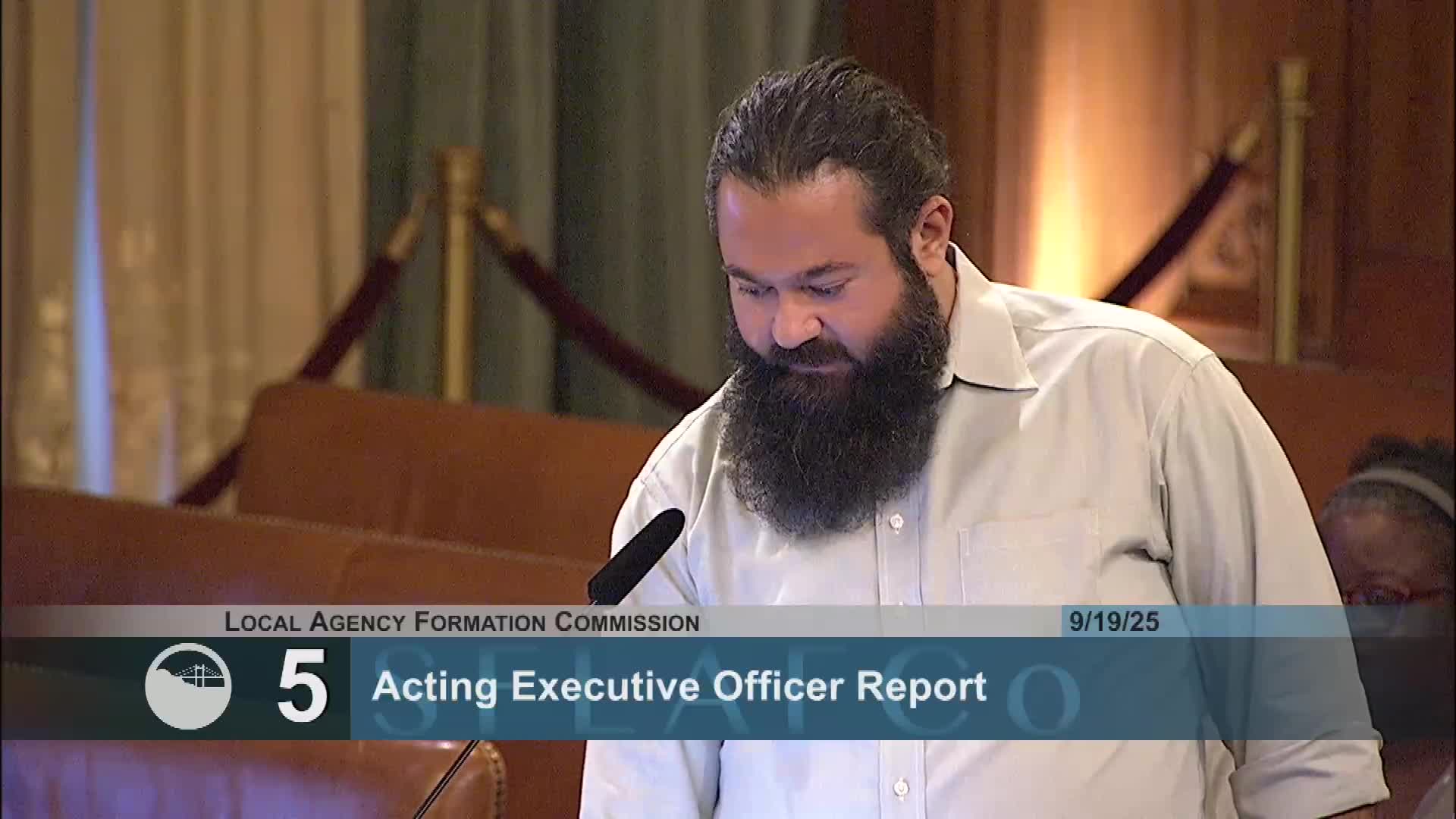
Acting Executive Officer Khalid Samrai told the Local Agency Formation Commission on Sept. 19 that LAFCO is supporting city efforts to form a Municipal Financial Corporation (MFC) that could serve as a San Francisco Green Bank and public bank.
Samrai summarized the reinvestment working group’s estimate of pre-opening funding needs, operational capitalization, and early lending outputs. He said pre-opening funding — to hire a professional banker or “green bank coordinator,” finalize articles of incorporation and related documents, and present a completed entity for board approval — is estimated at between $1,300,000 and $2,600,000.
If the entity is approved and registered, Samrai said the MFC would require year‑one capitalization of roughly $26,000,000, which the working group projected could support $19–20 million in loans in year one. By year three, the plan cited approximately $90,000,000 in capitalization with projected lending outputs of about $60,000,000 focused on three priority areas identified by the working group: green/electrification projects, affordable housing, and small business lending. Samrai said the MFC would likely partner with community development financial institutions (CDFIs) and credit unions to leverage existing local relationships.
Samrai noted the reinvestment working group’s analysis was advisory and that plans need updating in light of two years of changes since the working group issued its recommendations. He said next steps include refining incorporation documents, securing pre-opening funding, and coordinating with the treasurer’s office and city attorney.
Commissioner Chan urged the commission, through the chair, to request a formal memo or report that lays out financing tools and next steps, including options such as regional affordable-housing bonds or state-level infrastructure boards being discussed by the state treasurer. Chan suggested the city controller’s Office of Public Finance be consulted to identify alternative financing paths to reach the capitalization targets. Chair Jackie Fielder and Acting Executive Officer Samrai agreed to return with a report; Samrai said staff would provide a report at the commission’s next meeting.
Samrai also briefed the commission on the municipal housing agency study: LAFCO staff has authorized an RFP for a consultant to recommend a pilot municipal housing agency structure to manage cross-subsidized, city-owned mixed-income housing and expects to release an updated RFP in the fall.
No formal votes were taken on the Green Bank or the municipal housing study during the meeting. Commissioners asked for additional detail on funding sources, potential partnerships, and financing tools and requested a staff report that includes input from the controller’s office and other city financial staff.