Get Full Government Meeting Transcripts, Videos, & Alerts Forever!
Get email alerts on the Comprehensive Plan topic
No spam. Unsubscribe anytime.
Caroline County planning commission approves housing and economic development chapters; debates land‑use, water, workforce and solar issues
Summary
The commission approved the draft housing chapter and the economic development chapter for the county’s comprehensive plan and discussed land‑use issues including mineral resources, water and sewer constraints, Ridgely Tech Park, workforce training and solar policy ahead of a planned zoning update.
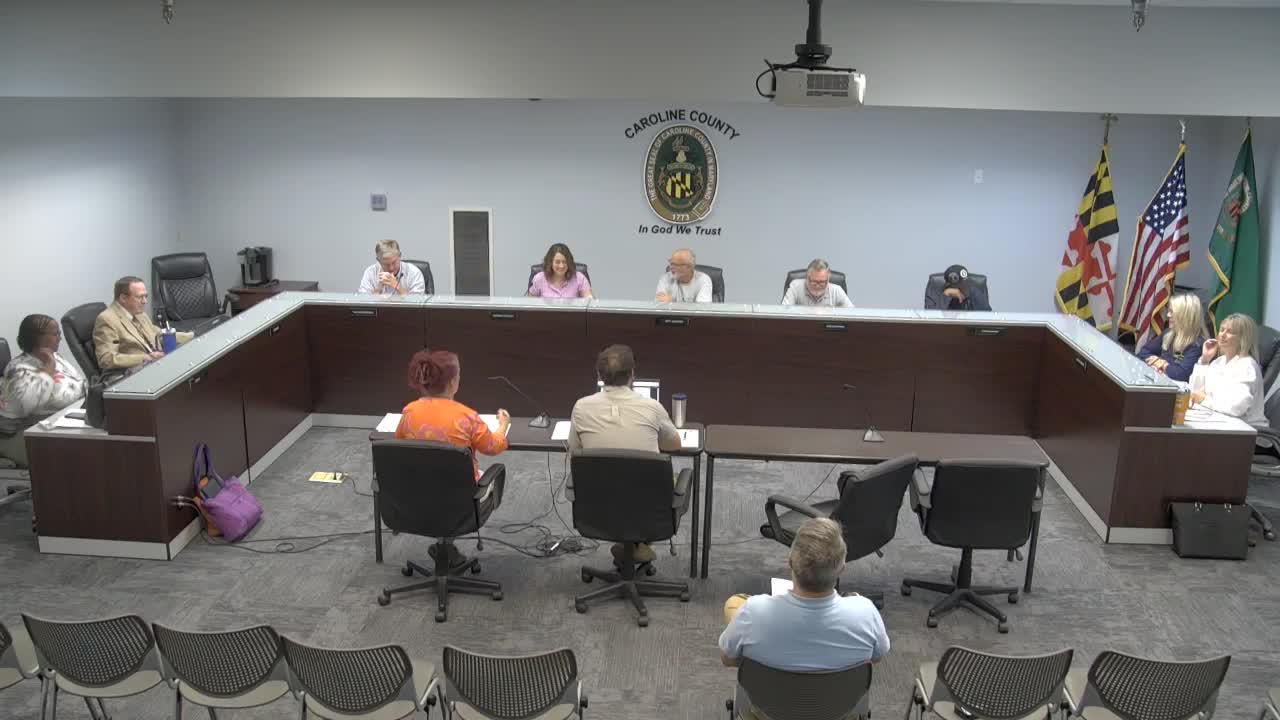
Caroline County Planning Commission members approved draft chapters for housing and economic development during their Sept. 20 meeting and held an extended, preliminary discussion of the draft land‑use chapter and related constraints.
Commissioners voted to approve the draft housing chapter, which staff described as a near‑final version. Planning staff said the only edits since the August planning commission workshop were to align objectives and implementation bullets. Staff also noted a minor typographical correction: the Maryland Rural Development Corporation (MRDC) name was reversed in the draft and will be fixed before public distribution.
The commission also approved the draft economic development chapter. The document lays out goals and implementation steps including promoting higher‑wage jobs, strengthening agritourism, coordinating infrastructure investments, expanding business incubation and a recommendation to partner with Caroline County Public Schools on apprenticeships and on‑the‑job training.
Bob (last name not specified in transcript), the county’s economic development director, briefed commissioners on several project updates. He said the county is "actively engaging folks who are already looking at us" and described recent activity on Ridgely Tech Park. He said a federal program that previously encumbered the site has sunseted and that a METCO grant will fund a marketability report and bring site selectors to the property for marketing. "This will get us national attention and possibly international attention too," he said.
Commissioners and staff discussed an ongoing shortage of developed industrial and commercial sites in the county, and recurring constraints: limited municipal water and sewer capacity in parts of the county; state permitting timelines and environmental reviews; and a regional housing shortage that affects employers’ ability to recruit workers. Bob and others urged closer partnerships with towns and municipalities and suggested coordinated investments — for example, county participation to expand a town’s sewer capacity in exchange for annexation or development bonuses.
The meeting included updates on local assets and projects: plans to revamp Choptank Marina, an update that one Denton industrial building that recently closed appears poised to be reoccupied, and continuing interest in Federalsburg industrial acreage. Commissioners also discussed Shoreline Vinyl’s recent closure in the Denton Industrial Park and county efforts to help affected employees via state resources and job fairs.
Workforce and training issues were a significant thread. Commissioners said Caroline County Public Schools’ workforce coordination and apprenticeship linkages should be emphasized in the plan. Commissioners noted Chesapeake College’s planned Queen Anne Tech facility and discussed transportation and access barriers for students in southern parts of the county.
Solar energy and battery storage were raised as an imminent policy item. Staff said the county is drafting a proposed solar ordinance and had adjusted a proposed mitigation payment from 50% to 100% of an applicable easement or land‑value metric. Commissioners discussed possible fees or contributions for battery energy storage that could fund fire‑equipment purchases or training for volunteer fire companies.
Olivia (planning staff) said the land‑use chapter is intended as a framework: "land use is like that — it’s your stomach muscles. If you're moving any part of your body, your stomach is involved," she said, explaining why land use underpins other chapters. Commissioners discussed tools for directing growth (zoning updates, transfer of development rights or density bonuses, and prioritizing municipal infill and PFAs) and raised options for mineral resources and surface mining, including whether the county can limit permits or require disclosure in land records for properties adjacent to permitted mines.
Both chapters approved by the commission will proceed to the next steps in the comprehensive‑plan update: staff said the housing chapter will be circulated for state review and public comment and that the full plan and zoning updates will follow in subsequent months. The economic development draft was approved with the record showing a motion and second; commissioners agreed to refine language and implementation bullets before that chapter advances.
Commissioners directed staff to continue outreach to towns and to return with refined language on workforce links, town‑county partnerships for water and sewer, Ridgely Tech Park marketing steps, and proposed solar‑mitigation mechanisms.