Get Full Government Meeting Transcripts, Videos, & Alerts Forever!
Get email alerts on the Ems Operations topic
No spam. Unsubscribe anytime.
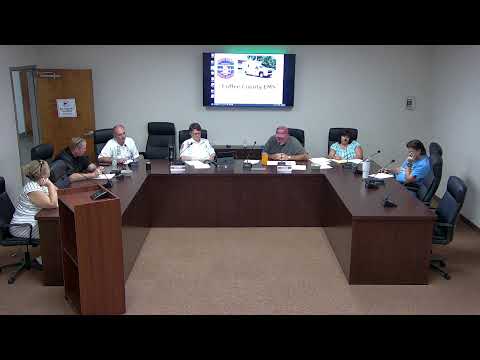
Coffee County EMS board reviews staffing gaps, lift-assist calls and North Station mold remediation
Summary
At its Aug. 21 meeting, the Coffee County Emergency Medical Services board heard a director’s report on staffing shortages and recent personnel injuries, discussed repeat ‘lift-assist’ calls at assisted-living sites and accepted mold remediation work at the North Station. The board approved routine agenda items and set a Sept. 18 meeting.
The Coffee County Emergency Medical Services board on Aug. 21 reviewed staffing shortages and recent injuries among emergency personnel, discussed an increase in “lift-assist” calls at assisted-living sites and received an update that Servpro completed mold mitigation at the North Station.
The issues surfaced during the director’s report and a facilities update at the board’s meeting in Coffee County. Board members asked staff to provide follow-up information next month on lift-assist reporting and on the written policy used to charge repeat callers.
The director (name not specified) told the board that overall call volume and calls-per-day averages remain close to historical levels but staffing is strained. The director said the service has two open advanced emergency medical technician (AMT) positions and four open medic positions, and that three AMT interviews were scheduled for the following Tuesday. The director reported current absences: one employee on workers’ compensation with a hand injury, two out on medical leave, one on maternity leave due to return Monday, and one who recently underwent cardiac bypass procedures and had stents placed.
"If I can get my injured reserve people back, it will look better again," the director said, describing the staffing picture as improving compared with last year but still vulnerable to multiple simultaneous call-outs.
Board members pressed on a recurring operational issue: so-called lift-assist calls (non-emergency assists where crews help people who have fallen but do not require transport). Staff said the county likely does more lift assists than reported because the patient-care system sometimes labels those runs as “public assist,” making automated tallies incomplete. The director said they had asked the county communications center to send a monthly report specifically listing calls logged as lift assists.
A number was referenced in discussion: "67" (noted by a meeting speaker) as a figure tied to lift-assist reporting efforts, but no comprehensive, documented count was provided at the meeting.
Members also discussed repeat calls from some subsidized housing or assisted-living sites, specifically Kingwood Arms, where facility pull-switch alarms have generated multiple ambulance responses. The board recalled an earlier policy that began charging a modest fee after a repeat caller’s third response (figures discussed during the meeting included $25 and $50 as historical amounts). One board member said the existing policy did not have adequate enforcement and recommended strengthening it.
"We need to make that policy a little more stouter than it was and probably need to start enforcing it," a board member said, urging staff to circulate the old policy by email for review ahead of the September meeting.
Discussion also touched on how alarms are routed. Board members and staff noted some facility pull-switches go directly to the county communications center while others route first to an alarm company that will attempt to contact the resident or on-site staff before alerting emergency services. The board asked staff to confirm how Kingwood Arms and similar facilities are configured and to report back.
On facilities, Paul (staff member) reported that representatives from Servpro evaluated, mitigated and tested the air quality at the North Station after an employee complaint. Servpro removed sections of sheetrock around two ceiling air vents and a small area over a doorway, sealed affected areas with plastic and performed a post-mitigation air test. Staff said the remediation was complete and that final sheetrock repairs were pending: maintenance staff would determine whether the repair work would be done in-house or subcontracted.
"They did a quality air test afterwards," Paul said. "It's sealed up; I meant to get with Rick today and see if his crew is gonna make that final repair or whether they're gonna sub it out."
Board members said Servpro did not identify a single, ongoing leak source during the mitigation; roof issues on the older building were noted as a historical concern. Staff suggested the mold could have resulted from earlier water intrusion or from condensate in ductwork, and they said no active leaks were detected at the time of the inspection.
The meeting proceeded past routine business. The board approved the meeting agenda and the May meeting minutes. A motion to approve three months of write-offs was made and discussed; the record in the transcript is unclear about the formal outcome of that specific motion (the motion and a second were made on the floor, but the transcript does not capture an explicit roll-call or chair announcement of passage). The board also set the next meeting for Sept. 18 at 5:00 p.m. and then adjourned.
No statutes, ordinances or grant awards were cited at the meeting. Staff were directed to circulate the old repeat-caller policy by email, to obtain a monthly lift-assist report from the communications center, and to clarify alarm routing at Kingwood Arms and similar facilities for the next meeting.
The board’s discussion highlighted short-term operational steps (monthly reporting and policy review) rather than new funding or capital commitments. The North Station remediation was completed as an operational repair; longer-term building decisions were noted as potential future work but not acted on at this meeting.