Get Full Government Meeting Transcripts, Videos, & Alerts Forever!
Get email alerts on the Parks Safety Unhoused topic
No spam. Unsubscribe anytime.
Pawtucket committee reviews safety, enforcement and homelessness outreach at Slater, Sunset parks
Summary
At an Aug. 26 meeting, the Pawtucket Joint Recreation and Property Committee discussed speeding, vandalism, alcohol use and people living in Slater and Sunset parks; staff described recent traffic-calming measures, permit practices and homelessness outreach, and committee members asked for recurring enforcement and security reports.
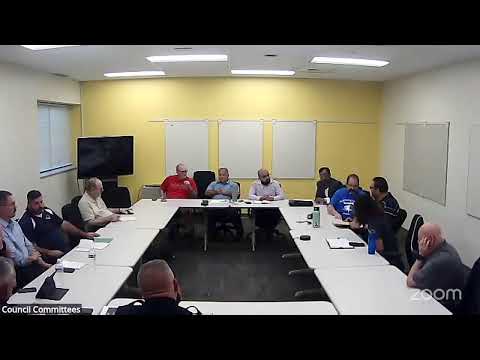
The Pawtucket Joint Recreation and Property Committee on Aug. 26 continued a discussion about safety and maintenance at Slater Park and Sunset Park, focusing on speeding, alcohol use, vandalism and people living in the parks, while city staff described recent physical changes and outreach efforts to the unhoused.
Committee members said the parks' location near residences and heavy pedestrian use makes the issues urgent for families and park users. The committee heard that staff and police have deployed physical measures and periodic patrols, and learned that the city's new unhoused-coordination efforts are working with dozens of people across the city.
City parks staff and the Pawtucket Police Department described traffic-calming and site-control work already completed or planned. Staff said the city installed two speed tables (one at the park office and another near the carousel), repainted and restriped crosswalks, replaced faded speed-limit signs, placed boulders to block parking on lawns near ball fields, and added small roadway “rumble” features to slow drivers. The city also intends to relocate one of its portable solar speed-sign trailers into the park and has used temporary trailer-mounted signs in multiple locations.
Police staff said patrol coverage has been intermittent because of staffing shortages. The department reported 156 security checks in the park system since May 1 and said patrols are scheduled to perform several predetermined checks per shift, but officers' overtime and manpower constraints limit continuous presence. Council members and residents urged that officers be placed in visible positions near main park entrances and the carousel to increase deterrence; one resident said, “People out on their walks are saying that they have to really watch where they are because they’re afraid that they’re going to get hit by a car,” and asked for more consistent stationing of officers.
Committee members discussed enforcement tools and limits. Participants noted that automated speed-camera programs in the city are deployed under state rules and that placing camera enforcement inside public parks likely would require legislative changes; staff said they had not identified a law allowing automated speed cameras in parks. Members floated lower-cost deterrents such as visibly parked retired patrol vehicles and rotating officer placements to maintain unpredictability.
Parks permitting and post-event cleanup were also raised. Staff said picnic-shelter permits currently cost $25; athletic fields carry a $200 security deposit; and the council earlier adopted an event-permit structure in which a $400 permit can return $350 if the site is cleaned. Committee members suggested raising picnic permit levels or adding refundable deposits for larger informal gatherings to reduce party-related litter and damage, but staff cautioned that any fee changes would have to balance affordability for families.
Bicycle patrols and temporary details were discussed as alternatives to more constant car-based patrols. Staff said Pawtucket no longer operates a sustained bike program because of equipment condition and training gaps, though some foot and ad hoc bike patrols remain during events. Committee members asked staff to explore grants or equipment purchases to restore a visible bike presence in parks.
Separately, Robert Rungay, the city’s grants administrator who also coordinates unhoused services for Pawtucket, briefed the committee on outreach. Rungay said the city meets every two weeks with community service providers to avoid duplicating effort and to coordinate outreach. “Right now, I can tell you that we’re working with 53 unhoused throughout the city,” Rungay said, and added that since January 18 the city has helped 21 people move into permanent housing. Rungay identified Crossroads and Better Lives of Rhode Island among partners and said encampment engagement includes offering garbage bags, referrals and inclusion in the coordinated entry system.
Committee members asked for better data and recurring briefings to track trends. Members agreed it would be useful for parks staff and police to forward periodic security and speeding reports to committee chairs and to place summary reports on future agendas; staff said the committee would need to formally request those reports at a meeting to direct city departments to submit them. The group suggested a quarterly reporting cadence tied to calendar quarters and proposed a follow-up agenda item or a standing quarterly update for the commission.
No new ordinance or formal funding decision was adopted at the meeting; apart from a procedural motion that passed to take up the agenda item, the session focused on reporting, coordination and next steps. The committee set a follow-up window and discussed placing the topic on its next substantive agenda; the committee’s next regular meeting was scheduled for Sept. 8.
A number of residents, councilors and staff emphasized that consistent, visible enforcement combined with physical site improvements and coordinated social-service outreach are all needed to reduce speeding, illegal camping and litter while preserving public access for families and recreational users.