Get Full Government Meeting Transcripts, Videos, & Alerts Forever!
Get email alerts on the Housing Development topic
No spam. Unsubscribe anytime.
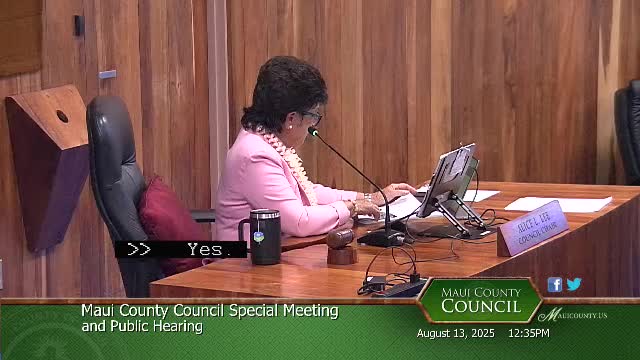
Maui County Council approves Wailea 670 zoning amendments; attempt to restore 450 affordable units fails
Summary
On Aug. 13, 2025, the Maui County Council voted 5-4 to pass two bills amending zoning and project-district rules for the Kihei Makena/Wailea 670 project. A separate amendment to reinstate 450 on-site affordable units failed 4-5 after extended public testimony and council debate over deed restrictions, DOT road commitments and evacuation risks.
The Maui County Council on Aug. 13 passed two ordinances on second and final reading that revise zoning and project-district rules for the Kihei Makena/Wailea 670 development, after rejecting a council amendment that would have reinstated 450 affordable units on the project site.
The council voted 5-4 to adopt Bill 171 CD1 FD1 20 24 and Bill 172 CD1 FD1 20 24, which were described by staff as updates to chapter 19.9A of the Maui County Code and to prior ordinances (Ordinance 3,554 as amended by Ordinance 4,849) governing conditional zoning for the approximately 670-acre site. Council member Keani Rollins Fernandez proposed an amendment to “reinstate the last line in section 2, subsection b: 450 affordable units shall be within the project district,” which failed 4-5 in a roll-call vote.
Why it matters: The measures finalize changes to the Wailea 670 conditional-zoning framework, lock in a project schedule and conditions tied to roadway improvements, and set deed-restriction terms for workforce and ownership units. Supporters said the package secures infrastructure and guaranteed affordable units; opponents said the reduced on-site affordable count and reliance on developer commitments leave Maui residents without required housing and stretch local evacuation and water resources.
What the council debated
Council member Keani Rollins Fernandez, who introduced the amendment, framed her motion as a response to repeated public testimony asking that more workforce units remain on-site. “It started off as 700 units for the community,” Rollins Fernandez said, and “450 is more than 288” — the smaller on-site number the council had been working with. She said the higher count was necessary to give residents a realistic opportunity to remain on-island and to protect water resources.
Council members who opposed the amendment cautioned that requiring 450 units on-site could delay or derail the project and the developer’s commitments. Council member Tom Cook said he would not support the amendment “not because I don’t support affordable housing,” but because the project contains firm timing and infrastructure conditions—including a requirement that market units not be sold until the affordable housing reaches certificate of occupancy—that he argued protect the affordable-housing delivery and related road improvements.
Developer and state commitments
Chip Chase, representing the applicant (identified in the record as Honua Ola Partners LLC / YLA 670), told the council he and state Department of Transportation officials had negotiated a partnership on the Pā‘ia–Lāna‘i (Pāʻilani/Kealana?) highway widening and that “there’s no possibility that the project moves forward beyond the affordables without doing the road. That’s a clear condition.” Chase said the only remaining negotiation point with DOT concerned a clause addressing what happens if DOT cannot timely complete the road and the developer must take it over.
Chase also told the council the project schedule anticipates completion of the affordable-housing buildings by late 2030 (Q4 2030) and that market units may not be sold until the affordable units receive certificates of occupancy. On subsidies, he said the developer is not seeking council subsidies; he estimated a subsidy to make extra on-site units feasible would exceed $1.5 million per unit and “in excess of $200,000,000” overall, and said such an amount was not available in county budgets as proposed.
Deed restrictions and timing
Council members pressed for clarity about the duration and trigger for deed restrictions. Council member Tamara Poulton and others asked whether the 10-year deed restriction for ownership units begins at sale or at occupancy. Deputy Corporation Counsel Michael Hopper and the county’s legislative attorney said the county code and prior practice treat the deed-restriction period as commencing “at the time of the initial sale.” Hopper and Corporation Counsel also said the ordinance conditions and any workforce-housing agreement would be the practical place to pin down the start date and required enforcement.
Legal background and resource commitments
The developer and staff told the council there remain several contractual and litigation items tied to the project. Chip Chase said that after additional surveys and agency review, the project no longer requires an incidental-take permit and that earlier Habitat Conservation Plan (HCP) commitments became contractual obligations with the Sierra Club. He said the HCP-related commitments had been maintained by contract even after federal HCP obligations were deemed unnecessary; the developer has a contractual commitment to conservation measures that Chase said reflect earlier HCP provisions, though he said the exact dollar figure cited in public correspondence might be imprecise.
County staff and corporate counsel also reported a recent court decision dismissing an appeal filed by Maui Tomorrow challenging the Planning Commission process; the circuit court dismissed the appeal for several procedural reasons, and the intermediate court of appeals later affirmed a separate ruling allowing a counterclaim to proceed (the court found the counterclaim was not a SLAPP as argued by appellants).
Public safety and infrastructure concerns
Fire and evacuation concerns figured heavily in deliberations after public testimony. A resident (identified in the record as “Miss Hall”) and several council members raised concerns about evacuation capacity in South Maui following recent tsunami warnings and wildfire experiences. In response, the council convened the fire chief, who said the department had worked with the developer to require connections to Maui Meadows and other access routes, and that the county had contingency routing through Haleakala Ranch and other Mauka corridors when police and ranch owners can coordinate access. The fire chief told the council that early evacuation and public education are essential because some wildfire events provide little advance notice.
Votes at a glance
- Amendment (Rollins Fernandez): Reinstatement of “450 affordable units shall be within the project district” — Motion failed, 4 ayes, 5 noes (roll call recorded in meeting minutes). The motion was moved by Council member Keani Rollins Fernandez and seconded; a roll call was taken and the clerk announced the vote count as 4–5.
- Main motion: Pass Bill 171 CD1 FD1 20 24 and Bill 172 CD1 FD1 20 24 on second and final reading — Motion passed, 5 ayes, 4 noes (roll call recorded in meeting minutes). The motion to pass both bills on second and final reading was moved by Council member Pro Tempore Tasha Kama and seconded by Vice Chair Yukile Sugimura.
Next steps and implementation
The bills as adopted include conditions, unilateral agreement requirements and references to workforce-housing agreements that will govern deed restrictions and subdivision approval steps. County attorneys and the housing department will be asked to finalize any workforce-housing agreements and to confirm the specific timing language for deed restrictions and enforcement. The council also filed a county communication related to the amendments for the record.
Council members and members of the public who testified said they expect continued follow-up at the administrative level to clarify deed-restriction start dates, DOT timing and the mechanics of any potential subsidies or unilateral-agreement amendments. Several council members asked staff to continue confirming technical details with the Department of Transportation, the Department of Housing and the county’s fire and emergency agencies.
(Quotations in this article are taken from the Aug. 13, 2025 Maui County Council special meeting transcript and are attributed to speakers who spoke on the record.)