
Residents urge support for new arts space, YMCA facility and oppose College Lakes 7‑Eleven during public forum
Get AI-powered insights, summaries, and transcripts
Sign Up Free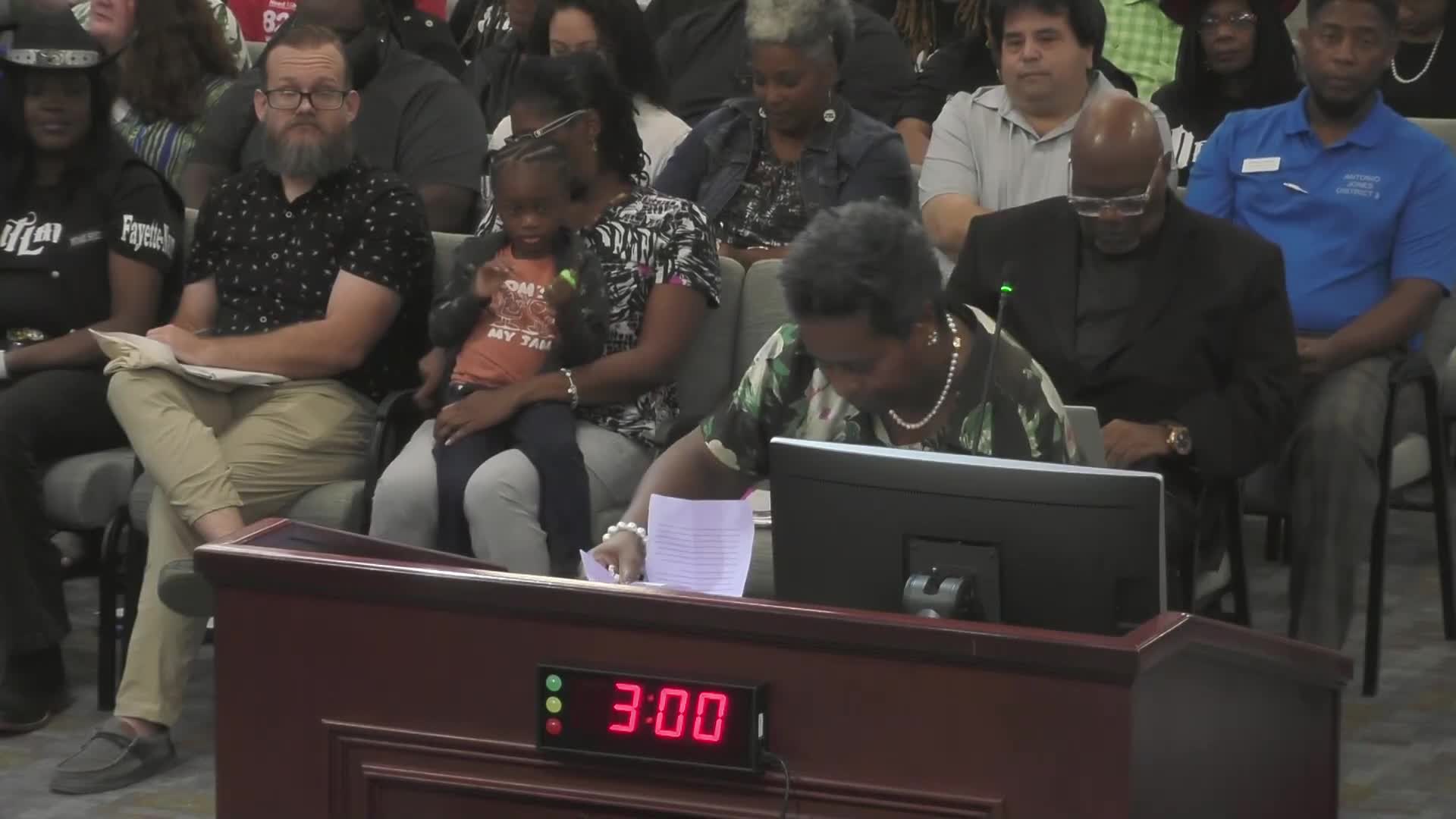
Summary
At the Aug. 11 Fayetteville City Council meeting, dozens of residents and nonprofit representatives used the meeting’s 30‑minute public forum to ask the council for funding, hearings and city help for local projects, including an arts center for BIPOC artists, a replacement YMCA facility and a public hearing on a proposed 7‑Eleven in the College Lakes neighborhood.
At the Aug. 11 Fayetteville City Council meeting, dozens of residents and nonprofit representatives used the meeting’s 30‑minute public forum to ask the council for funding, hearings and city help for local projects, including an arts center for BIPOC artists, a replacement YMCA facility and a public hearing on a proposed 7‑Eleven in the College Lakes neighborhood.
Carmela McKellar, president and CEO of Region 6 Project Inc., told the council the nonprofit’s newly renovated three‑floor arts center at 100 Hay Street has hosted more than 300 visitors since a soft opening in June and “in a city that is at least 60% BIPOC, there has never been a place dedicated to documenting, holding, representing, or celebrating BIPOC culture and art.” McKellar asked council members to “come see what we're doing, come alongside us” and consider support for the organization’s programming.
Several speakers urged the council to prioritize replacing or upgrading the local YMCA building. Dr. Dion Felice, a retired general surgeon and patient advocate, said the YMCA is “the largest nonprofit community service in America” and called a new facility a “catalyst” that would let the YMCA expand health and senior services. Justin Chase, speaking for the YMCA of the Sandhills, said the local building is leased from Fayetteville Technical Community College, is 55 years old and “failing,” with HVAC and structural problems that sometimes cancel classes. Reverend Bernard Hayes, a District 3 resident, said the YMCA’s community value includes youth swim instruction and intergenerational programming.
College Lakes residents asked the council to remove a rezoning request for a 7‑Eleven from the consent agenda and schedule a public hearing. Arlene Fields, a College Lakes resident of 26 years, asked the council to “remove this item from the consent agenda and to schedule a public hearing on the issue on Aug. 25,” saying many neighbors cannot take three hours to attend a meeting and deserve the opportunity to comment. Donna Johnson listed “health, negative health safety, and traffic concerns” and urged council members to “vote no on the rezoning of the 07/11 and give us our public hearing.” Mayor Pro Tem Jensen later moved to set the item for a public hearing and the council voted 9–1 to do so (see Actions).
Speakers also raised a range of other neighborhood concerns and requests: - Bernard McCoy described outreach around the federal Inflation Reduction Act’s HEAR program and said about $208 million is “sitting in Raleigh” for distribution; he urged the city to prepare contractors and training so the money benefits Cumberland County residents. - Keosha Brown, broker in charge at Town to Tenth Properties, urged incentives for developers to include affordable units, expanded down‑payment assistance and public‑private partnerships to make homeownership attainable after citing that median single‑family sale prices rose from about $155,000 (2021) to $239,000 (Aug. 2024). - Eugenie Balogun said she was a victim of financial fraud and requested the city and Fayetteville Police Department reopen a case she says was reclassified as civil; a police representative agreed to speak with her after the meeting. - Clifton Goodwin asked staff and the city attorney’s office to address an auto‑repair operation on a residential street. - Catherine Goldblatt, representing neighborhoods between Haymount and Terry Sanford, asked the council to add Fort Bragg Road intersections to the city’s small‑area study for pedestrian improvements and to install temporary high‑visibility signage.
Several people also described local nonprofit work funded by microgrants: Tasco Lizzie, secretary for the Outlaw Horse Club, reported an outreach day that drew about 320 attendees and thanked the council for a microgrant. Other attendees asked how city microgrants can support restorative justice and youth programming at recreation centers; city staff said microgrants and the Office of Community Safety will try to support those activities.
Council responses and next steps: Council members acknowledged many of the requests, and staff offered follow‑ups. The council agreed to schedule the College Lakes rezoning for public hearing on Aug. 25 (vote 9–1). City staff said they would talk with the fraud victim and with residents who reported neighborhood code and traffic issues, and the Office of Community Safety discussed ongoing late‑night youth events and how the city will work with community leaders to make activations more locally accessible.
Why it matters: Speakers tied small, local requests — better arts space, a functioning YMCA, pedestrian safety, affordable housing tools — to broader concerns about equity, youth opportunity and neighborhood livability. The council’s scheduling of a public hearing and staff commitments to follow up create formal opportunities for those concerns to be addressed in upcoming meetings.
"In less than 2 months of our soft open on June 19... We have welcomed over 300 people into the space," Carmela McKellar said. "Because Region 6 exist, those words should never be spoken again."