Get Full Government Meeting Transcripts, Videos, & Alerts Forever!
Get email alerts on the School Budget topic
No spam. Unsubscribe anytime.
Shelton School District projects negative year-end fund balance, outlines levy options to rebuild reserves
Summary
District staff told the school board the Shelton School District expects to close the fiscal year with a roughly $2 million deficit driven by end-of-year accounts payable. Officials described steps to prioritize vendor payments, conservative enrollment assumptions and three levy scenarios to shore up revenue.
Staff member 1, a Shelton School District staff member, told the board during a work session that the district expects to end the current fiscal year with a negative fund balance after recognizing outstanding year-end liabilities.
“We're projecting to end this year with a negative amount … about 2,200,000, maybe negative 2,000,000,” Staff member 1 said, adding that those numbers reflect accounts payable and payroll liabilities that are recognized when the district closes its books.
The presentation outlined how an accounting recognition of outstanding bills creates a large, one-time spike in expenses on budget graphs. Staff member 1 said the district has discussed the figures with the Educational Service District (ESD) and submitted the data to the Office of Superintendent of Public Instruction (OSPI) for review.
Why it matters
The shortfall and the district’s reliance on restricted funds have direct implications for services, staffing and maintenance. District staff said they built next year’s budget conservatively, projecting roughly $85 million in revenue and about $81 million in expenditures, with the plan intended to restore a positive fund balance over the coming fiscal year.
“We will start next year a little bit better,” Staff member 1 said, but added the district will hold back some basic education levy dollars to rebuild reserves. Staff projected an end-of-year positive fund balance of about $1,600,000 under the current plan, with the caveat that some federal Title and other OSPI dollars arrived too late to be included in the submitted budget documents.
Key details and finances
- Projected year-end deficit on recognition of liabilities: approximately $2,000,000–$2,200,000 (Staff member 1). - Revenue and expenditures cited: approximately $85,000,000 in revenue and $81,000,000 in planned spending for the budget year (Staff member 1). - Restricted dollars (program-specific funding such as LAP, ELL and special education) represent about 22% of state revenue; staff said roughly $19,000,000 of state funds are restricted. - Basic education apportionment is about 57% of the district’s total budget, with levy proceeds representing roughly 9% (about $8,000,000) of revenue (Staff member 1). - About 330 vendors have outstanding invoices; district staff said they are prioritizing local vendors, community partners and Running Start university bills. - The district sold a house on University (a property sale referenced by staff) for about $270,000; staff said they did not include any non‑guaranteed receipts in conservative budget projections.
Vendor payments and cash flow
Staff described daily outreach to vendors and universities with outstanding invoices and said many vendors have been cooperative. “We have about 330-ish [vendors],” Staff member 1 said, noting staff or the superintendent have contacted most of them and are working from oldest invoices forward.
Officials emphasized the difference between accounting recognition of liabilities and actual cash on hand. Staff member 1 explained that some carryforward or restricted dollars are not liquid until reimbursed, which constrains the district’s ability to immediately pay all outstanding bills even if reported revenue appears large on paper.
Enrollment and revenue drivers
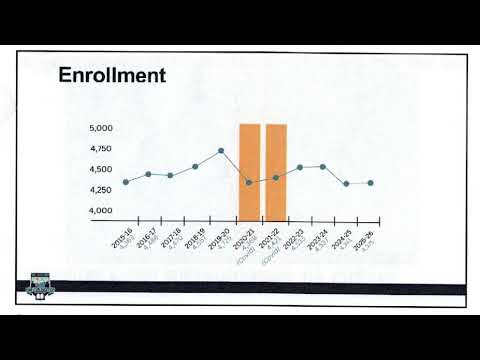
Enrollment drives state apportionment, staff said. The district budgeted conservatively for enrollment next year and is conducting outreach to re-enroll students who left during the COVID period, especially at the high school level. Staff member 1 said the district budgeted for 43.75 full-time‑equivalent students (in thousands) as a conservative uptick from the most recent year and that a modest increase in high school enrollment (the presentation referenced “about 50” additional students found through outreach) would help revenues.
Program and accounting notes
Staff explained program and object-code accounting that affects how funding appears in the budget. They noted a state coding decision requiring certain special-education overages to be coded into basic education programs rather than the levy, which staff said reduces transparency about how much special education truly requires beyond state funding. Staff characterized that administrative change as complicating advocacy for additional state funding.
Staff also highlighted district investments in Career and Technical Education (CTE) and said the district has maximized CTE allowable expenses to provide more predictability for those programs.
Maintenance, technology and risk
Board members and staff discussed deferred maintenance and technology risks. Staff said the district has a long history of deferred maintenance and that Robert (facilities staff) maintains a prioritized list of needs. Staff warned large, unplanned facility failures — for example, multiple chiller or boiler replacements — would change the budget outlook rapidly.
Staff noted cybersecurity vulnerabilities and recent ransomware attacks across Washington school districts as a funding concern for technology and security improvements.
Levy scenarios
Staff presented three common levy scenarios for board consideration (no decision required at the work session): 1) keep the current levy collection amount steady, 2) keep the current tax rate steady (which would increase the dollars collected as assessed valuation grows), and 3) go to the state tax-rate limit discussed at previous elections. The presentation used a conservative assessed‑valuation growth assumption of 5% to project future levy rates and collections, and staff described the inverse relationship between assessed valuation growth and the levy rate.
Staff member 1 said the district currently collects roughly $8.2 million under its levy scenario and showed how that figure changes under different rates and valuation growth assumptions. Board members discussed community receptivity and the trade-offs of pursuing a higher rate versus a more modest ask.
What the board asked and next steps
Board members asked about the timeline and the state auditor’s involvement. Staff said the district is communicating regularly with ESD and OSPI, and that auditors review budget materials; staff said the district’s plan and decisive mid‑year actions are the intended path out of the deficit. The board was reminded that the district must adopt a budget at the next publicly noticed meeting and that levy resolution drafting and a public hearing will follow in the fall if the board decides to place a levy request on the ballot.
Ending
District staff described the budget as conservative and said the current plan prioritizes classroom programs while holding back some levy dollars to rebuild reserves and address outstanding liabilities. Staff and board members scheduled further discussion and indicated they will provide comparable levy outcome data and additional public‑facing materials to explain the levy options and the district’s financial position to community members.