Get Full Government Meeting Transcripts, Videos, & Alerts Forever!
Get email alerts on the Water Rates And Capital Plan topic
No spam. Unsubscribe anytime.
Bloomington City Utilities presents $84 million capital plan, seeks 30.5% revenue increase to fund projects
Summary
Consultants told the City of Bloomington Utility Service Board the water utility needs a 30.5% overall revenue increase to fund an $84 million capital improvement plan and stabilize annual extensions-and-replacements funding; a related plan to issue waterworks revenue bonds totaling about $71 million was described but not acted on.
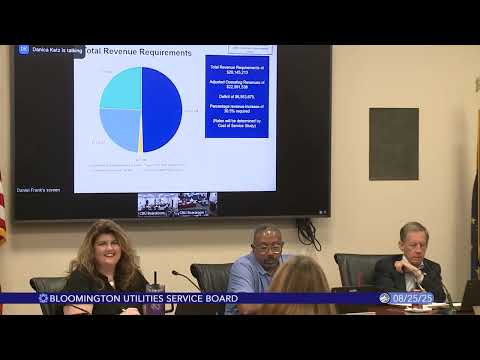
The City of Bloomington Utility Service Board on an unspecified date heard a water rate study showing the utility needs a 30.5% overall revenue increase to meet a $84 million capital improvement plan and to maintain about $7.1 million per year in extensions-and-replacements cash.
Jennifer Wilson, a consultant with Crow, told the board her team used year-end 2024 as a test year and adjusted operating expenses for known, measurable items. She said the 2025–2029 capital improvement plan totals $84,000,000, of which roughly $54,500,000 is proposed to be bond-funded and $28,400,000 is expected to be funded from ongoing cash for extensions and replacements. “We looked at balance sheets, your income statements, your debt service and your leases,” Wilson said, summarizing the study’s approach.
Wilson said the study set ongoing annual funding for routine extensions and replacements at $7,100,000. Using the study’s revenue requirements, the utility’s total revenue need is $29,100,000 compared with current revenue of about $22,600,000, creating an indicated shortfall of about $6,500,000 and the 30.5% revenue increase.
Danica, a Stantec analyst who participated in the cost-of-service study, described how Stantec allocated the revenue requirement across customer classes and produced proposed rate designs. She said a typical residential customer with a 5/8-inch meter using 5,000 gallons — the survey baseline used — currently pays about $30.60 for water; under the full requested increase that billary charge would rise to $36.64, an increase of about $6.04 or roughly 19.7% for that example. Stantec’s analysis also showed the usage charge per 1,000 gallons for the residential class would move from $4.38 to $5.31 under the proposed structure.
City staff and board members discussed how the rate package would support several large projects at the Monroe Water Treatment Plant, including electrical and instrumentation upgrades, pump and variable-frequency-drive work, and other measures intended to restore or modernize aging infrastructure. A staff speaker said the projects aim to ensure redundancy and reliability so Monroe can continue treating water at current capacity and meet expected near-term demand; that speaker added the rate update also addresses higher operating costs since the utility’s last rate case, which used a pre-pandemic test year.
Bradley Bingham of law firm Lewis & Thornburg (bond counsel) described a companion resolution in the board packet that contemplates issuing waterworks revenue bonds with a contemplated total par amount around $71,000,000 in two series (noted as 2026 and 2028 in the presentation). Bingham said no action on bond issuance was requested at the meeting; the plan is for the board to consider rates and the bond resolution in tandem and to bring the resolution back to the board on Sept. 8 before sending to the full council for final consideration.
Board members and staff also reviewed benchmarking results showing Bloomington’s current 5,000-gallon residential charge sits below many similarly sized Indiana communities; the proposed increase would move Bloomington upward in those rankings but still near peer levels. Consultants said the cost-of-service approach used customer class and meter-size distinctions rather than a multi-block (increasing tier) usage charge in the current proposed design.
Votes at a glance (formal actions taken at the same meeting) - Minutes of the previous meeting — approved (motion and second recorded; outcome: approved). - Standard invoices, $1,584,624.18 — approved (outcome: approved). - Utility bills, $138,992.25 — approved (outcome: approved). - Wire transfers, $533,276.81 — approved (outcome: approved). - Customer refunds, $9,438.23 — approved (outcome: approved). - Consent agenda (agreements totaling $38,492.34, including HVAC, pest control, compressor repairs, and drain line work) — approved (outcome: approved). - Resolution 2025-15 designating surplus property for auction — approved (outcome: approved). - Amendment No. 1 with HNTB for Catalin Sewer Improvement Project ($54,200) — approved (outcome: approved). - Contract with Bridal (overhead crane replacement) not to exceed $75,000 — approved (outcome: approved). - Amendment No. 1 to on-call services agreement with Harold Fish Inc. (additional $10,000) — approved (outcome: approved). - Agreement with Potomac Electrical Services LLC for high-voltage preventative maintenance — approved (outcome: approved).
Why it matters: The board’s consultants and staff linked the rate update to two immediate needs: (1) funding major repairs and modernization at the Monroe Water Treatment Plant so the utility can maintain treatment capacity and system reliability, and (2) aligning revenues with higher operating costs that were not reflected in the utility’s last rate case. The board did not adopt rates or bonds at the meeting; staff and bond counsel said both items are expected to return for formal action at later meetings.
What’s next: The board was told the rate ordinance and the bond resolution will be coordinated; bond counsel indicated the resolution would likely return to the board on Sept. 8 and then be forwarded to the full city council for consideration.