Get Full Government Meeting Transcripts, Videos, & Alerts Forever!
Get email alerts on the Land Conservation Donation topic
No spam. Unsubscribe anytime.
Authority discusses 87-acre Wesley Chapel donation; staff to follow up on building envelopes and boundary-line consolidation
Summary
Members discussed a proposed donation of 87 acres near Wesley Chapel Road that would remove many development rights but permit two dwellings; members asked staff to request building-envelope details, raised concerns about internal parcel lines and tax/IRS implications, and deferred final action pending further information.
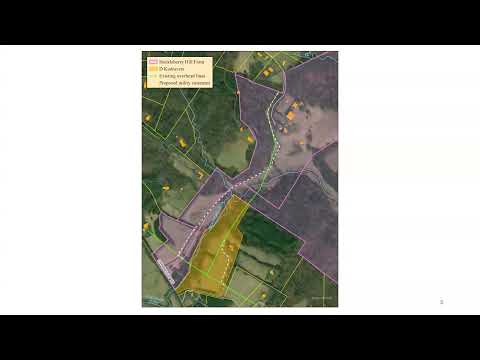
The authority reviewed a proposed 87-acre donation off Wesley Chapel Road and discussed conditions and donor expectations but did not take final approval action. The property is three parcels of record that together would be encumbered by a conservation easement; staff said the donation proposal would eliminate most development rights while permitting two dwellings in total and limiting aggregate dwelling size.
Staff described the parcel as roughly 87 acres with one existing dwelling and the potential for up to 17 dwellings under current subdivision potential (three parcels with five development rights each, plus other acreage), of which the donation document would retain two dwelling rights. Staff said approximately 77 acres of soils on the north portion are designated important for agriculture, about 4,000 feet of the property boundary adjoins existing conservation easements, and the proposal calls for a 200-foot riparian buffer along an intermittent stream and a 6,500-square-foot aggregate limit across the two permitted dwellings. The parcels were described in staff materials as being in the South Fork Rivanna Reservoir watershed.
Members raised two recurring policy issues: whether the donor should be required to merge or remove interior parcel lines (a boundary-line adjustment) prior to donation, and whether the authority should require explicit building envelopes or setbacks to protect scenic views and to reduce the risk of later subdivision or unexpected placement of future structures. Several members said asking every donor to pay for new surveys and boundary-line adjustments could be a costly new requirement and might discourage donations; others said removing internal parcel lines or adding explicit deed language that the three parcels must be treated as one would strengthen long-term protection.
Legal and tax considerations received attention. Staff and counsel noted that building-envelope language can affect the federal charitable deduction, and that the authority should advise donors to consult their tax counsel and surveyors on the timing of any boundary-line work and the tax consequences. The authority asked staff to provide donors the guidance that the IRS may require building envelopes and to consider whether an envelope or a setback would better protect scenic and conservation values.
The authority did not take a final vote on acceptance. Instead members asked staff to communicate these concerns to the donor and counsel (including the donor's attorney identified in the record, Charlie Alvis of Williams and Robin), to request building-envelope proposals and to return with a recommended path forward. Staff said it would prepare a short legal/practical memo on the policy implications of requiring boundary-line adjustments and building envelopes before asking donors to bear the cost.