Get Full Government Meeting Transcripts, Videos, & Alerts Forever!
Get email alerts on the Utility Rates And Power Agreements topic
No spam. Unsubscribe anytime.
Marietta BLW recommends MEAG power agreement; hears electric marketing plan and water authority financial updates
Summary
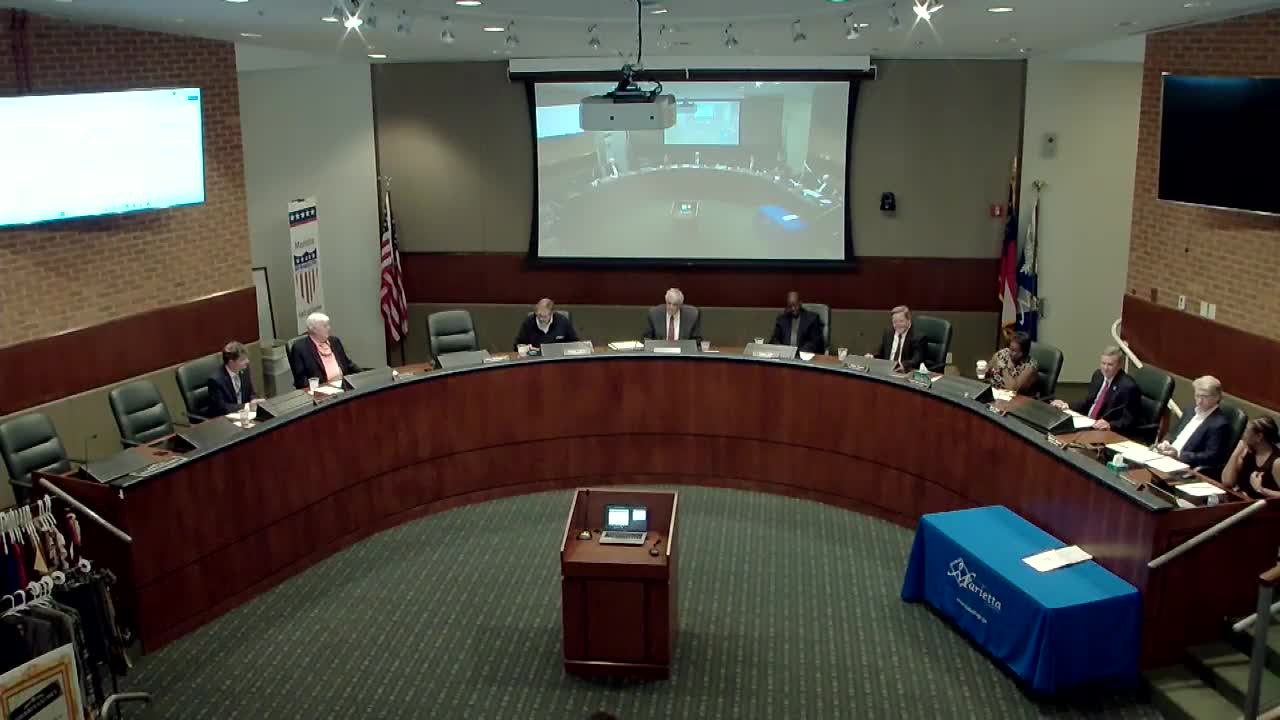
The Marietta Board of Lights and Water on Aug. 11 voted unanimously to recommend that City Council approve an annual power subscription agreement with the Municipal Electric Authority of Georgia and received presentations on electric marketing, prospective data-center load and water authority finances.
The Marietta Board of Lights and Water on Aug. 11 voted unanimously to recommend that the City Council approve and execute an annual power subscription agreement with the Municipal Electric Authority of Georgia (MEAG) and received reports on electric marketing, anticipated data-center load growth, and water authority finances and capital projects.
The MEAG recommendation was presented as a board motion to authorize MEAG to sell the utility’s excess capacity; board members voted 7-0 to approve the recommendation and forward the agreement to City Council. The general manager described the package as an annual subscription that would allow MEAG to sell 60,313 kW of the city’s capacity and included per-kilowatt figures as stated in the meeting record; the board voted to recommend approval and execution of the attached agreement.
The board’s action matters because MEAG markets excess capacity and manages supplemental supply arrangements that affect how the utility meets peak demand and generates non-rate revenue. The recommendation now goes to City Council for final approval.
Board heard marketing and load forecasts
A BLW marketing presenter summarized the utility’s strategic and competitive position, saying Marietta’s residential rates and incentives are currently lower than nearby alternatives and that the utility’s non-emitting generation comprises more than half of its portfolio. The presenter said commercial incentive programs and time-of-use rates are not yet widely offered by Marietta because the utility needs additional advanced metering infrastructure (AMI) and a meter-data-management (MDM) system to capture the granular consumption data required to enable those rate designs.
On development and customer acquisition, the presenter said Marietta charges lower per-home development fees and lower temporary-power fees than nearby utilities, which helps attract residential development. The presenter also described a potential large new load—about 144 megawatts—connected to planned projects and said that figure would be significant relative to the utility’s current metrics: a system peak of roughly 230 megawatts and average system usage of about 100–150 megawatts. The presenter estimated the prospective data-center load factor at about 85–90 percent and said high load-factor customers can reduce the utility’s per-kilowatt-hour fixed-cost allocation by spreading fixed costs over more kilowatt-hours.
The marketing presenter recommended continuing AMI/MDM deployment to enable demand-responsive pricing and to support further commercial programs; the board discussion noted the city would have several years before any new large customer reached full capacity and that the utility would reassess capacity- and customer-choice strategies as loads grow.
Water authority and finance updates
Councilman Chalfont presented the Cobb County Merit Water Authority report and said water sales averaged 76,200,000 gallons per day for the month (budget: 89,500,000 gallons per day). He reported sales revenue of $8.3 million, about $1.2 million below budget, and net income of $4.6 million, about $255,000 below budget. Year-to-date capital spending totaled $26.3 million, with a remaining annual CIP commitment of about $65 million and cash reserved for CIP spending of roughly $54 million, according to the report.
Chalfont listed active projects, including the Cedartown water main (1,800 feet of 24-inch and 2,500 feet of 16-inch pipe), which he said should be in service in about a month; a Highway 41 main replacement running behind schedule but with two crews assigned; and Stilesboro Road work expected to finish by the end of the year, weather permitting.
Finance director Tina Brown reviewed July financials and supplemental items, saying operating revenues were generally on target but water- and sewer-related revenues were down because of lower usage. She said year-to-date project costs were below budget and that changes in MEAG true-ups and supplemental calculations make some fixed-cost forecasting more challenging. Brown noted margins dipped from about 50 percent to about 48 percent year to date and highlighted routine first-quarter administrative expenses such as IT and maintenance that tend to be higher early in a fiscal year.
Other business and personnel notes
The board recognized longtime board member Ryan Torres for 12 years of service and acknowledged staff and an HR initiative: Keisha Register, the employment manager and human resources director, announced “Sherry’s Closet,” a staff-facing program that will provide business attire to new and current employees who may need support building professional wardrobes in honor of an employee’s long tenure.
What’s next
The MEAG agreement recommendation will proceed to Marietta City Council for final action. Board members said they will continue AMI deployment and monitor capacity and procurement options as projected large loads develop. The meeting closed with a 7-0 vote to adjourn.