Get Full Government Meeting Transcripts, Videos, & Alerts Forever!
Get email alerts on the Municipal Budget topic
No spam. Unsubscribe anytime.
Cape Coral council hears FY2026 budget; leans to keep millage at 5.2188 and fund public safety through FSA
Summary
Cape Coral City Council held a budget workshop on Aug. 5, 2025, to review the city manager’s proposed FY2026 budget of $1,515,592,288 and a general fund plan of about $266 million; staff recommended a 5.2188‑mill levy and raising the fire service assessment recovery from 70% to 81%, and council members signaled a preference to retain the 5.2188 millage while funding public safety needs.
Cape Coral City Council held a budget workshop on Aug. 5, 2025, to review the city manager’s proposed fiscal year 2026 budget and related rate changes. Budget Administrator Nicole Reitler presented a proposed all‑funds budget of $1,515,592,288 and a general fund budget of about $266 million; the proposal assumes a general fund operating millage of 5.2188 mills and a fire service assessment (FSA) recovery increase from 70% to 81%.
The workshop focused on structural balance across FY2026–2028, proposed revenue adjustments and utility rate changes, and a package of staffing additions that the city manager included in the recommended budget. Reitler told the council the proposed millage of 5.2188 mills is unchanged from FY2025 and that a previously set not‑to‑exceed rate of 5.5188 mills (an additional 0.3 mills) remains available for council consideration. “Once we receive that updated information, we will present that to council,” Reitler said when noting outstanding state shared revenues and a not‑yet‑finalized police contract.
Why it matters: the council’s choices determine tax levies and how recurring costs such as contract increases and new staff are funded. The city manager’s balanced FY2026 plan relies in part on raising the FSA and on modest growth assumptions; without additional measures the staff presentations showed forecast deficits in the later years.
Key facts from the presentation
- Total proposed budget (all funds): $1,515,592,288. General fund proposed: approximately $266,000,000. The proposed millage rate: 5.2188 mills (no change from FY2025). Reitler said the city used July 1, 2025, taxable values from the property appraiser to calculate the levy.
- Revenue and rate changes in the proposal: fire service assessment recovery rising from 70% to 81%; an 11% increase in water and sewer rates; a $7 increase in stormwater rates; and a $0.3849 (reported as $38.49 per dwelling) increase in solid waste rates per dwelling (transcript expressed the solid waste change as “38 and 49¢ per dwelling”).
- If council adopted the not‑to‑exceed 5.5188 mills, staff estimated additional revenue of about $9.2 million in FY2026 and roughly $9.4M and $9.7M in FY2027 and FY2028 respectively; staff recommended placing those additional funds into the budget stabilization reserve.
- Staffing and operating context: personnel services were presented as 56% of the general fund budget (about $149.4 million). The budget includes roughly 2,058.77 full‑time equivalent employees (excluding the CRA and the charter school). Proposed added positions for FY2026 included 19 in fire (16 firefighters, plus analyst/logistics/inspector), 16 in police (including nine officers and several sergeants), 12 in utilities, and multiple positions across development services, parks, public works and other departments.
- Capital and asset management: an asset management plan with proposed expenditures of $654,700,000 across capital projects, equipment, facilities, fleet, and land purchases was included in the book. Reitler said land purchases budgeted at $600,000 are not specific purchases but budget placeholders and that department line‑item detail appears in the budget book (cited pages provided during the meeting).
Forecasted deficits and options discussed
Staff presented forecasts showing FY2026 structurally balanced at the proposed millage and assumptions, but projected deficits of about $8.8 million in FY2027 and $7.4 million in FY2028 under current assumptions if additional positions and debt service are included. A consultant (Stantec) analysis shown to council earlier indicated larger mill increases would be needed in later years to eliminate those forecast deficits (for example, staff cited scenarios that would require total millages near roughly 5.98 and 6.125 mills in 2027–2028 under certain assumptions). City staff recommended the extra 0.3 mills (the difference between 5.2188 and 5.5188) be placed in the budget stabilization reserve if council chose to adopt it, to provide flexibility for future years.
Council discussion and direction
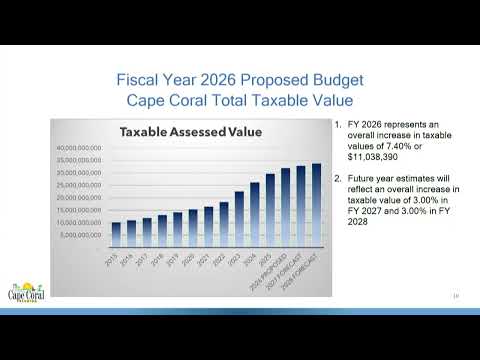
Council members debated whether to raise the millage now to address future forecasted deficits or to hold the current millage and rely on projected assessed value growth. Speakers noted the city saw a 7.4% increase in taxable value for FY2026 (including about 5.9% new growth and 1.5% recurring value), greater than the 3% growth assumption used in some forecasts. Several council members said they preferred to wait until the September hearings when final values and any new contract information were available before increasing taxes.
Council member comments repeatedly focused on two tradeoffs: (1) whether to fund the package (including public safety positions and contract increases) now through the FSA and potential millage increase, or (2) to delay tax increases and seek internal budget reductions or rely on higher‑than‑projected assessed value growth in subsequent years. The city manager said departments had been “scrubbed” for operating reductions and the proposed budget already reflects operating cuts and other adjustments made to reach a balanced FY2026 plan.
Several council members stated support for keeping the millage at 5.2188 mills and for the overall package as presented; others asked for additional data (for example, multi‑year personnel fill‑rate history, the budgetary effect of budgeting personnel at less than 100% fill, and scenarios using 4–6% assessed value growth). Reitler and the city manager said staff would provide follow‑up information and that two public hearings are scheduled: the tentative millage and tentative budget hearing on Sept. 11, 2025 at 5:05 p.m., and the final hearing on Sept. 25, 2025 at 5:05 p.m.
Citizen input and other notes
During the public comment period residents asked for information on FEMA reimbursements and on how budget surpluses and reserves are reflected in amendments and the CAFR. A resident and several council members also noted interest in clearer, more accessible reserve reporting.
Formal actions
The workshop did not include a formal vote on the millage or on adoption of the budget; it was a staff presentation and council discussion. The only formal motion recorded on the workshop agenda was a motion to adjourn at the end of the meeting; that motion was seconded and approved by voice vote.
What’s next
Staff will provide the additional requested materials (personnel fill‑rate detail, alternative assessed‑value growth scenarios, and the historical budget amendment detail). The council will consider the tentative millage and tentative budget at the Sept. 11 public hearing and the final millage and budget at the Sept. 25 public hearing.