Get Full Government Meeting Transcripts, Videos, & Alerts Forever!
Get email alerts on the Housing Tif topic
No spam. Unsubscribe anytime.
Walker officials weigh using Brownfield TIF to spur mixed‑income housing
Summary
Kent County staff described how recent changes to Michigan's Brownfield Redevelopment Authority Act allow tax-increment financing (TIF) to be used for housing projects. City commissioners asked for local policy guardrails and agreed to form an ad hoc committee to draft priorities for when Walker will support housing TIF plans.
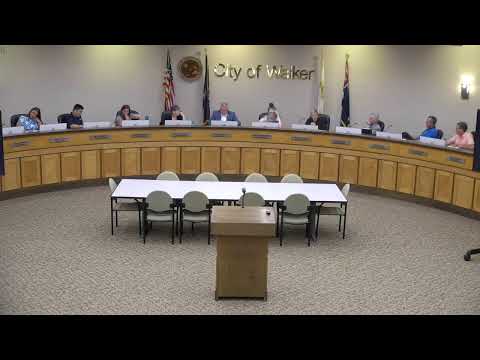
At the City of Walker commission meeting on June 23, Kent County representatives outlined how Michigan's Brownfield Redevelopment Authority Act can be used to support housing through tax-increment financing and commissioners agreed to form an ad hoc committee to propose local priorities and procedures for approving housing TIF plans.
Kent County staff described the substantive changes in state law that expand the definition of a brownfield to include any property on which housing activities occur, explained eligible uses under housing TIF and recommended local policy settings Walker should consider before approving plans. "A couple years ago, the state of Michigan kind of flipped the Brownfield Redevelopment Authority Act on its head," said Josh, a Kent County Brownfield Redevelopment Authority representative. He urged local officials to set clear priorities so developers know what the city will support.
The county presentation emphasized five practical points commissioners cited during discussion: (1) who must approve a plan locally and in what order, (2) which expenses are eligible for reimbursement, (3) the income bands likely to be feasible for housing TIF, (4) typical affordability periods, and (5) default limits on capture periods that the county applies.
On eligible uses, Kent County staff said housing TIF can reimburse a developer for many housing-related costs, including rehabilitation of existing rental units, demolition, site preparation, certain infrastructure tied to a housing project and, importantly, reimbursement to fill a documented financing gap for a housing pro forma. The county noted an important exception: if TIF is used solely for public infrastructure tied to a housing project, that portion need not be tied to income-qualified units. "You could reasonably have a development that has million-dollar homes asking for . . . housing TIF for infrastructure," Josh said, warning that local policy should address that possibility.
Kent County pointed commissioners to the recent county housing needs assessment by Housing Next to frame local choices. County staff highlighted that the most practical target for housing TIF is households between roughly 51% and 120% of area median income (AMI). Using Kent County figures for a family of four, 120% AMI was cited at about $109,000. County staff said below roughly 50% AMI the financing gap is typically too large to fill with TIF alone and other subsidy tools are generally required.
Kent County also described policy choices the county adopted that Walker may mirror or alter. The county set a default 15-year tax-capture limit for housing projects (though the state law allows up to 30 years) and will permit longer captures only if local units and developers demonstrate the need. For affordability periods the county set a minimum of 10 years for rental units (or the length of capture if longer) and five years for for-sale units, with a second-position, forgivable-loan tool to discourage quick resale to protect affordability for the stated period. Kent County said it expects a minimum of 20% of units in a supported development to meet the income-qualified threshold.
Commissioners pressed on process and local prioritization. Commissioner Burt asked how a TIF plan would move through Walker's review bodies; county staff advised early coordination with planning and with the city's Brownfield authority and reiterated that the local governing body must approve a plan before the county will take it up. For projects that change use or require rezoning (for example redevelopment of a movie theater site or a greenfield subdivision), staff said plans would typically go to planning commission and city commission first; interior rehabilitations that do not change use might not need planning commission review but the city would be involved early.
Several commissioners said the city should align any TIF decisions with its master plan and avoid approving projects that could degrade neighborhood quality over time. Commissioners supported forming a small working group—two city commissioners, two planning commissioners and one DDA representative—with county staff participation to draft policy priorities and application criteria. Staff agreed to coordinate schedules so the group can meet promptly; commissioners discussed aiming to return a policy recommendation to the full commission before Labor Day.
There was no formal motion to adopt a Brownfield policy on June 23; the meeting concluded with an agreement to form the ad hoc committee and continue work.
Votes at a glance - Approval of commission minutes for June 9, 2025: approved by voice vote (mover/second not specified in the transcript). - Approval of expenditures totaling $512,155.83: approved by voice vote (mover/second not specified in the transcript).
Why it matters: The county presentation and commissioners' direction set the groundwork for how Walker will decide whether to let developers use local and (in some cases) state tax capture to lower construction costs and expand mixed-income for-sale and rental housing. Key policy choices—geographic targeting, minimum percentage of income-qualified units, allowable eligible costs (infrastructure vs. direct housing subsidies), capture length and required affordability periods—will affect what kinds of housing projects are financially feasible in Walker and which taxpayers share their development costs.
Next steps: staff will convene the ad hoc working group with county representatives and return a draft local Brownfield/housing TIF policy to the commission for consideration.