Get Full Government Meeting Transcripts, Videos, & Alerts Forever!
Get email alerts on the Sidewalk Inspection topic
No spam. Unsubscribe anytime.
City intern finds 199 sidewalk defects; 36 rated immediate priority, maps sent to DPW
Summary
An engineering intern reported 199 sidewalk and trail discrepancies found during Walker's 2025 inspection, including 36 priority-1 hazards the city recommends repairing within 30 days; maps and a spreadsheet will be handed to DPW.
An engineering intern reported 199 sidewalk and trail defects across Walker on July 28, recommending 36 of them be fixed within 30 days after the city’s 2025 inspection.
"My name is Chase Gumbs. I'm the engineering intern for this summer. And today, I will be sharing with you some of, the results from my sidewalk and trail inspection for 2025," said Chase Gumbs, the city engineering department intern, at the Walker City Commission meeting.
The intern told commissioners the Michigan Municipal League has cited trip-and-fall incidents on sidewalks as the state’s most common liability claim, and the city’s inspection used an iPad with an app called Field Maps to photograph and precisely locate each defect. Gumbs said the team then used ArcMap to compile a map book and a spreadsheet listing locations and photos.
Gumbs described the inspection’s three priority levels and recommended response times: priority 1 defects are "a sidewalk with a shift or gap that is 2 inches or greater," and should be repaired within 30 days; priority 2 defects (three-quarters of an inch to 2 inches) should be repaired within six months; and priority 3 defects (one-quarter to three-quarters of an inch) should be rechecked in one year.
"A total of 36 of these findings were found, and it's recommended that these, are repaired within 30 days," Gumbs said. He reported 159 priority-2 findings and four priority-3 findings, for a total of 199 findings in 2025.
Vegetation overgrowth was the single most common priority-1 cause, with 17 priority-1 vegetation obstructions identified. Gumbs said the city sent 50 letters to property owners about vegetation overgrowth; "only 14 of those vegetation overgrowth were on the city," he said, meaning the remainder were on private property and the city has asked residents to trim vegetation before DPW intervenes.
Gumbs walked the city block-by-block and supplied ward-level totals: Ward 1 had 49 findings, Ward 2 had 81 findings with a high concentration around City Hall, and Ward 3 had 69 findings. He said Alpine Estates, previously a hot spot for vertical rises, had fewer issues this year because utility work replaced sections of sidewalk.
Commissioners asked follow-up questions about the letters, resident responses and inspection mileage. Gumbs said letters had been sent and that he had received several calls from residents asking for re-inspections. He said he did not have a total mileage figure for the inspection.
Gumbs said the city will share the map book and spreadsheet with the Department of Public Works for repairs, which may involve replacing slabs where rises exceed 2 inches or grinding where rises are between three-quarters of an inch and 2 inches.
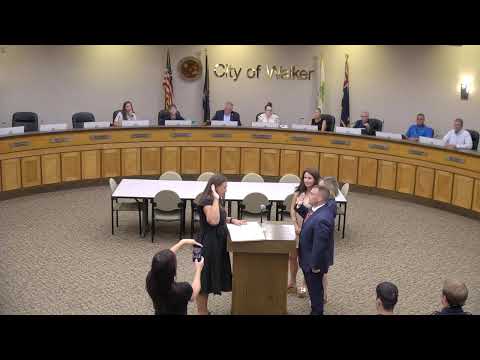
Votes at a glance: during the July 28 meeting the commission unanimously approved routine items including minutes from the July 14 meeting and a consent agenda that authorized expenditures totaling $3,024,434.90. The body also excused the mayor pro tem and administered the oath of office to Stanley Russell Schultz as fire chief; those items were handled by voice vote or oath and no roll-call tallies were provided in the public transcript.
Why it matters: the city’s prioritized list and mapped locations give officials a basis to schedule repairs and reduce pedestrian hazards that drive liability claims, officials said. Gumbs’ inventory will be used by DPW staff to plan repairs and resident outreach.
What’s next: the maps and spreadsheet from the 2025 inspection will go to DPW for scheduling and corrective work. The commission did not set explicit funding or timelines beyond the inspection’s recommended repair windows.
"All of these findings and maps will be shared with DPW along with the map book and the spreadsheet to ensure that all of these fixes to these sidewalks, are done," Gumbs said.