Get Full Government Meeting Transcripts, Videos, & Alerts Forever!
Get email alerts on the Gaza Humanitarian Crisis topic
No spam. Unsubscribe anytime.
UN warns Gaza faces collapse of lifesaving aid after convoy incident, new displacement orders
Summary
The United Nations said weekend incidents around a World Food Programme convoy, renewed Israeli displacement orders and damage to water and shelter infrastructure are aggravating an already dire humanitarian crisis in Gaza, putting more than 2 million people at risk of famine and mass displacement.
United Nations officials warned Wednesday that humanitarian conditions in Gaza are deteriorating rapidly after a World Food Programme (WFP) convoy encountered large crowds over the weekend and Israeli military displacement orders were issued for parts of Darrel Bala.
The UN said Secretary-General António Guterres described the killing of people seeking UN aid as “an atrocious and inhumane act,” and reiterated a call for protection of civilians, unimpeded humanitarian access and the immediate and unconditional release of hostages. “Civilians must be protected, and they must never ever be targeted,” Guterres said, according to the UN briefing.
Why it matters: UN humanitarian agencies say more than 2,000,000 people in Gaza are at risk of famine without consistent, large-scale aid deliveries, and recent orders to evacuate parts of Darrel Bala further fragment the territory and push people into overcrowded areas with little or no access to water, shelter or fuel.
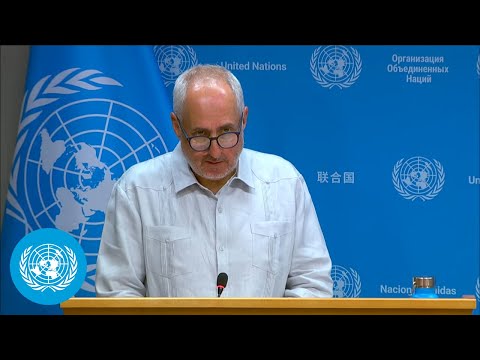
UN spokesperson Steph said the WFP convoy met large, desperate crowds seeking food and that UN agencies on the ground report “severely malnourished people” arriving at medical points. The Office for the Coordination of Humanitarian Affairs (OCHA) says the new displacement order affects four neighborhoods and initial estimates put the number of people in the area at about 50,080, including roughly 30,000 families sheltering in 57 displacement sites.
The briefing highlighted critical damage and risk to water and sanitation infrastructure: the Southern Gaza desalination plant, described as a main source of drinking water for internally displaced people in Al Mawasi, produces about 2,500 cubic meters of water per day and serves hundreds of thousands. UN agencies said about 80% of water, sanitation and hygiene facilities fall within military-designated zones or areas under displacement orders, and that as of early July an estimated 93% of households have no access to direct water.
Shelter and fuel shortages compound the crisis. UN agencies report that 1,350,000 people in Gaza need shelter and household items; no shelter supplies have been allowed into Gaza for about 140 days, and limited fuel deliveries are being prioritized for critical operations.
Ramiz Alakbarov, the UN’s new humanitarian coordinator for the occupied Palestinian territory, who recently met with Palestinian Prime Minister Mohammad Mustafa in Ramallah, called for “an immediate and permanent ceasefire, the unconditional release of the hostages, and the lifting of all restrictions on access to people in Gaza,” and urged that violence, including armed looting and recurrent shooting at civilians seeking aid, be independently investigated.
UN staff continued to operate in parts of Darrel Bala despite evacuation orders. When asked about UN personnel remaining in areas subject to displacement orders, the UN spokesperson said, “We are staying, currently staying,” and that Israel “has a responsibility to protect them whether they stay or whether they go.” The briefing said UN staff locations had been shared with relevant parties and that two UN guest houses suffered damage; the spokesperson said investigations into the incidents are ongoing and described one possible incendiary device and other shrapnel damage.
The secretary-general and humanitarian agencies appealed for immediate, safe and scaled-up deliveries of food, water, fuel and shelter to avert catastrophic loss of life. The briefing also noted wider regional risks and reinforced calls for the protection of civilians and humanitarian personnel.
Looking ahead, UN agencies said they stand ready to scale up operations if access is restored and urged independent investigations into attacks on people seeking aid.