Council debates unified-development ordinance changes on cluster subdivisions, open-space rules and development-area mapping
Summary
Planning staff and consultants presented draft UDO modules covering cluster subdivisions, subdivision infrastructure standards and development-area maps; council members debated open-space definitions, tree-preservation percentages, sidewalks, parking and whether the cluster option should be limited to low-density areas.
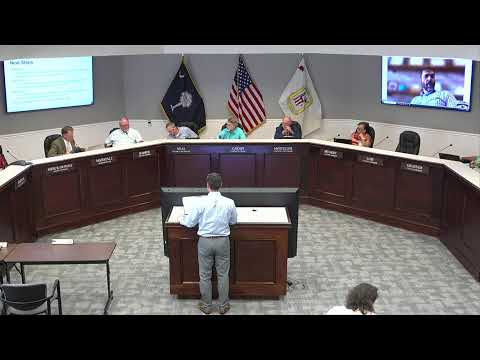
Planning staff and consultants presented a module of the proposed Unified Development Ordinance (UDO) July 15 that would combine cluster-subdivision rules, subdivision infrastructure standards and development-area mapping into a single draft for council review.
Allison Harden and consultant Sean Schutmeyer introduced Chapter 9 (subdivision and site design), explaining the proposal would consolidate cluster subdivision overlays with existing infrastructure standards and move procedures to the procedures chapter. Schutmeyer described conservation-oriented cluster subdivisions as permitting smaller lots in exchange for preserved open space or usable amenities such as trails, parks or community gardens.
Council members raised repeated concerns about how —open space— is defined and counted. Councilman Herbert and others said they want to prevent developers from counting wetlands, detention ponds or floodplain as the required open space without providing usable amenities. Councilman Herbert said wetlands-heavy properties had been developed under the existing cluster overlay and expressed a preference for conserving buildable land while limiting gross density increases.
Harden summarized a staff proposal that would require 10% open space for low-density residential, 20% for medium-density residential (MDR) and multi-family districts, with 5% of total site area required to be —improved— (usable) open space. Councilors debated whether tree-preservation and open-space percentages would effectively push development density higher and whether the standards should be simplified and clarified to avoid unintended density outcomes.
Council discussed where the cluster option should be allowed. Several council members favored allowing conservation clustering principally in lower-density rural areas (LDR) and limiting its use in MDR zones to avoid higher suburban density outcomes. Harden said staff will return with maps showing LDR and MDR zoned areas and suggested linking any change to a development-area map that distinguishes Greater Lancaster, Northern Panhandle and rural areas.
Infrastructure topics drew questions about private roads, sidewalks and grading plans. Councilors asked whether the county should allow gravel private roads for small family subdivisions, require wider road widths to accommodate emergency vehicles and mandate underground utilities in denser areas. Planning staff said curb-and-gutter and underground utilities are commonly installed in MDR areas and recommended an approach that calibrates standards by development area.
On stormwater and grading, staff proposed requiring applicants to provide state DES/DHEC grading approvals or equivalent documentation as part of county review to ensure tree protection and prevent post-development erosion issues. Council members also discussed requiring perimeter sidewalks on primary road frontages where future infill could connect pedestrian networks.
Council members expressed interest in incentives rather than mandates for some features — for example, offering reduced pavement requirements or increased density in exchange for trail easements or Carolina Thread Trail segments — but county legal staff warned that mandatory dedications could raise takings issues. Planning staff said incentives are a viable alternative and will coordinate with legal counsel on any draft language.
Ending: Harden said the UDO module draft will be returned in October for distribution to council and the planning commission after stakeholder workshops and additional staff work.
AI generated
The text on this page is AI generated. Summaries, highlights, analysis, and video transcripts are all produced from the original source material.
AI can make mistakes, so if you spot one, and we will fix it for everyone.
Note: the source content is unaltered by us. Any content source we link to, be it a video, an audio recording, or a document, is presented exactly as its publisher released it. That publisher is usually a government body, sometimes an individual official or another organisation.