Get Full Government Meeting Transcripts, Videos, & Alerts Forever!
Get email alerts on the Immigration Enforcement topic
No spam. Unsubscribe anytime.
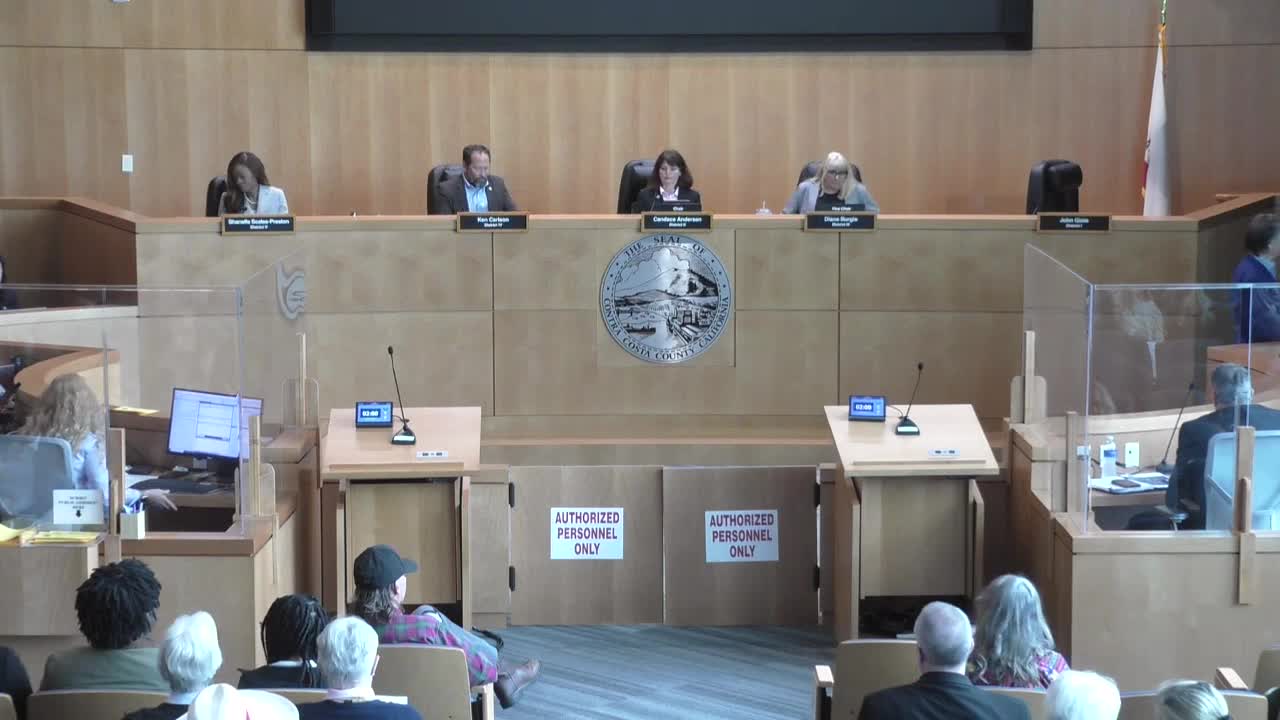
Contra Costa holds Truth Act forum as community and sheriff debate ICE notifications
Summary
Contra Costa County Board of Supervisors Chair Candace Anderson convened a Truth Act community forum July 22 to review county interactions with U.S. Immigration and Customs Enforcement; Sheriff David Livingston reported 578 ICE notification requests in 2024 and said the county honored 132 (96 distinct individuals), while advocates and the public urged the county to stop voluntary cooperation absent a judicial warrant.
Contra Costa County Board of Supervisors Chair Candace Anderson convened a community forum July 22 to review local interactions between county agencies and U.S. Immigration and Customs Enforcement under CaliforniaGovernment Code section 7283.1, commonly called the Truth Act. The forum featured a county overview, a presentation by an immigrant-rights attorney and a report from Sheriff David Livingston on 2024 notification activity.
Why it matters: the presentations and public comments highlighted a clash between the countys statutory obligations, the sheriffs discretion in interpreting those rules and community concerns about ICEuse of notification information. Residents and immigrant-rights groups called for stronger local limits on voluntary cooperation with ICE; the sheriff defended the offices narrow practice of responding to notification requests in cases he described as involving serious or violent felonies.
Sheriffs report: Sheriff David Livingston told the board his office received 578 ICE requests for notification in 2024 and made 132 notifications; because some detainees were the subject of multiple requests, Livingston said the number of distinct individuals notified was 96. He said the office does not honor immigration detainers and that ICE interviews are not facilitated inside county facilities. Livingston said notification requests are evaluated under SB 54(the California Values Act) and limited to people who meet the statutes enumerated categories (serious or violent felonies, specified prior convictions, or other qualifying charges). He said ICE must wait in a public lobby if it seeks to take custody, and that the sheriffs office requires supervisor sign-off before notifications are made.
Advocatesand legal concerns: A staff attorney from the Immigrant Legal Resource Center (ILRC) argued county staff and the sheriff should stop responding to notification requests because collaboration with ICE uses local resources for federal enforcement, fosters distrust that deters crime reporting, and risks violations of state law and civil rights. The ILRC presentation said national data indicate many people apprehended by ICE do not have criminal records and urged the county to adopt a policy or ordinance prohibiting voluntary cooperation unless ICE presents a judicial warrant or court order.
Public defender and legal analysis: Contra Costas public defender told the board the statute and case law around SB 54 and notification exceptions are complex. She said local staff and legal teams must often spend hours reviewing rap sheets and prior convictions to decide whether a notification is permitted, creating a high risk of error. She and other legal speakers urged the county to consider that risk of mistakes and legal liability.
Supervisorsquestions and context: Supervisors asked for more detail on how cases are selected for notification, in particular the so-called "wobbler" offenses that can be charged as misdemeanors or felonies. Sheriff Livingston and his custody commander said many notifications involve people with prior qualifying convictions discovered on rap sheets; they emphasized a supervisor now signs off on notifications. Supervisors and advocates suggested the county could clarify its practices and consider a local policy tightening notification criteria.
Public comment: Dozens of residents and community organizations filled the chamber and joined remotely to oppose voluntary cooperation with ICE and to ask the board to adopt a local ordinance to end nonmandatory sharing of release information with federal immigration authorities. Supporters of the Carnelianstyle community care model and some health providers also spoke at other points during the meeting; at the Truth Act forum many speakers stressed the trauma and disruption ICE actions cause families and urged the county to stop routine notifications.
Board posture and next steps: County staff said no formal board action was required to hold the forum and that departments had certified whether they had any ICE interactions in 2024; only the sheriffs office reported contacts. Staff noted the board can refer follow-up questions to the boards Public Protection Committee. Multiple supervisors asked the sheriff to provide a more detailed breakdown of the 96 notifications (for example, by charge type and whether notification was made under the wobbler prior-conviction exception) in a future quarterly report. The sheriff agreed to continue meeting with advocates and to return with additional detail in his next scheduled update.
Ending note: The forum underscored a policy fault line: the county is required by state law to be transparent about ICE access, but local officials and community groups disagree about how far the sheriff should go in responding to ICE requests that are allowed by SB 54. The board directed staff and the sheriffs office to continue information-sharing and to consider further clarifying county practice for public review.