Get Full Government Meeting Transcripts, Videos, & Alerts Forever!
Get email alerts on the School Closures topic
No spam. Unsubscribe anytime.
Parents and staff press Eau Claire board to preserve neighborhood schools as demographic committee outlines closure options
Summary
Community members urged the Eau Claire Area School District Board to reject proposals that would close or repurpose neighborhood elementary schools after a Demographic Trends and Facility Planning Committee presentation outlined options to absorb or repurpose schools to address declining enrollment.
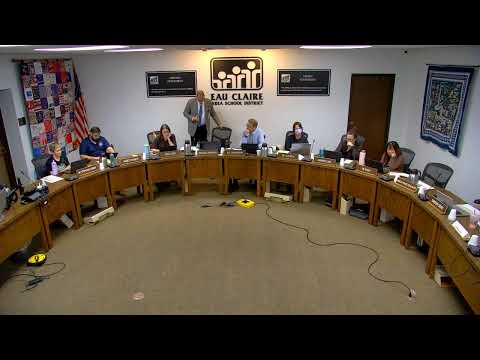
Community members urged the Eau Claire Area School District Board of Education on Wednesday to preserve neighborhood elementary schools and seek alternative solutions after the district's Demographic Trends and Facility Planning Committee presented options that could close or repurpose schools.
The committee outlined several options under consideration to address elementary underutilization, including proposals that would absorb students from Longfellow Elementary and either close or repurpose Flynn or Roosevelt Elementary to house expanded Montessori and dual-immersion programs. Superintendent Johnson and Kim Koehler, the administrative liaison to the committee, described the committee's process, data and next steps.
The committee presented enrollment and capacity data, maps of recent residential construction, birth-rate trends and analyses of ripple effects from boundary changes. Kim Koehler said the group narrowed a large set of possibilities to three leading options, described in the presentation as "option 3B" and "option 4," which would close one elementary school and repurpose another to expand choice programs. Koehler said repurposing Roosevelt to accommodate Montessori could require more than $5,000,000 in work and maintenance.
Why it matters: Speakers said proposed changes would disproportionately affect families who depend on walkable neighborhood schools and could harm students who are economically disadvantaged or who rely on close, familiar staff. Many asked for deeper community engagement, clearer cost analyses and more time before a final board decision.
Public comment was extensive. Flynn parents and residents emphasized neighborhood ties and quick emergency access: Diane Hewitt said her son, who has complex medical needs, can reach Flynn in three minutes and that changing schools would raise safety concerns. Krista Blessing, representing Flynn Elementary PTO, said residents have developed plans to reuse school space and want to be included in planning. "We would like to be involved in the decision making process," Blessing said.
Roosevelt supporters questioned the committee's capacity assumptions. Paul Gerczek, Roosevelt PTA president, said the school has raised more than $240,000 in donated funds and argued the Montessori program has not reached its stated capacity in recent years. Ben Holman, a former Demo and Trends committee member, noted boundary math: he told the board the three nearby schools that could absorb Roosevelt students at an 80% target have only 114 available seats while Roosevelt enrolls about 215 students, and warned closing Roosevelt would create significant geographic and capacity challenges.
Several speakers representing Longfellow and Flynn raised equity concerns. Angela Jones, a Longfellow parent, said Longfellow reliably reflects district diversity and asked how families who cannot attend evening meetings will have meaningful opportunities for input. Jessica Miller and others urged the board to pursue creative, community-driven alternatives rather than closures.
District staff and board members acknowledged the difficulty of the choices. Koehler said the committee's work included visits to representative elementary buildings, analyses of where new housing is being built, and modeling of boundary impacts. She noted the committee's guiding principles and that it tried to keep geographic impacts small.
Timeline and next steps: The district will form an administrative committee to review the preliminary recommendations, request additional data where needed, and produce a set of proposals for public informational sessions and surveys in mid-October. The superintendent plans to present a final recommendation to the board in late November or December, the presentation said. Koehler stressed the work is preliminary and intended to be transparent.
Board members and community speakers asked for expanded outreach. Several parents requested neighborhood meetings and more time for public input. Board member comments ranged from asking for more evidence of cost savings to urging the administration to broaden engagement with city planning and community stakeholders.
The district did not announce any final closures or boundary changes at the meeting. Superintendent Johnson said additional administrative review and community input will precede any formal board decision. "I will publicly share a final recommendation to the Board of Education for decision making" after the administrative committee compiles feedback, Koehler said.
Ending: The board did not take a final vote on any facility changes; it instead approved the process to continue with administrative review, public information sessions and a later board decision.