Get email alerts on the Comprehensive Planning topic
No spam. Unsubscribe anytime.
Elbert County launches 11‑month comprehensive plan update, steering committee named
Summary
Consultants and county staff held a kickoff meeting with a newly selected steering committee to outline scope, schedule, public outreach and priority topics — including housing, open space and water — for an 11‑month comprehensive plan update. Staff said the plan is advisory, not regulatory, and urged committee members to lead community outreach.
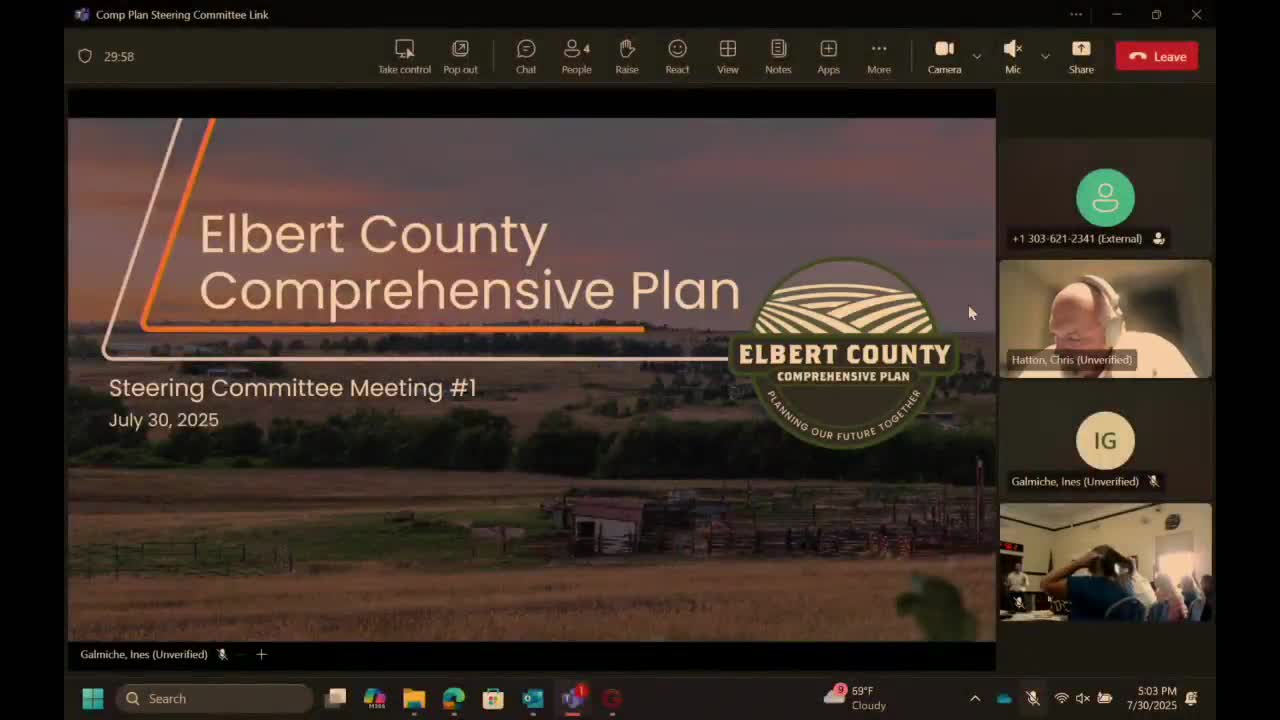
Elbert County officials and their consultants opened the comprehensive‑plan steering committee’s first meeting by describing an 11‑month schedule, a public engagement program centered on an online survey and a framework that will produce an advisory policy document rather than new regulations.
Consultant Blake Young, the project manager, told the committee the plan is “not a regulatory document.” Jennifer Jones, the county’s Community Development Services director, introduced county staff and described the county’s role in supporting the process. Participants discussed priorities including housing, protecting open space, water, infrastructure and how to balance growth while preserving county character.
The steering committee — appointed by the Elbert County Board of County Commissioners — met as consultants described roles and a draft schedule and then ran an interactive visioning exercise using a menti.com poll. Jones said the steering committee members are expected to act as “champions” in their communities and to help distribute the survey and outreach materials.
Why this matters: The comprehensive plan will frame local land‑use policies and priorities for roughly the next decade and guide later regulatory or project‑level work. County staff and consultants said the plan will be the policy foundation for future zoning updates, capital projects and smaller master plans, and that the Board of County Commissioners will be the adopting authority.
Most important facts: Consultants said the comp plan will be a community vision and strategy document rather than a zoning ordinance. The team set an expedited timetable of roughly 11 months and eight working meetings; most sessions are scheduled 5–6 p.m., with a November 13 set aside for small group implementation workshops. The outreach plan includes a public survey (open through Sept. 5 at the time of the meeting), a dedicated website and in‑person events including a booth at the county fair.
Discussion highlights and committee questions
- Scope and authority. Blake Young emphasized the plan’s advisory nature: “This is not a regulatory document,” and repeatedly said the consultants and staff would produce recommendations for the county and for later action by the Board of County Commissioners. The team said the comp plan will include a housing chapter, but a separate housing needs assessment and housing action plan are not included in the consultants’ scope.
- State guidance. The project team referred to guidance from the Colorado Department of Local Affairs (DOLA). Staff clarified that DOLA issues recommendations and guidance that municipalities and counties may follow, but that some DOLA recommendations apply only when a jurisdiction meets statutory population or growth thresholds. A committee member asked whether recent statutory changes require an affordable‑housing section; staff said applicability depends on a jurisdiction’s population and growth thresholds and said they would “double check” the precise threshold.
- Public engagement and materials. The team said steering‑committee materials (presentations and handouts) will be distributed roughly one week before meetings and that meeting results and survey summaries will be emailed afterward. The survey had received about 242 responses within four days of launch, staff said, and committee members were asked to help publicize it. The project website is elbertcountycomprehensiveplan.com.
- Housing and affordability. Committee discussion distinguished “attainable” housing (based on local median incomes) from subsidized programs such as Section 8. Staff said housing policies in the comp plan will focus on local market conditions and that more targeted housing studies could follow the plan.
- Open space and water. Several committee members and staff discussed open space protection and what “preserved open space” means in practice. One participant noted the county currently owns little dedicated open space and asked what “protecting open space” would entail; staff responded that the comp plan could recommend tools such as an open‑space preservation plan, maps and conservation easements. Committee members also raised water as a top environmental priority and asked that water be explicitly considered in environmental and capital improvement planning.
- Meeting format and access. A committee member asked that future materials be provided in advance and asked whether hybrid meeting options would be available because of spotty rural broadband. Staff said they would explore hybrid access options for future meetings and to send materials and calendar invitations in advance.
Quotes
“This is not a regulatory document,” Blake Young said when explaining the plan’s scope and purpose.
“I’m Jennifer Jones, the CDS director here at Elbert County,” Jones said when introducing county staff and the county’s role.
Committee member Chris Hatton, calling in from abroad, said, “I’m actually calling in from, Australia, so greetings from down under.”
Next steps and schedule
County staff and the consultant team will circulate meeting materials about a week before each steering committee session. The team plans to hold eight meetings over the next 11 months, with a mix of in‑person and virtual sessions and one day of focused small‑group implementation workshops on Nov. 13. The online survey was open through Sept. 5 at the time of the meeting; staff said they would email the steering committee a PDF of the results and screenshots of the menti exercise. Committee members were asked to share the survey with their networks and to contact project staff privately if they had concerns they did not want shared in a public meeting.
Ending
County staff and consultants closed by thanking the steering committee for volunteering and asked members to contact the project team with additional priorities or clarifying questions. The county plans additional public outreach in the coming months, and the Board of County Commissioners will review and ultimately decide whether to adopt the final comprehensive plan.
AI generated
The text on this page is AI generated. Summaries, highlights, analysis, and video transcripts are all produced from the original source material.
AI can make mistakes, so if you spot one, and we will fix it for everyone.
Note: the source content is unaltered by us. Any content source we link to, be it a video, an audio recording, or a document, is presented exactly as its publisher released it. That publisher is usually a government body, sometimes an individual official or another organisation.