Get Full Government Meeting Transcripts, Videos, & Alerts Forever!
Get email alerts on the Cultural Funding topic
No spam. Unsubscribe anytime.
Red Salmon Arts director urges city to protect small cultural groups amid ACME funding reset
Summary
Dr. Lilia Rosas, executive director of Red Salmon Arts, told the Arts Commission she and other small cultural organizations worry the city—s Creative Reset (ACME) will favor tourism-driven metrics over equity, and she urged commissioners to advocate for funding rules that preserve legacy, pay artists, and avoid commodifying culture.
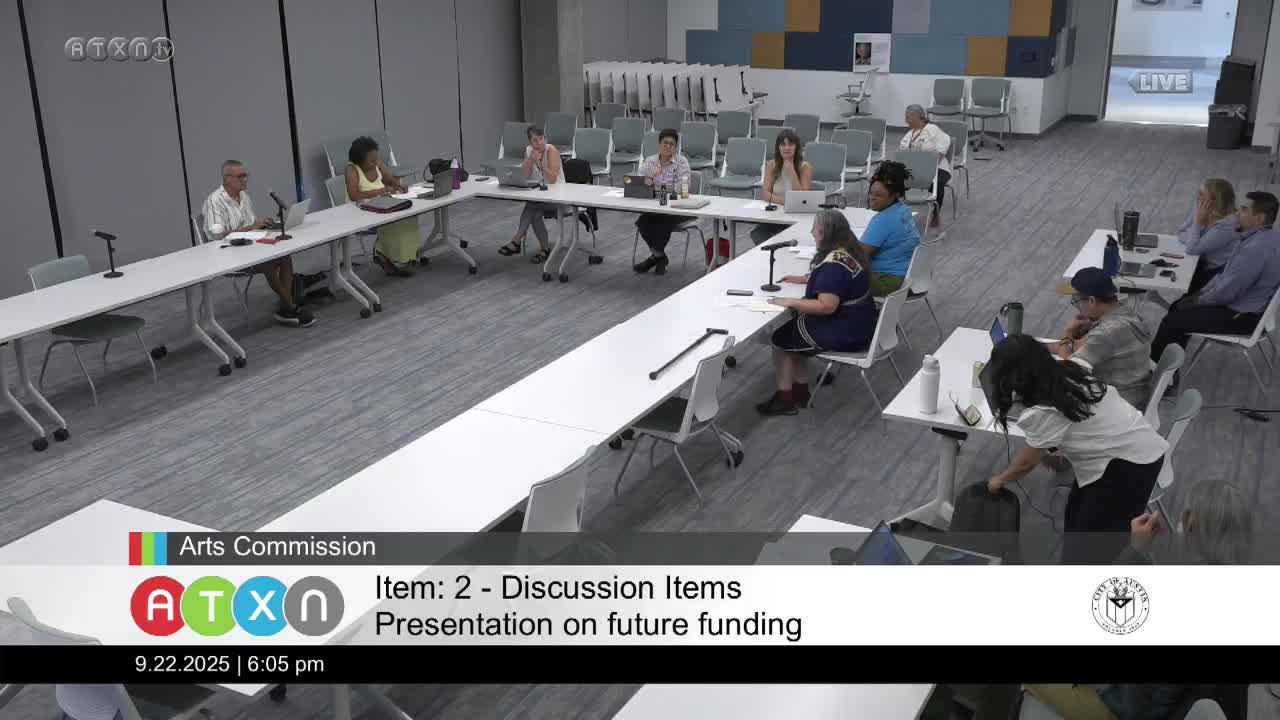
Dr. Lilia Rosas, executive director of Red Salmon Arts, told the Austin Arts Commission on Tuesday that the city—s Creative Reset (ACME) and recent grant changes have left small, community-rooted cultural organizations "severely underfunded." She said Red Salmon Arts was initially a Thrive recipient but was later moved to an Elevate tier and that the shift felt driven by applications being judged on revenue or tourism value rather than community impact.
"I am worried that we are now with the next reset creating conditions where we continue to ask arts organizations across the spectrum ... to commodify ourselves," Rosas said, adding that Red Salmon centers Chicano/Chicana/Chicanx, Latino/Latinx and Indigenous cultural work and strives to keep programs free while paying artists. "The culture is not for sale," she said.
Rosas told commissioners she and other cultural workers want the city to prioritize equity over tourism metrics and to allow legacy organizations room to continue community-facing work in neighborhoods she described as among the city—s poorest. She said the organization—s small staff deliberately kept equal pay among three part-time workers when it received Thrive funding, and that the demotion to Elevate under the new process undermined that model.
Commissioners and staff responded with information and questions. One commissioner noted that the Creative Reset funding uses hotel occupancy tax (HOT) revenue in part and asked what "established" meant under new guidelines; Rosas said she defines it by longevity, sustainability, ongoing outreach and accessibility. A commissioner recommended changing the term from "established" to "legacy," citing chamber definitions that use a 20-year threshold.
Commissioners and staff also gave Rosas application timing for ACME programs. A commissioner said eligibility forms open on Sept. 29, the application opens Oct. 21, and the deadline is Dec. 1; staff later provided slightly different dates in other remarks (see related coverage). Rosas and several commissioners urged better outreach and technical assistance so smaller organizations can meet new application requirements.
Why it matters: Rosas— remarks reflect a broader debate the city faces as it reshapes cultural funding: whether to prioritize organizations that generate measurable tourism revenue or to preserve the smaller neighborhood-based groups that provide free programming, cultural preservation and local education. Commissioners said they will advocate to council and staff as the Creative Reset is finalized.
Rosas— remarks and follow-up questions appeared during the commission—s public comment and agenda discussion; she was introduced by Commissioner Garza as a guest. The commission did not take a formal vote on the issues Rosas raised during the meeting.
Ending: Rosas said she would continue to advocate and to follow up with council offices and ACME staff; commissioners said they would press for outreach and clearer guidance to help legacy and small organizations apply under the new system.