Get Full Government Meeting Transcripts, Videos, & Alerts Forever!
Get email alerts on the Mental Health Response topic
No spam. Unsubscribe anytime.
City presents mental-health response team data and Good Neighbor program as part of safety strategy
Summary
City staff described the Mental Health Response (ICORM/MIH) teams’ call outcomes, transport numbers and efforts to expand voluntary crisis services; council members discussed how to scale services and integrate them with patrol operations.
SAN ANTONIO — City mental-health response staff presented an update on embedded mental-health teams and the Good Neighbor (Buen Vecino) program during the Aug. 19, 2025 budget session, reporting call counts, transport figures and outcomes and asking council to consider expansion options.
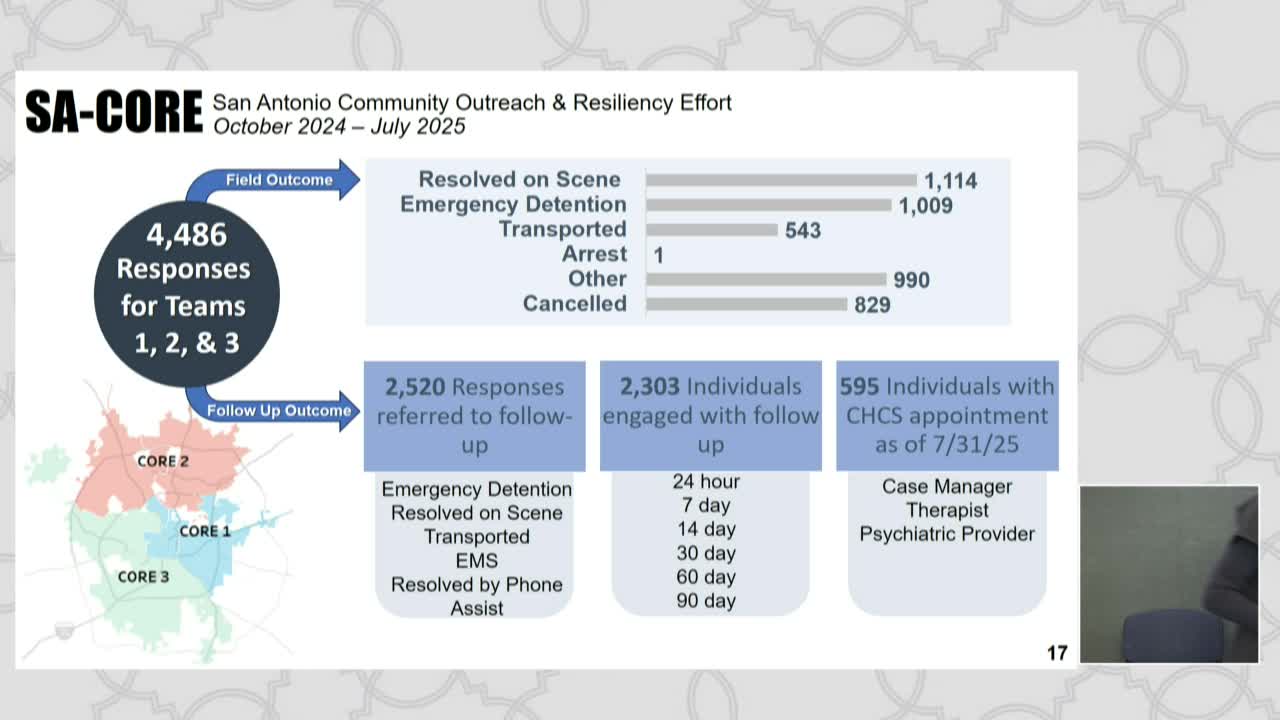
Jessie Hagens, city mental-health program lead, said the co-responder program (described in the presentation as ICORM/MIH) began in April 2022 and expanded from a single team to three teams. Staff reported cumulative call volumes (presentation figures provided in session): through July the program logged 2,520 responses classified as emergency detention/transport or scene resolution; of those, staff said 595 individuals received CHCS appointments and only one arrest resulted from the program’s responses.
The Good Neighbor program — a multi-department effort that targets single-family properties generating concentrated service calls — was described as operating on a referral threshold (properties with at least 12 calls in a three-month period are considered for the program). Staff said Good Neighbor maintains an active caseload of about 25 properties and prioritizes interventions using a neighborhood-index algorithm that incorporates call volume and other factors.
Council members asked how the mental-health teams could expand outreach, whether the teams could complete transports directly to non-hospital follow-up services and how to fund growth without creating unsustainable recurring costs. Staff said federal grant opportunities were being pursued for additional officer hiring and that long-term local funding would be required to sustain expanded service beyond pilot periods.
Ending — Councilmembers expressed support for expanding mobile mental-health services but asked staff to provide options, expected outcomes and cost estimates before the council makes funding commitments.