McKinney planning staff outlines how new state zoning laws limit local rules, sets rapid code-amendment timeline
Loading...
Summary
City planning staff reviewed three recently adopted state laws that narrow local control over where and how multifamily, small-lot single-family and certain rezoning protests proceed; staff plans code amendments for Planning & Zoning on Sept. 9 and City Council on Sept. 16.
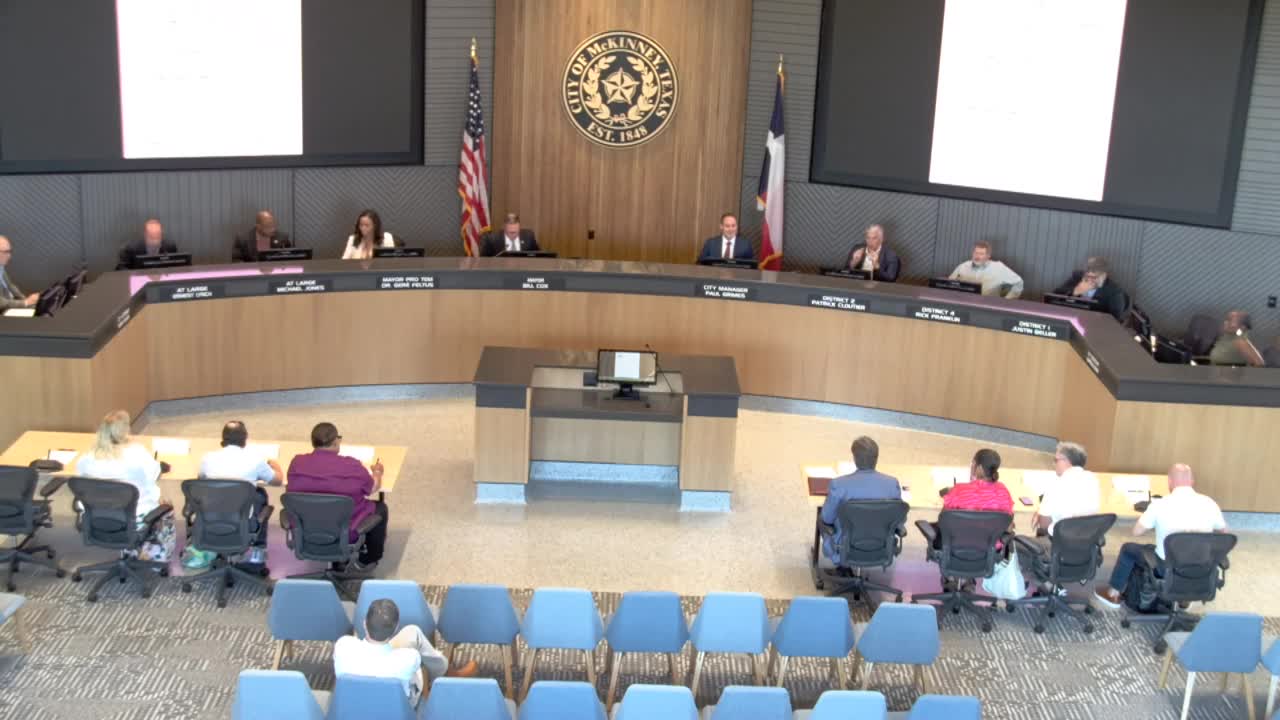
Haley Angel, the city’s planning manager, told a joint meeting of the McKinney City Council and Planning & Zoning Commission on Aug. 19 that three bills enacted in the 89th Texas Legislature will significantly restrict local zoning controls for multifamily and small-lot single-family development and change how zoning protest petitions are measured.
Angel said the primary law, Senate Bill 840, requires municipalities to allow multifamily and mixed-use residential development in any district where office, commercial, retail, warehouse and similar uses are permitted. “The crux of the bill is that it says that as a municipality, we must allow multifamily and mixed use land uses where office, commercial, retail, warehouse, and similar uses are allowed,” Angel said.
The changes matter because they limit McKinney’s ability to set several common development standards. Angel listed the bill’s specific thresholds: a minimum density of 36 dwelling units per acre, a baseline building height of 45 feet in affected areas, a maximum setback requirement of 25 feet in applicable cases, and a parking standard limited to one space per dwelling unit. She said the bill restricts — but does not entirely eliminate — the city’s authority to regulate other features such as landscaping, amenities and interior design standards.
Angel also explained an exemption for conversions: developers converting existing commercial or office buildings to multifamily or mixed use are generally protected from some local engineering-study requirements (for example, traffic-impact analyses) that cities could otherwise require for new, greenfield development. She emphasized that the exemption applies only to conversions, not to new construction.
Senate Bill 15, sometimes called the “small lot” bill, affects single-family subdivisions. Angel said the law prevents cities from requiring lots larger than 3,000 square feet or wider than 30 feet when the site is five acres or larger and not a recorded plat. It also sets other limits: cities may only require one parking space per lot (and may not require that space be covered), must allow up to three stories, and must require alleys for lots 50 feet wide or narrower.
House Bill 24 alters the zoning protest-petition process. Angel said that for rezoning cases that are exclusively residential and that increase the number of permitted dwelling units, petition validity will use a 60% surrounding-land-area threshold (up from the prior 20% area test). If petitioners meet that new 60% threshold, the petition will be valid but the council vote to approve will require only a simple majority rather than a supermajority in most cases. For cases that include industrial or commercial uses, the existing 20% area threshold remains.
Angel noted that the laws’ applicability is limited by population criteria in state statute: they apply only to municipalities with populations over 150,000 located in counties with populations over 300,000, which concentrates the law’s effect in larger North Texas cities. Staff also mapped the zoning districts in McKinney that would be subject to SB 840, excluding heavy industrial zones and airport adjacencies, and then removed parcels already developed to estimate vacant land that could be affected. The map showed much of the exposure north of University Drive and along State Highway 121.
She urged the council and commission to remember that local regulations are only one factor affecting development, listing financing, material and labor costs, interest rates, infrastructure availability (roads, water, sewer) and market demand as additional constraints on near-term development.
Angel said staff’s objectives when drafting code amendments are to maintain compatible development patterns, ensure high-quality construction, preserve space for commercial uses and keep certain pathways viable for commercial conversion. To those ends, staff is considering form-based measures (limits on the number of attached units in a single building), minimum building heights in some commercial districts, interior-corridor access for units and increased amenity or first-floor-height requirements to make future commercial occupancy feasible.
Timeline: Angel told the joint bodies that staff intends to present draft Unified Development Code amendments to the Planning & Zoning Commission on Sept. 9 and to City Council on Sept. 16.
The presentation closed with an audience question about existing multifamily properties and expansions. Angel said the law’s reach can affect existing multifamily properties in questions of legal nonconformity: whether an expansion must be brought up to current standards depends on the existing property’s status and the nature of the work proposed. She also confirmed the new parking requirement is one space per dwelling unit.
The meeting then adjourned without further zoning action.