Get Full Government Meeting Transcripts, Videos, & Alerts Forever!
Get email alerts on the Community Preservation Act topic
No spam. Unsubscribe anytime.
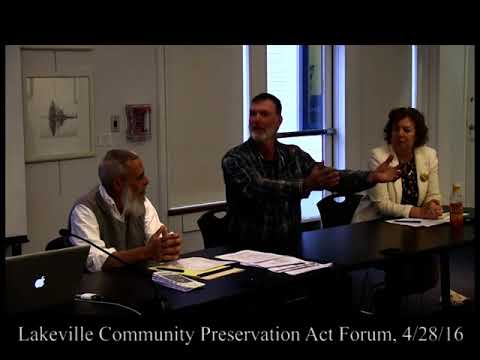
Lakeville forum outlines proposed Community Preservation Act, cites open‑space, historic‑preservation and housing benefits
Summary
Town of Lakeville — Residents and officials from neighboring communities urged Lakeville voters to consider adopting the Massachusetts Community Preservation Act, or CPA, as a means to create a dedicated local funding stream for open space, historic preservation, outdoor recreation and affordable housing.
Town of Lakeville — Residents and officials from neighboring communities urged Lakeville voters to consider adopting the Massachusetts Community Preservation Act, or CPA, as a means to create a dedicated local funding stream for open space, historic preservation, outdoor recreation and affordable housing.
“The reason why is because residents of Lakeville, through the years, have consistently and repeatedly expressed a wish to preserve our community and its rural character,” said Sarah Kulakovich, organizer of the Lakeville CPA presentation. Kulakovich described CPA as “a way that we can create a steady funding source for preserving and improving our community's character and our quality of life.”
Advocates explained how CPA works and offered local examples and calculations to show likely local cost and potential state matching funds. The presenters recommended a 1% local surcharge — the lowest permitted percentage — with a $100,000 residential exemption. Using figures cited at the forum (an average 2016 single‑family home value of $304,000 and a tax rate of $14.13 per $1,000), presenters calculated the 1% surcharge would cost the average Lakeville homeowner about $28.83 per year. Presenters noted homeowners qualifying for elderly or low‑income exemptions would be exempt from the surcharge.
Why it matters: CPA creates a restricted town account that can be used only for specific categories (open space, historic preservation, community housing and recreation). Presenters said those town funds are locally controlled — projects must be recommended by the local Community Preservation Committee and approved at town meeting — and that CPA can leverage state matching dollars and outside grants.
Presenters from other towns described results they attributed to CPA. Mark Russo, who identified himself as chair of the Plimpton Community Preservation Committee, described land purchases and a boardwalk project that connected parcels and added trails and wetlands to a public park. “I like to call myself a land guy,” Russo said, describing his motivation to preserve farmland and town open space.
Joe Ruthowitz, representing Middleborough’s Community Preservation Committee and the Middleborough Housing Authority, said Middleborough had to bring the CPA to voters multiple times before passage and has since funded projects totaling about $1.7 million in a recent fiscal year. Ruthowitz cited a FEMA grant that required a 12% town match and said CPA funds were used to supply the town’s matching share. He also noted that a relatively small town investment can unlock substantially larger outside grants.
Speakers described the two‑step CPC application process used in other towns: an eligibility review followed, if approved, by a full application with project detail and oversight. They emphasized committee vetting, public meetings and ongoing committee oversight of funded projects as measures to protect taxpayer dollars.
During a question‑and‑answer session, presenters discussed state matching percentages, which vary year to year. “The match is the match is flexible depending on the funds that are available from the state. I think we're at 19%,” one presenter said, while noting the percentage has ranged higher in earlier years.
Panelists described how the CPA committee is typically constituted in other towns: a mix of appointed members from town boards (planning, conservation, historical commission, housing, parks/highways) and at‑large members, with follow‑on review by the select board and, in some towns, the finance committee before items go to town meeting.
Speakers also highlighted limitations and pitfalls. A recreational project in one town was rejected at town meeting after questions about which body had final oversight of the land; presenters said applicants and CPCs must confirm land ownership and oversight before submitting an application. Presenters also said not every proposed project will qualify under CPA categories and that towns should expect to reject or ask applicants to revise incomplete proposals.
Organizers circulated a sign‑up sheet and encouraged residents to ask questions before town meeting. No formal vote or Select Board action occurred during the forum; presenters urged residents to consider the CPA warrant article and, if supportive, to vote on the local ballot or at town meeting as required.
For further information, presenters directed residents to the Community Preservation Coalition website and left printed literature at the library.