Get Full Government Meeting Transcripts, Videos, & Alerts Forever!
Get email alerts on the Water And Sewer topic
No spam. Unsubscribe anytime.
Hialeah warns countywholesale wastewater hike will push utility costs higher; council approves fee relief and credits policy
Summary
Hialeah officials warned that a proposed 19% wholesale wastewater rate increase from Miami—Dade County would sharply raise the city—s water-and-sewer costs. The council voted to suspend the city—s water-and-wastewater franchise fee for one year and approved revisions to the city—s leak-credit policy while staff seek further review of county accounting.
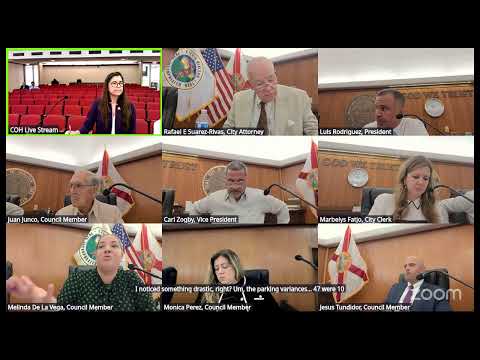
HIALEAH, Fla. — City officials warned Tuesday that a proposed 19% wholesale wastewater rate increase by Miami-Dade County would sharply raise Hialeah—s utility costs and leave the city facing a budget gap unless officials act.
Kevin Linsky, Hialeah—s director of public works, told the City Council his department—s analysis shows roughly 70% of the utility department—s operating costs are payments the city makes to the county to treat wastewater and provide wholesale water. Linsky said the county—s planned 19% increase for wholesale wastewater this fiscal year would, by itself, raise Hialeah—s total utility costs by roughly 11 percentage points.
"The wholesale customer for wastewater, like Hialeah, will go up 19%. That—s an amazing increase," Linsky said during a presentation on the city—s public-works budget and water system. "It—s almost mathematically impossible because they have to buy their own services. ... I did find things I can—t explain, and it would be better for a forensic accountant to go in and explain these things to me."
Why it matters
Linsky told council members the county—s audited financial statements show retail revenues have risen far less than revenues the county reports it receives from wholesale customers over recent years. He said the discrepancy suggests cost-shifting between the county—s internal retail and wholesale accounts but that city staff could not determine whether the difference represented accounting choices or errors.
That gap matters for Hialeah because the city buys treated water and pays for wastewater processing the county performs. "When they try to give a 19% increase on us, that alone increases our total cost by 11%," Linsky said. The increase would produce a multi-million-dollar shortfall in the coming budget cycle, he said.
Council actions
Facing the projected increase and resident concerns about water affordability, the council took three actions during the meeting: - The council voted to suspend collection of the city—s water-and-wastewater franchise fee for one year. The motion passed in roll-call vote during the administrative agenda. (Second reading and an implementing ordinance were scheduled for a later meeting.) - The council approved a resolution that revised the city—s leak-adjustment policy. The approved change sets clearer limits and conditions on credits for unusually large bills: for confirmed ("known") leaks the council limited relief to bills at least twice a customer—s 12-month average; for cases where no clear cause is initially found (so-called "unknown" high bills), council approved a higher threshold and tighter limits. The council adopted the resolution after amending staff—s draft; the motion passed in roll call. (The resolution as adopted specifies a once-per-12-month credit for most qualified cases, and restricts the "unknown leak" credit to two credits within a 10-year period.) - Councilmembers discussed but did not vote on a separate, broader repeal of the franchise fee at that same session; the council later approved an ordinance in first reading to remove the city—s water-and-wastewater payment-in-lieu-of-franchise-fee section of city code (second reading was scheduled for 09/09/2025).
The council did not tie the franchise-fee suspension to a guaranteed offset from the county. Linsky and multiple councilmembers said the city will need to decide whether to absorb increased wholesale charges in city revenue or pass increases on to customers.
City response and next steps
Linsky said the city is preparing additional proposals to limit the budget impact, including an ongoing program to find and repair leaks and reduce infiltration into the sewer system (lining and inspection work). He described a multi-year program the administration has funded with roughly $40 million to inspect and line sewer pipes and reduce inflow, which he said could cut wastewater flows and reduce the wholesale charge.
Council members pressed for more review of county accounting. Several members supported an independent forensic review of Miami-Dade—s water-and-wastewater finances; Linsky said he found anomalies while reviewing county documents and recommended an audit.
County litigation reported
Late in the meeting the city attorney—s office informed the council that Miami-Dade County had filed a lawsuit claiming approximately $18 million in unpaid charges from the city. City attorneys described a process of dispute-resolution meetings and mediation earlier in 2025 that failed to resolve the disagreement; the county filed suit after the mediator declared an impasse. The city attorney said the city will contest the lawsuit and evaluate potential counterclaims. The city must file a response to the complaint by September 11, 2025.
What council members said
Several council members framed the county—s actions as a cost-shift that needs outside scrutiny. One council member said residents feel they are "being gouged" by the wholesale charges, while others urged caution about immediately shifting costs onto residents without exploring administrative and legal options.
Linsky noted operational realities as well: the city cannot control wholesale charges and must pay for the treated water and wastewater the county provides. "If we keep our rates completely flat, we will generate about the same revenue ... Because primarily of the rate increases from the county, we would be short about $13,400,000," he told the council.
The council scheduled follow-up budget hearings and a second reading of the franchise-fee repeal ordinance for 09/09/2025.
Ending note
Council members said they want more analysis of county accounting, clearer information for residents about how bills are computed, and quicker progress on the city—s pipeline repair work that staff say could reduce wastewater flows and ease future wholesale increases.