
Beaverton facilities committee adopts four "North Stars" after broad community outreach
Get AI-powered insights, summaries, and transcripts
Sign Up Free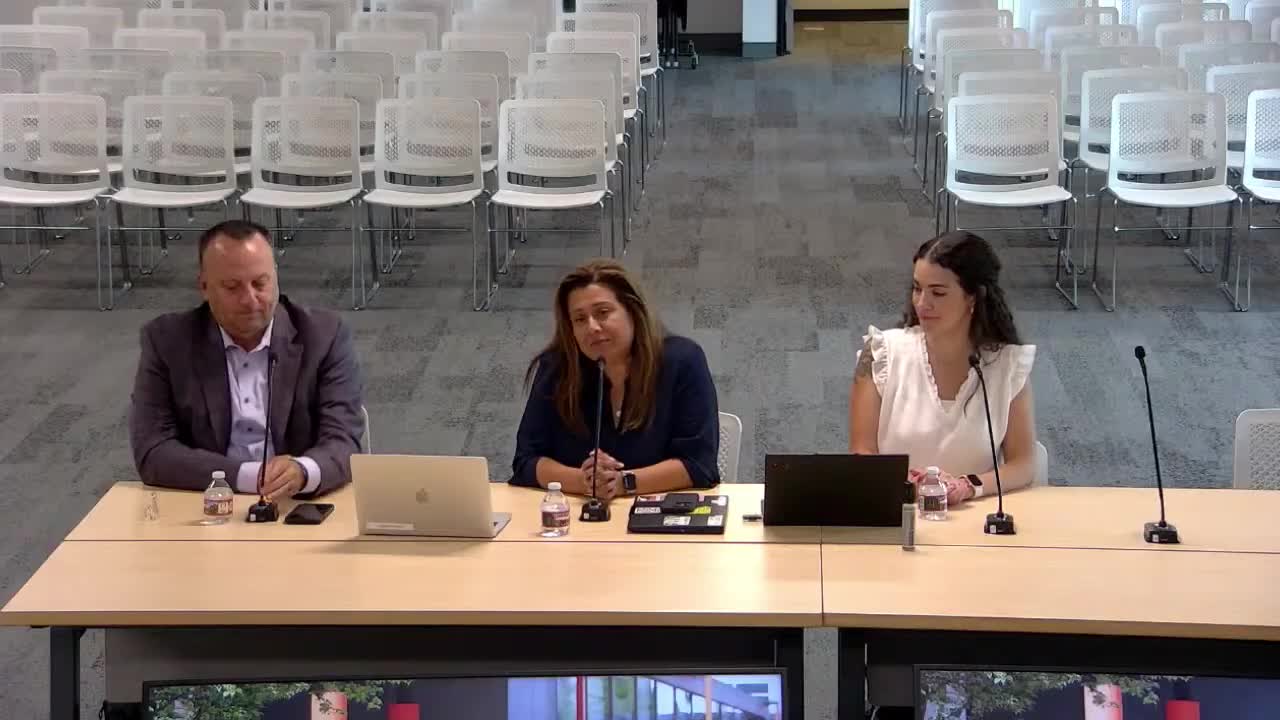
Summary
A consultant-led long-range facilities planning committee for Beaverton School District developed four guiding values — "North Stars" — after listening sessions with families, students and staff. The committee will use those values and planning implications to evaluate scenarios this fall and return recommendations to the district next winter.
The Beaverton School District's long-range facilities planning committee has formalized four guiding values, or “North Stars,” intended to steer the district's 10- to 20-year facilities plan and to shape scenarios the committee will now develop and test with the community.
Consultants from BRaidal Architecture presented the work during the board retreat Aug. 26. Karina Ruiz, one of the consultants, told the board the process combined quantitative data and months of qualitative listening to craft planning implications tied to each North Star. "We wanted to create an approach that tries to balance the quantitative data that usually drives long range facilities planning around enrollment, around capacity, and also bring into bear some of the qualitative elements," Ruiz said.
Why it matters: district facilities decisions — including school capacity, locations of specialized programs and potential boundary adjustments — shape students' daily experience, operating costs and the district's budget outlook. The committee's North Stars are intended to make the tradeoffs explicit so options can be evaluated against a set of shared values.
What the committee adopted
The committee reached consensus on four North Stars: (1) students are known, seen and supported; (2) equitable and sustainable resource stewardship; (3) culture, connection and belonging; and (4) preparing students for future success. For each North Star the consultants and committee produced "planning implications" — concrete effects the value would have on facilities, staffing and district operations if the committee advanced options aligned with that value.
Consultant Ken Bell described how the planning implications will be used: options that the committee develops will be scored against each implication to show how well a scenario meets the district's stated values. The consultants told the board they expect the committee to use the North Stars and implications as the basis for drafting multiple scenarios this fall, present those scenarios to the public in November–December, and then return to the board with a refined recommendation in February.
Community engagement and inputs
The district's outreach included in-person forums at each comprehensive high school, three virtual community forums and targeted "shared experiences" meetings for specific groups, the consultants said. Those meetings included high school students and groups identified as having distinct experiences in the district: Afghan youth (Dari/Pashto speakers), Latino families, Muslim families, Black families, Native families, newcomer families and Somali families. The consultants estimated roughly 10–40 participants per session and said overall participation across events and surveys likely reached into the low hundreds.
Board members asked for concrete, research‑based detail to support planning implications. Board member Carrie Delf urged the committee and staff to make education research (for example on classroom design and learning outcomes) available to the committee so it can assess likely impacts of facility choices on teaching and learning. Board member Syed Qasim and others also asked the consultants to clarify which decisions fall inside the committee's purview and which are operational or instructional matters for staff.
Scope and next steps
Consultants and district staff emphasized the committee's narrow role: to recommend a long-range facilities plan tied to district property and capacity decisions (rather than to set detailed instructional policy). Gustavo Balderas, the superintendent, was cited by consultants as the official channel for committee recommendations to reach the board: committee recommendations come to the superintendent, then staff will provide implementation information before the board decides.
The planning timeline presented to the board calls for scenario development in September–October, community review of scenarios in November–December, committee refinement in December–January, and an expected committee recommendation to district leadership and the board in February. The consultants also said any recommended facilities changes would not be scheduled to take effect before the 2027 school year, giving the district and families time to plan.
Ending
Board members and the consultants agreed to continue outreach and to provide additional background materials the committee requested — including facility condition data, enrollment projections and relevant research linking learning outcomes to space — so the committee can evaluate options with the context staff will later use when assessing costs, educational impacts and operational feasibility.