Get Full Government Meeting Transcripts, Videos, & Alerts Forever!
Get email alerts on the Government Budget topic
No spam. Unsubscribe anytime.
Governor’s FY2026 wrap‑up: $1.759 billion budget, big federal inflows and continued focus on vendor payables and insurance choices
Summary
OMB presented a fiscal wrap‑up showing a proposed FY2026 government budget of about $1.759 billion, a large share from federal disaster and recovery funds, persistent vendor payables of roughly $50 million and an upcoming decision on employee health‑plan changes that would shift deductibles and introduce an HRA.
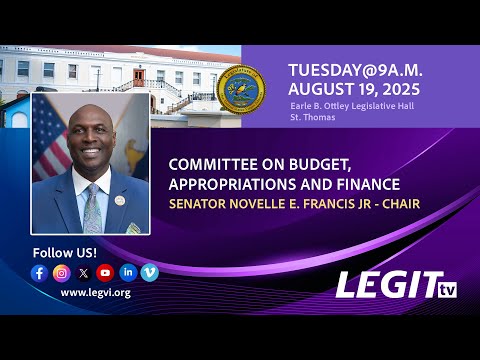
Director Julia A. Reimer and the governor’s financial team presented a FY2026 executive budget wrap‑up to the Senate Budget Committee on Aug. 19 that showed a proposed government‑wide spending plan of roughly $1.759 billion and highlighted a large rise in federal funding for disaster recovery projects.
Top‑line figures and federal inflow Reimer described the FY2026 package as combining a general fund component, other appropriated funds, federal funds (notably disaster recovery awards) and non‑appropriated funds. The combined sum is approximately $1.759 billion (about $936.4M general fund, $68.8M other appropriated funds, $691.9M federal funds and $62.5M non‑appropriated). The administration said a substantial portion of the federal increase reflects disaster recovery and hazard mitigation awards—some obligations will be executed by the Office of Disaster Recovery and related program offices in FY2026.
Vendor payables and cash position Reimer told senators that central government vendor payables totaled about $50.1 million as of Aug. 8, 2025, with roughly $41 million tied to general and special funds. The team reported progress on reducing the agency‑level invoice backlog: regular mandatory reporting by chief financial officers and a new “fiscal recovery unit” are intended to improve invoice processing, cash‑flow visibility and the timing of payments. The administration reported a net available cash balance of about $37.2 million on Aug. 8 and noted a $150 million line of credit (currently with about $91.0M outstanding) the government is using to bridge reimbursements and pay contractors; officials said the line is scheduled to expire at year‑end 2026 and recommended retaining borrowing capacity while recovery projects proceed.
Insurance and personnel costs A major near‑term budget choice identified by OMB and Personnel is whether to accept proposed health‑plan option changes that would raise employee premiums and shift to higher deductibles covered by a health‑reimbursement account (HRA). Reimer told senators the Government Employees’ Health Insurance (GEHI) board is considering options that would raise costs to the government by $10.4M (option 4) or $20.2M (option 2, different design). Option 4 would raise single coverage premiums by about $12.13 per month while adding higher deductibles and a $1,000 individual HRA; specialty and office copays would also change. The board planned a final decision on Aug. 21; OMB noted any change would affect employee take‑home pay and retiree costs and stressed the need to balance coverage and fiscal impact.
Revenue and outlook Reimer said FY2025 general‑fund receipts were forecast at about $889.1M (a modest downward revision from earlier May projections). The administration had reduced allotments this year after identifying exaggerated earlier revenue assumptions. Reimer emphasized improving revenue collection and monitoring, pointing to weekly cash‑flow reporting from agencies and tighter CFO reporting as measures that had already cut invoices aged over 120 days by about 60% since the new reporting requirement was implemented.
Debt and recovery spending The administration noted $706M of disaster‑related federal funding for projects and 2026 spending anticipated in the $600M range tied to mitigation and construction. Officials emphasized the need for workforce capacity to deliver large capital programs and flagged semi‑autonomous agencies (health system, WAPA, waste management) with significant payables that must be addressed for long‑term fiscal sustainability.
Committee reaction and follow‑ups Senators asked for supplemental information and follow‑up documents including: a departmental breakdown of FY2025 allotment reductions; confirmation of the state of outstanding vendor invoices (including >120‑day items); and detailed cash‑flow and line‑of‑credit schedules. The administration agreed to provide requested spreadsheets and to continue working with CFOs and agencies on timely federal drawdowns and faster invoice processing.
Ending: The administration framed FY2026 as a mix of continued recovery spending and steady general‑fund operations, flagged the health‑insurance decision as a near‑term fiscal choice, and urged continued inter‑agency collaboration to speed collections, clear payables and prepare for large federally‑funded projects.