Get Full Government Meeting Transcripts, Videos, & Alerts Forever!
Get email alerts on the School Maintenance topic
No spam. Unsubscribe anytime.
New Bureau of School Construction and Maintenance seeks $5.75M from capital fund, warns of legacy maintenance gaps
Summary
The new Bureau of School Construction and Maintenance, formed by Act 87‑17 and in operation since Oct. 1, 2024, asked the Senate budget committee for $5.747 million from the school construction capital fund for FY2026 to support routine maintenance, warehouse build‑outs, and vehicle purchases, and warned of aging school systems and a carryover vendor backlog of roughly $1.47 million.
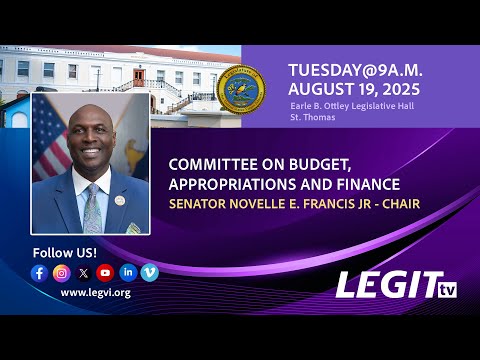
The Bureau of School Construction and Maintenance, the territory’s new agency created by Act 87‑17 and active since Oct. 1, 2024, made its first budget presentation to the Senate Committee on Budget, Appropriations and Finance on Aug. 19.
Dr. Charmaine Myers, the bureau’s chief financial officer (presenting on behalf of Executive Director Craig Benjamin, who had surgery), told senators BSCM has established core operations in its first 10 months and asked the Legislature to appropriate $5,747,746.52 from the School Construction Capital Fund for routine school maintenance and non‑school facility capital projects in FY2026. The bureau also described an operating budget recommendation and a request for additional maintenance workers.
Budget request and priorities BSCM told the committee it needs operating funds for personnel and fringe, plus capital outlay for vehicles and warehouse build‑outs. The FY2026 request to the capital fund totals $5,747,746.52 and the bureau broke that sum down as roughly $1,000,989.57 for routine maintenance in St. Thomas/St. John, $2,273,181.51 for routine maintenance in St. Croix, and $1,485,000 for capital work at non‑school facilities (for example, roof replacement and remediation at administrative annexes, school lunch facility HVAC/electrical upgrades, and warehouse/equipment work).
Dr. Myers described the bureau’s operational start‑up and said BSCM received approximately 30 vehicles transferred from the Department of Education (17 for St. Thomas and 13 for St. Croix), created email and finance accounts in the ERP, and established standard operating procedures and public pages for transparency. She told senators the bureau processed $10,000,624.59 in obligations under a capital portfolio and had expended $6,132,404.72 as of June 30, 2025.
Maintenance backlog, staffing and KPIs BSCM reported that many public school buildings are decades old and described competing priorities during limited maintenance windows—e.g., repairing leaking roofs before repainting classrooms. The bureau presented four operational KPIs it will track: total work orders created, work orders closed, backlog size and backlog age. Dr. Myers said the bureau completed about $11 million in projects this year and expects additional maintenance spending to flow from an already‑appropriated capital outlay account if space for warehouses can be secured.
Staffing: the bureau reported 72 positions on the personnel list (67 filled as of the hearing), split between districts (37 in St. Thomas/St. John and 35 in St. Croix). BSCM requested funding for 12 additional “skilled maintenance” positions to place dedicated technicians at schools; the bureau said the positions would shift the agency from reactive to proactive maintenance. Dr. Myers said the bureau had submitted in‑depth classification paperwork to the Division of Personnel and was completing exempt‑employee notices of personnel action; the remaining unionized classification work remained with the Division of Personnel process.
Senators pressed BSCM officials about specific school conditions and payments to contractors. Committee members cited recent school closures or early dismissals tied to electrical or HVAC issues (committee members noted specific examples such as roof or power problems at Lomaco, John Woodson and other campuses). BSCM staff said some invoices are delayed because they pass through property and procurement review before finance can pay them; the bureau reported a current vendor payables balance in the $1.47 million range and said many payments were already in requisition or encumbered.
Warehouse/vehicles and capital readiness BSCM requested $1,260,000 for capital outlay to buy crew‑cab utility trucks and complete warehouse build‑outs in both districts; staff said the parcels had not yet been secured on St. Thomas and requested re‑appropriation of a $1,000,000 capital provision that could not be obligated in FY2025. Senators raised concerns about aged fleet and requested monthly utility and maintenance cost reporting for vehicles.
Follow‑ups and committee requests Senators asked for (a) a detailed FY2025 actuals vs. obligations spreadsheet for personnel, fringe, supplies and services; (b) an itemized list of outstanding vendor invoices (including amounts older than 120 days); (c) a timeline and vendor‑by‑vendor schedule for clearing the $1.47M backlog; (d) confirmation of the status of in‑depth classifications and the 11 vacancies reported to the committee; and (e) confirmation of which BSCM leadership staff are resident and assigned to each district. BSCM staff agreed to provide updated personnel listings, the status of office/warehouse searches, and a written schedule for vendor obligations ahead of budget markup.
Ending: Senators welcomed the formation of BSCM but cautioned that getting routine maintenance funded and vendors paid will be decisive to preventing recurring school facility problems. The committee set a short turnaround for BSCM to supply requested financial and personnel details prior to markups.